
In short: HDI (Humane Design) helps Ahmedabad organisations in pharma, chemicals, textiles, manufacturing and financial services improve the customer, employee and process experiences that sit around their core operations. We offer workshops, in-house team training programmes and consulting retainers, delivered on-site at your offices and plants or remotely.
In a pharmaceutical or chemical plant, nobody improvises. Batches follow validated procedures, deviations are documented and every change goes through control. That discipline is exactly why some Ahmedabad leaders assume design thinking is not for them.
We think the opposite is true. Design thinking in Ahmedabad works best when it respects that discipline and focuses on everything around the regulated core: how customers and distributors experience the business, how employees learn and apply procedures, and how functions hand work to one another. Humane Design (HDI) works with teams in Ahmedabad and Gandhinagar on-site at your offices and plants, or remotely from our studio in Andheri West, Mumbai.
Does design thinking fit a regulated, process-led business?
It is a fair question, and the answer depends on where you apply it. Three common concerns come up in early conversations:
- We cannot experiment with validated processes. Correct, and we do not ask you to. Prototyping happens on paper, in simulations or in areas outside the validated scope, such as training, communication or customer service.
- Our teams are engineers and scientists, not designers. That helps. The method treats ideas as hypotheses and asks for evidence, which suits technical people well.
- We already run lean and continuous improvement. Those tools optimise a known process. Design thinking helps at the earlier stage, when the problem or the user need is still unclear.
Used this way, design thinking adds to the improvement systems a plant already has rather than competing with them.
Design thinking in Ahmedabad’s pharma and chemicals companies
Ahmedabad and its surrounding industrial estates are known for pharmaceutical and chemical manufacturing. In these businesses, the best opportunities for design thinking are usually found in a few places:
- Standard operating procedures that are correct but hard to follow, leading to avoidable deviations
- Onboarding and on-the-job training for operators and analysts, where knowledge sits with a few experienced people
- Handoffs between R&D, regulatory, manufacturing and commercial teams during a product launch
- The experience of distributors, hospitals, doctors or industrial buyers dealing with sales and service teams
Each of these can be researched, reframed and redesigned without touching a validated process. Our article on human-centred process design explains how we approach procedures from the point of view of the people who carry them out.
Textiles and manufacturing: the mill city’s next chapter
Ahmedabad’s identity was shaped by its textile mills, and textiles remain part of its economy alongside a wide base of engineering and manufacturing firms. Many are family-run and are now working out how to compete on design, speed and brand rather than on volume alone.
For these businesses, design thinking helps answer commercial questions. Which customers should we build for? What does a retail or brand buyer value beyond the fabric or the part? How do we bring a new range to market faster? The same approach helps family-owned firms as they bring in professional managers, by making decisions visible and testable rather than personal.
A useful starting point is often a short round of buyer interviews. Sales teams in these firms usually know their accounts well, but they rarely hear directly what a buyer weighs when choosing between suppliers. Hearing it first-hand, as a cross-functional group, tends to change the conversation inside the business quickly.
Financial services at GIFT City
GIFT City in Gandhinagar, the international financial services centre a short drive from Ahmedabad, has brought banks, insurers, fund managers and fintech teams into the region. Many of these units are newly established, which makes them a good place to design operations, client journeys and team culture well from the start.
Our work here tends to focus on client onboarding and servicing journeys, the employee experience for teams relocating to a new centre, and the culture of a unit that has to work closely with a parent organisation elsewhere. Our system and process design practice supports this kind of build.
A 90-day starting plan
For organisations that want to see results before committing to a larger programme, a three-month plan often works well:
- Weeks 1 to 2: agree one problem, its owner and how success will be judged; interview the people affected
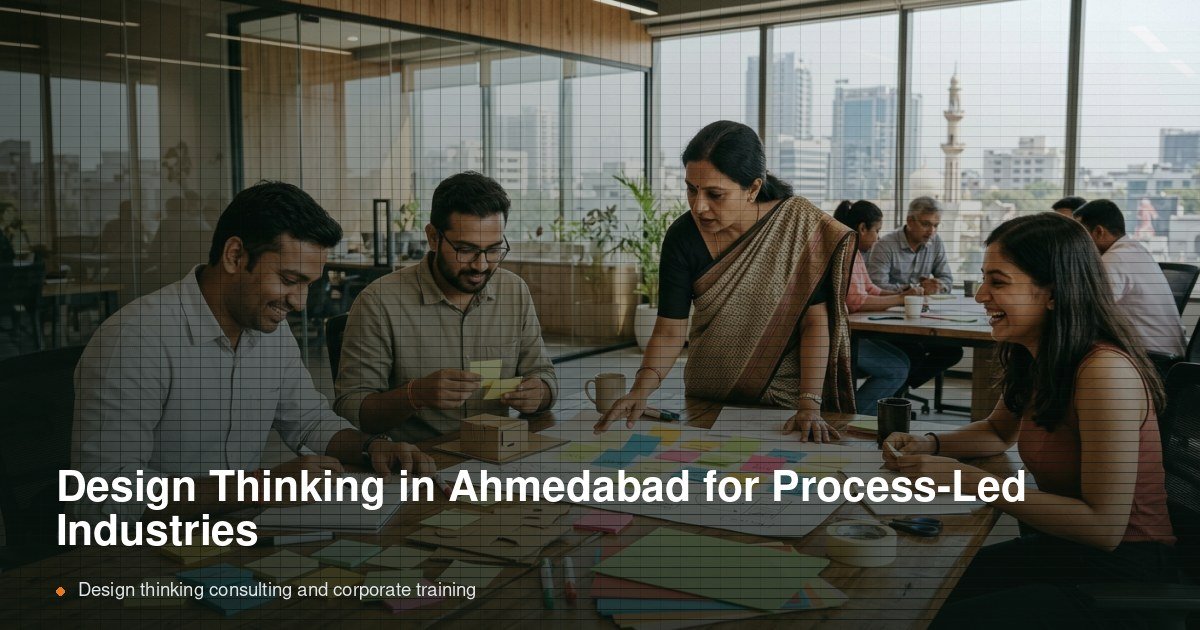
- Weeks 3 to 4: run a design thinking workshop in Ahmedabad with a cross-functional team to frame the problem and generate ideas
- Weeks 5 to 9: build and test prototypes with real users, in training rooms, offices or simulations rather than live validated processes
- Weeks 10 to 12: decide what to scale, agree owners and measures, and plan capability building for the wider team
This fits within an embedded consulting retainer, which can run from 3 to 12 months depending on the scope.
Training, workshops and consulting with HDI
HDI offers three formats: a discovery sprint or workshop of 1 to 5 days, an in-house team training programme of 2 to 4 days and an embedded consulting retainer of 3 to 12 months. Every engagement runs through our toolkits for Design Thinking, Systems Thinking, Agility and Storytelling.
Design thinking training in Ahmedabad suits organisations that want managers and specialists to apply the method themselves. Our design thinking learning services can be combined with systems thinking, behavioural design or leading change. For leadership groups, design thinking corporate training in Ahmedabad is often the first step before a wider culture or innovation effort.
Design thinking consulting in Ahmedabad fits when you need a specific outcome, such as a redesigned launch process, a better distributor experience or a new client journey at GIFT City. Our consulting services include new product discovery, service and process design, innovation culture design and the AI Suite.
HDI was founded in 2021 by ex-Big 4 leaders. Our only studio is in Andheri West, Mumbai, and we work with teams in Ahmedabad and Gandhinagar on-site at your offices and plants, or remotely.
Frequently Asked Questions
Can design thinking be used in a GMP-regulated pharma plant?
Yes, as long as it is applied around the validated process rather than inside it. Teams use it to improve how procedures are written and taught, how departments hand work to each other and how customers experience the business. Prototypes are tested on paper, in simulations or in training settings, so no validated process is changed without the usual controls.
Can HDI run sessions at our plant or office in Ahmedabad or Gandhinagar?
Yes. We work with teams in Ahmedabad and Gandhinagar on-site at your offices and plants, and we plan sessions around shift patterns, cleanroom access and site safety rules. HDI’s only studio is in Andheri West, Mumbai, so our facilitators travel to you for in-person work. Remote and hybrid formats are also available.
We are setting up a new unit at GIFT City. How can design thinking help?
A new unit is a rare chance to design things well from the start. Design thinking helps you shape client onboarding and servicing journeys around real client needs, plan the experience of employees joining or relocating, and agree how the unit will work with its parent organisation. Testing these early avoids fixing them later.
Our textile business is family-run. Where would design thinking make the biggest difference?
Usually in two places: understanding what retail and brand buyers really value, and how decisions are made inside the business. The first helps you develop ranges that sell rather than ranges that are easy to make. The second helps family members and professional managers agree a shared, evidence-based way of deciding what to pursue.
How does design thinking relate to our existing lean and quality programmes?
It complements them. Lean and quality tools are strong at reducing waste and variation in a known process. Design thinking is strongest earlier, when you are still working out what the problem is or what users need. Many teams use design thinking to choose the right problem and then apply their existing tools to improve the chosen solution.
Who should attend a first workshop?
A mix of the people who own the problem and the people who live with it. For a launch process, that might include R&D, regulatory, manufacturing and commercial leads. For a client journey, include frontline and operations staff alongside managers. Mixed groups see more of the problem and produce ideas that are easier to put into practice.