
Introduction
Every organisation wants its operations to run smoothly. Leaders invest in new technologies, improve workflows, reduce unnecessary costs, and introduce Lean Management practices to increase productivity. On paper, these initiatives often look successful. Reports show faster turnaround times, lower operational costs, and better utilisation of resources.
Yet many organisations continue to face problems that numbers alone cannot explain. Employees feel exhausted despite improved processes. Teams struggle to adapt to new systems. Collaboration becomes difficult, and customer complaints continue even after major operational improvements.
This happens because efficiency is only one part of operational excellence. The other part is people.
A process may be perfectly designed from a business perspective but still feel frustrating for the people who use it every day. If employees constantly deal with confusing approvals, outdated software, unnecessary meetings, or unrealistic expectations, productivity eventually starts to decline. No amount of automation can completely solve these issues if the human experience is ignored.
This is where human-centred process design changes the conversation.
Instead of asking only, "How can we make this process faster?" it also asks, "How can we make this process easier, clearer, and more meaningful for the people doing the work?"
Modern organisations are beginning to realise that operational excellence and employee empathy are not two separate goals. They work best when they support each other.
In this article, we will explore why traditional Lean Management often misses an important human element, how employee empathy improves business performance, and what organisations can learn from successful Indian companies that have combined efficiency with people-first thinking.
Why Operational Efficiency Alone Is No Longer Enough
For many years, businesses believed that improving efficiency meant removing waste, standardising work, and increasing output. These principles have helped thousands of organisations become more productive.
However, today's workplace is very different from what it was twenty years ago.
Employees are expected to collaborate across departments, adapt to changing technologies, solve complex customer problems, and continuously learn new skills. Their work is no longer limited to following fixed instructions.
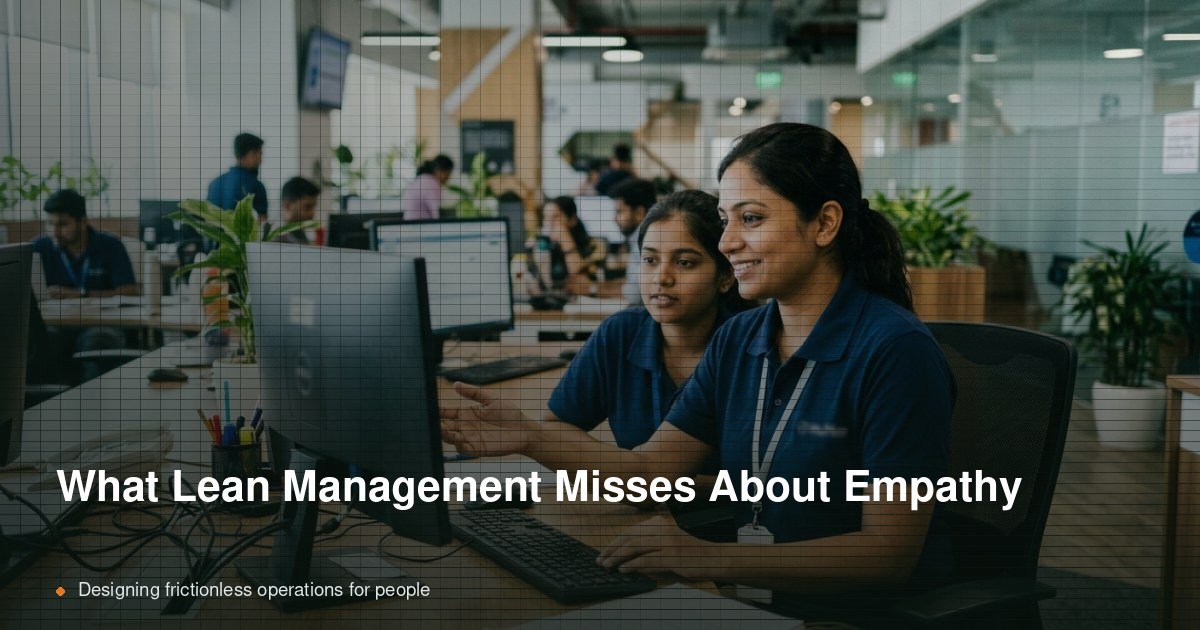
Imagine an employee who spends almost half of the day switching between different software systems just to complete one customer request. Technically, the process may have been documented correctly, but the daily experience remains frustrating.
Now imagine another employee who needs approvals from four different managers before solving a customer's simple issue. The organisation may call this a controlled process, but the employee experiences it as unnecessary delay.
These small moments create operational friction.
Over time, they affect motivation, productivity, innovation, and customer satisfaction.
Businesses that recognise these hidden challenges are moving beyond traditional process improvement. They are designing systems that work well not only for the organisation but also for the people who keep the organisation running.
That is the foundation of human-centred process design.
What Is Human Centred Process Design?
At its core, human-centred process design focuses on designing business processes around real human experiences instead of assumptions.
Rather than beginning with systems or technology, it begins with people.
It asks questions such as:
- Where do employees feel stuck during their daily work?
- Which activities create unnecessary stress?
- What slows decision-making?
- Which processes confuse employees instead of helping them?
- What changes would make work simpler without reducing quality?
Finding answers to these questions often reveals opportunities that traditional process reviews fail to identify.
This approach combines operational thinking with empathy.
It recognises that employees are not simply resources completing tasks. They are individuals with different experiences, skills, challenges, and expectations.
When organisations understand these experiences, they create processes that employees naturally want to follow instead of processes they are forced to follow.
Understanding Lean Management From a New Perspective
Lean Management has transformed industries across the world.
Originally developed to eliminate waste and improve efficiency, Lean encourages organisations to focus only on activities that create value.
Some of its well-known principles include:
- Eliminating unnecessary work
- Improving quality
- Reducing delays
- Standardising processes
- Encouraging continuous improvement
These principles continue to be extremely valuable.
The challenge is not Lean itself.
The challenge begins when organisations implement Lean without understanding how employees experience those changes.
For example, reducing the number of staff members may improve short-term productivity reports. However, if the remaining employees become overworked, stressed, and disengaged, the organisation eventually loses far more than it gains.
Similarly, introducing strict performance targets may increase output temporarily, but it can also reduce creativity and collaboration if employees feel constant pressure.
Efficiency should never come at the cost of employee wellbeing.
The most successful organisations understand that productivity and empathy can exist together.
Where Lean Management Often Misses Employee Empathy
Many operational improvement projects start inside meeting rooms.
Senior leaders discuss reports, identify bottlenecks, approve new workflows, and launch implementation plans.
What often gets missed is the voice of the people who perform the work every day.
Frontline employees usually know exactly where delays occur.
They know which approval adds no value.
They know which software creates confusion.
They know which meetings could simply be emails.
Unfortunately, they are not always invited into the conversation.
As a result, organisations sometimes solve the wrong problems.
A process may become technically faster while becoming emotionally more exhausting.
Employee empathy means understanding work from the employee's point of view before redesigning it.
That small shift changes everything.
Instead of asking employees to adjust to new systems, organisations begin designing systems that support employees.
Real World Indian Example: UPI Changed More Than Customer Payments
India's Unified Payments Interface, commonly known as UPI, is often celebrated for making digital payments faster.
However, its impact on operations is equally impressive.
Before UPI became widely available, shop owners handled cash reconciliation, maintained manual records, and dealt with payment verification challenges.
Digital payments reduced many of these repetitive operational activities.
Small business owners could focus more on serving customers instead of spending valuable time managing payment processes.
Bank employees also experienced fewer routine enquiries related to basic fund transfers.
The success of UPI was not only because it introduced better technology.
It simplified everyday work for millions of people.
That is exactly what thoughtful process design should achieve.
Real World Indian Example: Tata Motors Listened Before Improving
Manufacturing companies often focus heavily on production efficiency.
Tata Motors has consistently invested in continuous improvement by encouraging employee participation through suggestion schemes and shop floor feedback.
Instead of assuming managers always know the best solution, employees working directly with machines are encouraged to identify practical improvements.
Many small suggestions have resulted in safer workplaces, reduced delays, and smoother production processes.
This approach demonstrates an important lesson.
The people closest to the work often understand operational friction better than anyone else.
Listening becomes just as valuable as measuring.
What Does Operational Friction Actually Look Like?
Operational friction is rarely caused by one major problem.
It usually appears through dozens of small frustrations that employees experience every day.
Some common examples include:
Employees Entering the Same Information Repeatedly
Many organisations still require employees to update multiple systems with identical information.
Apart from wasting time, this increases the chances of human error.
Complicated Approval Processes
Employees sometimes wait days for approvals that could easily be completed within minutes.
Customers experience delays even though everyone is working hard.
Poor Communication Between Departments
Sales promises one timeline.
Operations follows another.
Customer support receives different information altogether.
Employees spend more time resolving misunderstandings than solving customer problems.
Technology That Creates More Work
Not every digital transformation improves employee experience.
Some software systems require dozens of unnecessary clicks, duplicate entries, or complicated navigation.
Instead of increasing productivity, they create frustration.
Constant Context Switching
Employees frequently move between emails, messaging platforms, spreadsheets, meetings, and project management tools.
The work itself becomes secondary to managing different systems.
Over time, these small interruptions reduce concentration and increase mental fatigue.
Businesses that recognise these hidden challenges are much better positioned to build frictionless operations.
How Human Centred Process Design Creates Frictionless Operations
Once organisations identify operational friction, the next step is to redesign processes with people in mind. This does not mean removing accountability or making work easier by lowering standards. It means removing unnecessary obstacles so employees can focus on meaningful work.
This is where human-centred process design becomes a practical business strategy instead of just another management concept.
When employees spend less time dealing with inefficient systems, they have more energy to solve customer problems, share ideas, and work collaboratively. The result is not only better employee satisfaction but also stronger business performance.
The Business Benefits of Human Centred Process Design
Many leaders assume that employee empathy is only about creating a positive workplace culture. In reality, it directly influences business outcomes.
Better Employee Engagement
Employees are more engaged when they understand why a process exists and feel that their feedback matters.
When people participate in improving workflows, they are far more likely to adopt new ways of working.
Faster Decision Making
Complicated approval structures often slow organisations down.
By simplifying decision making and giving employees appropriate authority, businesses reduce delays while maintaining accountability.
Improved Customer Experience
Employees who work with clear and efficient processes are able to serve customers with greater confidence.
Customers rarely know what happens behind the scenes, but they immediately notice when employees can resolve their concerns quickly.
Higher Innovation
Innovation does not happen only inside leadership meetings.
Many of the best ideas come from employees who interact with customers, suppliers, or internal systems every day.
Creating opportunities for employees to share these ideas often leads to practical improvements that senior leaders might never have identified.
Reduced Employee Turnover
People usually do not leave organisations because of one difficult day.
They leave after experiencing the same frustrations repeatedly.
Removing unnecessary operational friction creates a workplace where employees feel supported instead of overwhelmed.
How Design Thinking Strengthens Human Centred Process Design
Design Thinking and operational excellence complement each other.
While Lean Management focuses on improving efficiency, Design Thinking focuses on understanding people before designing solutions.
Together, they create sustainable operational improvements.
Start With Observation
Instead of relying only on reports and dashboards, spend time observing employees during their daily work.
Notice where they pause, where they become frustrated, and where they create their own workarounds.
These moments often reveal opportunities for improvement.
Ask Better Questions
Many organisations ask employees whether they like a process.
A better question is, "What makes your work unnecessarily difficult?"
This simple change often produces far more useful insights.
Build Small Solutions First
Large process changes can be risky.
Testing small improvements allows organisations to gather feedback before investing significant time and resources.
Small experiments reduce resistance because employees can see that their opinions influence future decisions.
Improve Continuously
No process remains perfect forever.
Customer expectations change.
Technology changes.
Employee needs change.
Successful organisations treat operational improvement as an ongoing practice rather than a one time project.
Real World Indian Example: Apollo Hospitals and Digital Patient Care
Healthcare depends heavily on operational efficiency, but it also depends on people.
Many hospitals across India, including Apollo Hospitals, have invested in digital systems that simplify patient registration, appointment scheduling, and access to medical records.
These improvements are often discussed from the patient's perspective.
However, they also reduce administrative work for doctors, nurses, and support staff.
When employees spend less time searching for information, they can spend more time providing quality care.
This shows how thoughtful operational design benefits both employees and customers at the same time.
Practical Steps Organisations Can Take Today
Creating frictionless operations does not always require expensive technology.
Many improvements begin with simple conversations and careful observation.
Listen Before Redesigning
Before introducing new systems, ask employees about their daily challenges.
The people performing the work often know exactly where improvements are needed.
Map the Employee Journey
Many organisations invest time in mapping the customer journey but rarely examine the employee journey.
Identify every step employees take to complete an important task.
Look for delays, confusion, repeated activities, and unnecessary approvals.
Remove Low Value Activities
Ask a simple question for every task.
Does this activity genuinely create value?
If the answer is no, consider simplifying or removing it.
Use Technology Carefully
Technology should simplify work rather than complicate it.
Before adopting any new software, evaluate whether it reduces effort for employees or simply adds another system to manage.
Encourage Cross Functional Collaboration
Many operational problems occur because departments work independently.
Regular collaboration between teams helps identify process gaps much earlier.
Celebrate Employee Suggestions
Employees are more likely to share ideas when they believe someone is listening.
Recognising practical improvements creates a culture of continuous innovation.
Common Mistakes Organisations Should Avoid
Even organisations with good intentions sometimes make decisions that increase operational friction.
Some of the most common mistakes include:
Assuming Leaders Already Know the Problem
Senior leaders understand business strategy, but frontline employees understand daily operational challenges.
Ignoring their perspective often results in ineffective solutions.
Measuring Only Productivity
Numbers matter, but they never tell the complete story.
Employee engagement, collaboration, learning, and wellbeing also influence long term business performance.
Introducing Too Many Changes at Once
When several new systems are launched together, employees often feel overwhelmed.
Gradual implementation allows people to adapt more confidently.
Treating Feedback as a Formality
Collecting employee feedback is useful only when organisations act on it.
When employees repeatedly share suggestions without seeing change, they eventually stop participating.
Why Employee Empathy Will Shape the Future of Operations
Artificial intelligence, automation, analytics, and digital platforms will continue transforming organisations.
However, technology alone will never eliminate operational friction.
Businesses that succeed in the future will combine advanced technology with deep human understanding.
Employees will continue to solve complex problems, build customer relationships, and drive innovation.
That makes empathy a competitive advantage rather than a soft skill.
Organisations that invest in human-centred process design today are preparing themselves for a future where operational excellence depends as much on people as it does on technology.
Conclusion
Lean Management has helped organisations improve efficiency for decades, and its principles remain highly relevant.
However, the workplace has evolved.
Today's employees expect clarity, collaboration, meaningful work, and systems that support rather than slow them down.
That is why operational excellence can no longer focus only on reducing waste.
It must also focus on reducing unnecessary frustration.
By combining Lean principles with human-centred process design, organisations create workplaces where employees perform at their best because processes have been designed around real human needs.
When employees experience fewer obstacles, customers receive better service, teams collaborate more effectively, and businesses become more resilient.
The most successful organisations of the future will not simply build faster processes.
They will build better experiences for the people behind those processes.
Frequently Asked Questions About Human Centred Process Design
What is human-centred process design?
Human-centred process design is an approach that improves business processes by understanding the real needs, behaviours, and challenges of employees and customers before designing solutions.
Why is employee empathy important in operational excellence?
Employee empathy helps organisations identify hidden frustrations that reduce productivity, increase errors, and affect customer experience. Understanding these challenges leads to better process improvements.
How is human-centred process design different from Lean Management?
Lean Management focuses primarily on reducing waste and improving efficiency, while human-centred process design also considers employee experience, usability, collaboration, and long term engagement.
Can small businesses use human-centred process design?
Yes. Businesses of every size can improve operations by listening to employees, simplifying workflows, reducing unnecessary approvals, and creating processes that are easier to follow.
How does Design Thinking support operational improvement?
Design Thinking encourages organisations to understand employee experiences, test ideas on a small scale, gather feedback, and continuously improve processes instead of making assumptions.
Which industries benefit the most from human-centred process design?
Manufacturing, healthcare, banking, retail, logistics, education, information technology, government services, and startups can all benefit from adopting human-centred process design.
How can organisations identify operational friction?
They can observe employees during daily work, conduct interviews, analyse workflows, collect feedback, review customer complaints, and identify repeated delays or unnecessary manual tasks.
Does human-centred process design improve customer satisfaction?
Yes. When employees work with clear, simple, and efficient processes, they can respond faster, make fewer mistakes, and deliver a better customer experience.
Is technology enough to create frictionless operations?
No. Technology is only one part of the solution. Organisations also need employee feedback, thoughtful process design, strong leadership, and a culture of continuous improvement.
Why is human-centred process design becoming more important?
As workplaces become more digital and customer expectations continue to rise, organisations need processes that support both efficiency and employee wellbeing. Human-centred process design helps businesses achieve sustainable growth by balancing operational performance with the needs of the people who drive it.