
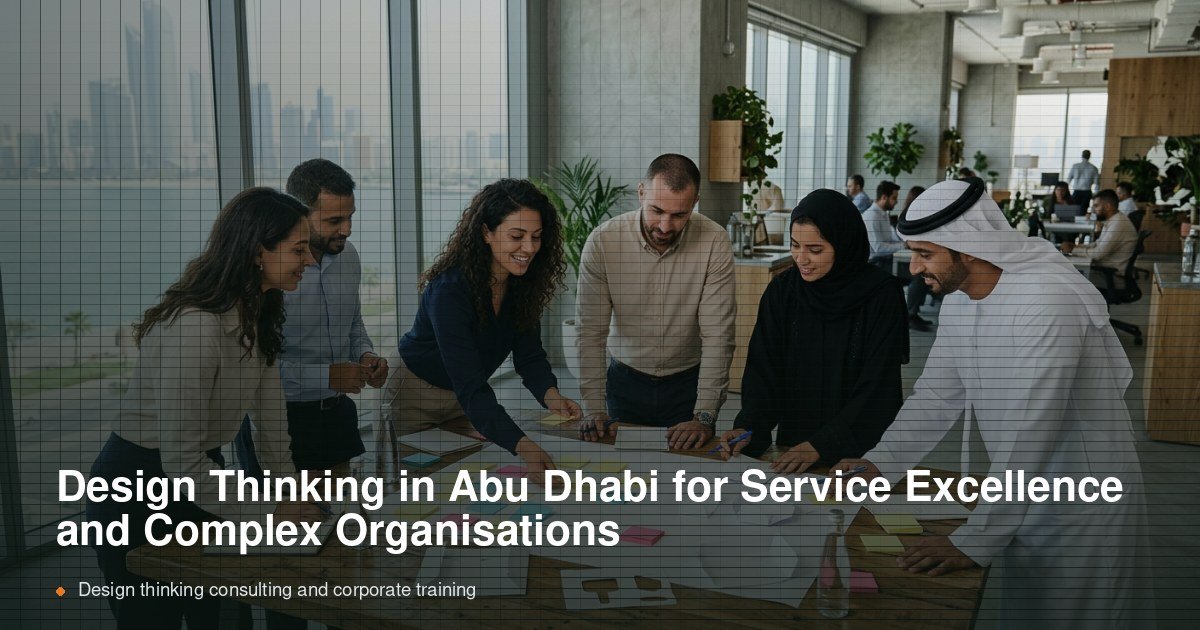
In short: Humane Design (HDI) helps Abu Dhabi organisations apply design thinking to public services, industrial operations and financial services. We work with government entities, energy and industrial groups and ADGM firms on-site at their offices or remotely, through discovery sprints, in-house team training programmes and consulting retainers. Our studio is in Mumbai, and we started operations in the Middle East in 2025.
Abu Dhabi’s large organisations, from government entities to energy and industrial groups, tend to share one challenge. They run complex systems that many people depend on, and they are expected to improve those systems without breaking them. Design thinking in Abu Dhabi is most useful in exactly that setting: careful, evidence-led change to services and processes that cannot simply be switched off and rebuilt.
Humane Design (HDI) was set up in 2021 by former Big 4 leaders to offer strategic design thinking and innovation consulting and learning. We began Middle East operations in 2025, and our one studio is in Andheri West, Mumbai. Abu Dhabi teams work with us at their own offices or remotely, depending on what each stage of the work needs.
Three settings where design thinking in Abu Dhabi fits
Government entities and service excellence
Customer happiness and digital-first public services are stated priorities for government entities across the country, and those in the capital are no exception. Service excellence teams are asked to raise satisfaction, simplify procedures and move transactions to digital channels, often all at once.
The difficulty is rarely the intent. It is that a single service runs across several departments, systems and approval steps, and nobody sees the whole journey. We help service teams map that journey from the resident’s side, find the steps that create the most effort, and test simpler alternatives through prototypes and controlled pilots before rollout. Our article on design thinking for service design explains the method in more detail.
Energy and industrial groups
Oil and gas, utilities, petrochemicals and heavy industry are central to Abu Dhabi’s economy. Their teams are engineering-led and data-rich, and they rightly distrust methods that feel soft or unstructured.
Design thinking earns its place here when it is applied to problems engineers recognise: maintenance processes that fail at handover points, safety procedures people work around, digital tools that field crews do not adopt, and internal services that slow projects down. Combined with our Systems Thinking toolkit, it helps teams see how a change in one part of the operation affects the rest.
Financial services in ADGM
Abu Dhabi Global Market (ADGM) is the emirate’s international financial centre, home to banks, asset managers and financial technology firms. These organisations face the same tension as financial firms everywhere: regulation demands rigour, while clients expect speed and simplicity. Design thinking helps product, operations and compliance teams redesign onboarding, reporting and client service together, so controls are built into the experience rather than bolted on afterwards.
An approach structured for complex organisations
Every engagement moves through five stages: empathise, define, ideate, prototype, test. With Abu Dhabi organisations we pay particular attention to two things.
- Governance: we agree the decision-makers, approval points and success measures at the start, so the work fits existing structures instead of bypassing them.
- Evidence: every recommendation is backed by user research and test results, which makes sign-off from senior leadership easier to secure.
We draw on four proprietary toolkits. Design Thinking provides the research, framing and prototyping tools. Systems Thinking maps dependencies and feedback loops across departments or operations. Agility keeps implementation moving in short, reviewable cycles. Storytelling helps teams present findings to leaders and frontline staff in a way that builds support.
Consulting, training and culture work
Consulting engagements
Our design thinking consulting in Abu Dhabi focuses on live problems: redesigning a public service, improving an internal process, or shaping a new product or digital channel. HDI consultants work alongside your team so the capability stays when we leave. Practice areas include our AI Suite, employee experience design, and service, system and process design, all set out on our design thinking consulting page.
Training for teams and leaders
For organisations building capability at scale, we offer design thinking training in Abu Dhabi as in-house programmes for service excellence, HR, strategy, digital and operations teams. Programmes can be paired with systems thinking, leading change or psychological safety modules, depending on what your teams need. Our design thinking learning services give the full detail.
Innovation and organisation culture
Large organisations often train people in new methods, then return them to structures that reward caution. We work with leadership and HR teams on organisation culture design and innovation culture, looking at decision rights, recognition and the everyday signals that tell people whether experimentation is welcome.
Formats that fit planning cycles
Abu Dhabi organisations often plan capability and transformation work well in advance. Our three formats are designed to slot into those plans.
- A 1 to 5 day discovery sprint: a design thinking workshop in Abu Dhabi focused on one service or process, ending with tested prototypes and a recommendation.
- A 2 to 4 day in-house programme: design thinking corporate training in Abu Dhabi for a cohort, applied to the participants’ own work.
- A 3 to 12 month consulting retainer: embedded support for a larger programme of change, from research to rollout and review.
Larger entities often combine formats: a sprint to prove the approach on one service, a training programme to spread it, and a retainer to support the first major redesign.
How we work with Abu Dhabi teams
We run in-person sessions on-site at your offices in Abu Dhabi, and remote or hybrid sessions when teams are spread across sites, including plants, field locations or other emirates. Sessions are delivered in English, and activities are designed for the multicultural, multilingual teams common in Abu Dhabi workplaces.
For a wider view of our work in the country, including Dubai and the other emirates, see our page on design thinking across the UAE.
Frequently Asked Questions
Can design thinking work in a government entity with formal approval processes?
Yes, provided the work is designed for it. We agree decision-makers, approval points and success measures at the start, then use prototypes and small pilots to produce evidence that approval committees can review. This respects governance while still letting teams test ideas with real residents and businesses before committing to a full rollout.
Is design thinking relevant for engineering-led energy and industrial teams?
It is, when applied to the right problems. Engineers already work with prototypes and testing; design thinking extends that discipline to people-centred problems such as procedure adoption, shift handovers, internal services and digital tools for field teams. Our Systems Thinking toolkit adds the structured mapping of dependencies that technical teams tend to value.
Does HDI have consultants based in Abu Dhabi?
No. Our only office is our studio in Andheri West, Mumbai, and our team travels from there for on-site work. We started operations in the Middle East in 2025. Abu Dhabi engagements combine in-person sessions at your offices with remote or hybrid work, depending on where your people are and what each stage requires.
How quickly will we see results?
A discovery sprint produces tested prototypes and a clear recommendation within 1 to 5 days. Changes to a live service take longer, because they depend on your systems, approvals and rollout plans. Consulting retainers of 3 to 12 months are designed to support that full path, from early research through pilots to measured improvement in the service.
Can one programme include both senior leaders and frontline service staff?
Yes, and it often works better that way. Leaders gain direct exposure to customer and frontline insight, and frontline staff see their experience shape decisions. We usually run a short leadership session to set the challenge and sponsor the work, then working sessions with service teams, followed by a joint review of prototypes and findings.
How do you measure whether the work has made a difference?
We agree measures with you at the start, using indicators your organisation already tracks where possible, such as satisfaction scores, processing times, rework or adoption of a digital channel. For training programmes, we also check whether teams apply the method to real projects afterwards, not only how participants rated the sessions.