
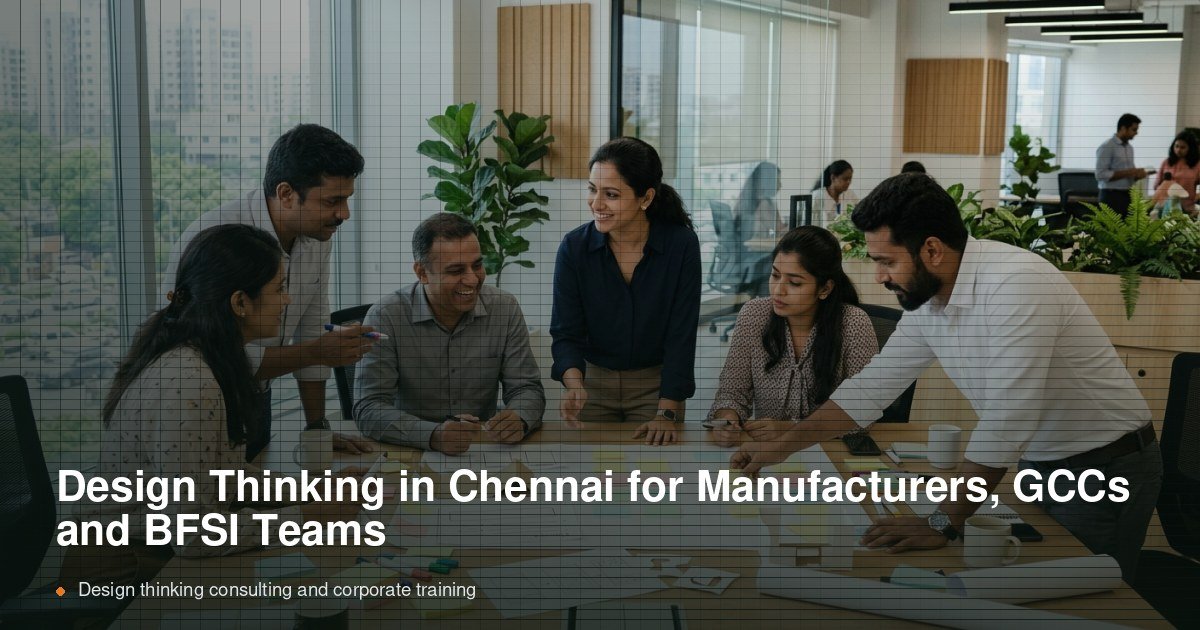
In short: HDI (Humane Design) is a design thinking consulting and corporate learning firm that helps Chennai organisations solve customer, process and culture problems with a tested, people-first method. We run workshops, team training programmes and consulting retainers for manufacturing, GCC, SaaS and BFSI teams, on-site at your offices or remotely.
Chennai’s reputation rests on making things well. Its automotive and manufacturing belt runs towards Sriperumbudur and Oragadam, its capability centres and SaaS companies line the IT corridor along Old Mahabalipuram Road, and its banks and insurers run large operations and shared services hubs across the city.
These organisations are good at execution. The harder question is whether they are executing the right thing. Design thinking in Chennai is about adding that front-end discipline: understanding the people you serve, framing the right problem and testing ideas before scaling them. Humane Design (HDI) works with teams in Chennai on-site at your offices or remotely, from our studio in Andheri West, Mumbai.
Three Chennai buyers and the questions they bring
We see the same method applied very differently depending on who is buying. Here is how it tends to look for the three groups we speak with most.
Plant, quality and engineering heads in the automotive belt
Manufacturers and their suppliers face shifts in vehicle technology, new customer expectations and pressure to digitise the shop floor. Their questions are practical. Why does a new quality app sit unused? Why do engineering changes take so long to reach the line? How do we hold on to the know-how of senior technicians?
Design thinking helps by putting operators, technicians and supervisors at the centre of the redesign, so new tools and processes fit the way work actually happens.
Product and engineering leaders in GCCs and SaaS companies
Chennai has a well-known SaaS ecosystem and a growing number of global capability centres. Their leaders want teams that do more than deliver to a backlog. They want people who can talk to users, challenge a brief and bring forward ideas that headquarters or customers will back.
For these teams, the focus is on product discovery: finding unmet needs, writing sharp problem statements and testing concepts before engineering effort is committed. Our new product discovery and design practice supports this work directly.
Operations and shared services heads in BFSI
Back offices for banks, insurers and financial services firms process large volumes of claims, onboarding requests and service tickets. Efficiency programmes have often taken out the obvious waste. What remains is harder: processes that work on paper but frustrate customers and wear out staff.
Here, design thinking is used to redesign a journey from both sides, the customer’s and the employee’s, within the regulatory limits that govern the work.
Design thinking in Chennai: how an engagement runs
Whatever the sector, our engagements follow the same backbone, adjusted to your context and timelines:
- Listen: interviews and observation with customers, employees or operators, depending on the problem
- Frame: findings are turned into one or two problem statements the leadership team agrees to own
- Generate: cross-functional ideation that pulls in people who rarely work together
- Prototype: quick, low-risk versions of the most promising ideas, from paper screens to revised process steps
- Test: prototypes go back to real users, and the team keeps, changes or drops each one
- Embed: owners, measures and next steps are agreed so the work continues after we leave
This sequence is supported by HDI’s toolkits for Design Thinking, Systems Thinking, Agility and Storytelling. Systems Thinking is particularly useful in Chennai’s supplier networks and large back offices, where a fix in one place can create a queue in another.
Workshops, training programmes or consulting
Three formats cover most needs. A design thinking workshop in Chennai, or a discovery sprint of 1 to 5 days, is the right start when a leadership team wants to test the method on one real problem.
Design thinking training in Chennai through an in-house team training programme of 2 to 4 days suits organisations building capability across a function or a cohort of managers. Our design thinking learning services can be combined with programmes in strategic thinking, business agility, psychological safety or leading change. For GCC leaders, design thinking corporate training in Chennai often sits inside a wider leadership development plan.
Design thinking consulting in Chennai, through an embedded retainer of 3 to 12 months, is the better fit when a redesigned product, service or employee journey has to be delivered. Our consulting services include service, system and process design, employee experience design, innovation culture design and the AI Suite.
How to tell whether it is working
Chennai organisations tend to ask for evidence, and they should. We agree measures with the sponsor at the start, linked to the problem being solved rather than to the workshop itself.
- For a plant tool: whether operators use it without being chased, and whether it saves them time on shift
- For a product team: how many assumptions were tested with users before build, and how many ideas were dropped early
- For a BFSI journey: repeat contacts, handoffs and rework at the steps that were redesigned
- For capability building: whether managers run their own discovery work in the months after the programme
Our article on measuring the ROI of design thinking sets out a fuller approach to tracking returns over time.
How an Engagement Runs for Chennai Teams
HDI was founded in 2021 by ex-Big 4 leaders and works with corporates, MSMEs and funded startups in India and globally. Our only studio is in Andheri West, Mumbai. For Chennai teams, our facilitators come on-site to your offices or plants, and we run remote and hybrid sessions for groups spread across the city or across countries, as many GCC teams are.
A first conversation usually covers three things: the problem you want to solve, who owns it and which people are affected by it. From there we suggest the smallest format that will give you a useful answer, whether that is a two-day workshop for a product team in a capability centre or a longer retainer for a plant-wide change. Scope grows only when the early work earns it.
Frequently Asked Questions
Can HDI run sessions at our plant near Sriperumbudur or our office on OMR?
Yes. We work with teams in Chennai on-site at your offices and plants, including locations along the automotive belt and the IT corridor. For manufacturing work we prefer being on-site, because observing the line is part of the method. HDI’s only studio is in Andheri West, Mumbai, and remote or hybrid formats are also available.
How can a GCC team in Chennai use design thinking with headquarters overseas?
It gives the team a credible way to propose work rather than only receive it. By running user research, framing problems clearly and testing prototypes, a capability centre team can bring evidence to global stakeholders. We can run hybrid sessions that include colleagues at headquarters, so the problem is framed jointly from the start.
Our SaaS product team already runs agile sprints. What does design thinking add?
Agile sprints are strong at building and shipping. Design thinking strengthens what happens before a feature enters the backlog: understanding users, finding unmet needs and testing whether an idea is worth building. Teams that combine the two waste less engineering effort on features customers do not use, and make clearer cases for what to build next.
Can design thinking work in a regulated BFSI back office?
Yes. The method changes how a process feels and flows for customers and staff, not the controls required by regulators. Compliance and risk colleagues are involved from the framing stage, so prototypes respect those limits. Typical targets include onboarding, claims and service journeys where customers repeat themselves or staff rely on workarounds.
We are an auto component supplier, not a carmaker. Is this relevant to us?
Very much. Suppliers deal with demanding customers, frequent engineering changes and tight delivery windows. Design thinking helps them understand what their own customers’ engineers and buyers value, redesign internal handoffs that slow changes down and build tools their technicians will actually use. It is a practical method, not a branding exercise.
What should we prepare before a first workshop?
Bring one real problem with a clear owner and some access to the people affected, whether customers, operators or employees. Before the session we speak with the sponsor and a few participants to sharpen the brief. A mixed group drawn from several functions, including people who meet customers, usually works best for a first workshop.