
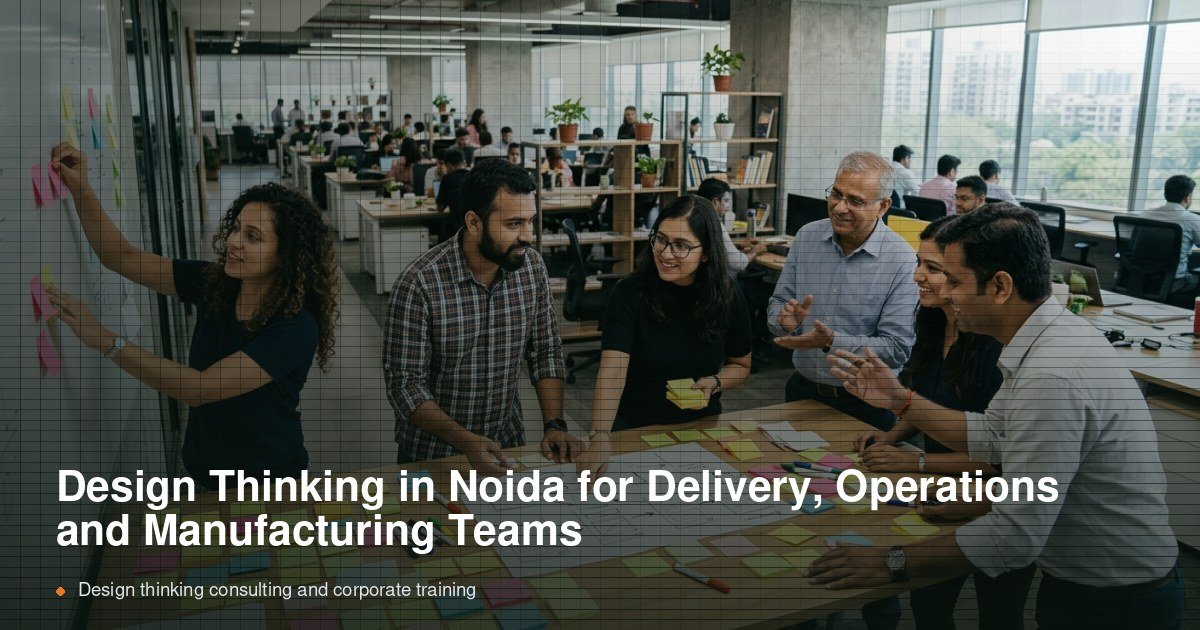
In short: Humane Design (HDI) is a design thinking and innovation consulting and learning firm that helps process-heavy organisations rethink services, workflows and employee experience. We work with IT and ITES delivery centres and electronics manufacturers in Noida on-site at their offices or remotely, through workshops, team training programmes and consulting retainers planned around shifts and SLAs.
Noida runs on process. Its IT and ITES delivery centres manage service-level agreements around the clock, its electronics plants assemble products on tightly balanced lines, and its back offices handle work for banks, insurers and global clients. These are organisations that measure everything and improve continuously.
So why would they need design thinking in Noida? Because process improvement methods tell you how to make a step faster or cheaper. They rarely ask whether the step should exist, or how the person at the other end experiences it. Design thinking adds that question, and it sits comfortably alongside the quality methods teams already use.
Humane Design (HDI) is a consulting and learning firm with its studio in Mumbai. We work with teams in Noida and Greater Noida on-site at their offices or remotely, and we plan sessions so people can step away from the floor without disrupting delivery.
Design thinking in Noida’s IT and ITES delivery centres
Delivery centres in Sector 62, along the Noida-Greater Noida Expressway and elsewhere in the city tend to share a familiar set of problems: rising client expectations, escalations that repeat despite root-cause analysis, and capable people who stay in execution roles because the operating model leaves no room for anything else.
Design thinking helps in three specific ways:
- Redesigning client-facing services from the client’s experience outward, using journey maps built from interviews rather than ticket data alone.
- Reworking internal processes such as onboarding, transitions and knowledge transfer, where small frictions add up across large teams.
- Giving delivery managers a structured way to propose improvements to clients, which helps a centre move from executing work to shaping it.
Back offices that process work for banks and insurers face a version of the same problem. Their processes were usually designed around the parent organisation’s systems, not around the customer waiting for a loan decision or a claim payout. Mapping that wait from the customer’s side, step by step, tends to show delays no single team can see on its own dashboard.
Our system and process design practice covers this kind of work in depth, from mapping the current flow to piloting a redesigned one.
Electronics manufacturing: designing with the shop floor, not for it
Noida and Greater Noida are a well-known cluster for mobile phone and consumer electronics manufacturing. Here the method is less about the consumer product, which is often designed elsewhere, and more about how work is organised on the ground.
- Onboarding and induction for contract and new workers, where the first weeks decide whether people stay.
- Line and workstation layouts, prototyped with operators who know the real workarounds.
- Quality escalations between production, quality and supplier teams that keep coming back.
- Supervisor routines, shift handovers and communication across teams with different first languages.
In each case the principle holds: the people closest to the work are interviewed, observed and involved in testing changes. This often surfaces fixes that a desk review would miss, and it builds ownership among the people who live with the result. Our employee experience design work often starts here.
Questions operations heads ask, and our answers
We already run Lean and Six Sigma.
Good. Those methods are strong at removing waste and variation from a known process. Design thinking is most useful earlier, when the problem itself is unclear or the customer’s needs have shifted. Used together, they help teams choose better problems to optimise.
Our clients define the process. We cannot change it.
Often less true than it seems. Clients care about outcomes and experience. A delivery team that brings evidence from users and a tested alternative usually gets a hearing, and that conversation is how centres earn wider scope.
We cannot take people off the floor for four days.
You may not need to. A design thinking workshop in Noida can be split into half-day blocks across a fortnight, run between shifts, or combined with remote sessions for teams on rotating rosters. We plan around your schedules, not ours.
Formats that suit operations-led teams
Every engagement draws on our Design Thinking, Systems Thinking, Agility and Storytelling toolkits. Systems thinking matters most in operations, where fixing one queue can simply move the bottleneck to another.
- Discovery sprint or workshop, 1 to 5 days, for one clearly defined service or process problem.
- In-house team training programme, 2 to 4 days, for delivery managers, team leads, quality and HR teams.
- Embedded consulting retainer, 3 to 12 months, for redesigning a service line or operating model with your people.
Our design thinking learning services describe the training options in detail. Design thinking training in Noida works best when the group mixes functions that rarely solve problems together, such as delivery, quality and HR. For larger workforces, design thinking corporate training in Noida can run in waves, so each cohort applies the method to a live problem before the next begins.
When the problem is specific and the stakes are high, our design thinking consulting team works alongside yours. Design thinking consulting in Noida usually begins with a short diagnostic of the service or process, followed by research with the people it affects.
Connecting Noida teams with the rest of the region
Many organisations in Noida report to leadership in Delhi or Gurgaon, or work closely with sister teams there. Bringing those groups into the same room, physically or remotely, often reveals why a decision taken at head office causes friction on the delivery floor. Our Delhi NCR page explains how we run programmes that span the region.
Whichever format you choose, we start by speaking with the sponsor, usually an operations head, CHRO or Head of L&D, to agree the problem, the participants and how success will be judged.
Frequently Asked Questions
Do you run sessions in Noida or only in Mumbai?
We come to you. Our only studio is in Andheri West, Mumbai, and we work with teams in Noida and Greater Noida on-site at their offices or remotely. For distributed delivery teams, a mix of on-site sessions and remote follow-ups is often the most practical option, especially across shifts.
Can design thinking work alongside SLA-driven delivery?
Yes. SLAs define what must be achieved, not always how. Design thinking helps teams look at the experience behind the metrics, such as why users raise repeat tickets or why handovers fail. Changes are tested in small pilots, so performance commitments are protected while improvements are proven.
Is this relevant for a factory workforce?
Yes, when adapted. On the shop floor we rely on observation, short conversations at workstations and quick physical prototypes rather than long sessions in a meeting room. Timing is planned around shifts, and supervisors are involved early so that ideas from operators are taken seriously and followed through.
How does this fit with our Lean or Six Sigma programme?
It complements it. Lean and Six Sigma improve a defined process; design thinking helps decide which problem deserves attention and what customers or employees actually need. Many teams use design thinking to frame and test a change, then rely on their existing quality tools to standardise and sustain it.
Who in a Noida delivery centre should take part?
A mix works best: delivery managers, team leads, quality or process excellence staff, and someone from HR or L&D. Including a client-facing manager keeps the client’s perspective in view. Senior leaders should at least join the opening and the final readout, so they can act on what the team proposes.
Can you help a centre make the case for more ownership with its client?
Yes. Part of the work is helping delivery teams present findings with evidence and a clear narrative. Our Storytelling toolkit is designed for this: turning research and prototype results into a proposal that a client or global stakeholder can assess quickly and approve with confidence.