
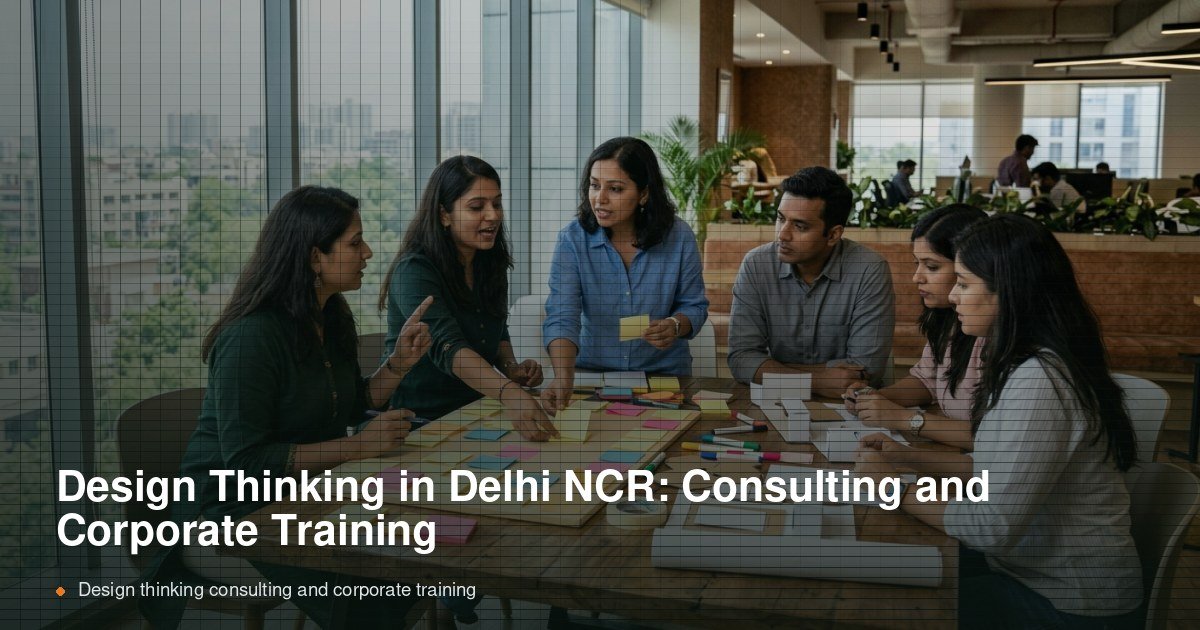
In short: Humane Design (HDI), founded in 2021 by ex-Big 4 leaders, provides design thinking and innovation consulting and corporate learning. We work with organisations across Delhi, Gurgaon, Noida and the wider NCR on-site at their offices or remotely, running discovery sprints, team training programmes and consulting retainers that help leadership teams solve customer, service and culture problems with evidence rather than opinion.
Delhi NCR is less a single city than a cluster of business districts spread across the national capital and its neighbouring states. A consumer goods head office in Gurgaon, a bank’s operations hub in Noida and a public sector undertaking in central Delhi all sit inside one region, yet each answers to different customers, regulators and rhythms. Design thinking in Delhi NCR has to start from that spread, not ignore it.
What these organisations share is scale. Headquarters in the capital region take decisions that reach very large numbers of customers, citizens or employees, often after several layers of approval. When those decisions rest on assumptions about what people need, being wrong is expensive and slow to correct.
Humane Design (HDI) helps leadership teams replace assumptions with evidence. Our studio is in Andheri West, Mumbai, and we work with teams across NCR on-site at their offices or remotely, depending on what the work needs.
Design thinking in Delhi NCR, district by district
The method is the same everywhere. The problems that bring teams to it change as you move across the map.
- Central Delhi and Aerocity: ministries, public sector undertakings, industry bodies and the advisory firms that serve them. Work here often concerns citizen-facing services, policy delivery and internal process.
- Gurgaon: multinational offices, global capability centres and consumer goods headquarters. Our page on design thinking in Gurgaon covers that agenda in more detail.
- Noida and Greater Noida: IT and ITES delivery centres, electronics manufacturing and back-office operations for banks and insurers. See design thinking for Noida teams for the operations-led view.
- Faridabad and Ghaziabad: established manufacturing and engineering firms, including many promoter-led businesses where change tends to come from the top.
This hub page is the right starting point if your organisation spans more than one of these locations, or if leadership sits in Delhi while delivery happens elsewhere in the region.
Four problems NCR leadership teams are trying to solve
Consumer goods: closer to the shopper than the spreadsheet
Consumer goods companies headquartered in the region sit on rich sales and panel data, yet product and pack decisions are still often made in a conference room. Design thinking puts brand, sales and insights teams in front of shoppers, distributors and retailers early, so ideas are tested in a kirana store or a modern trade aisle before they reach a launch plan.
BFSI: journeys that cross too many departments
Banks, insurers and NBFCs often find that a customer’s onboarding or claim passes through product, operations, compliance and technology, with no single owner of the experience. Journey mapping and service blueprints show where the handoffs fail and give each function a shared picture to redesign against.
Public sector undertakings: change inside a long-established system
PSUs carry deep institutional knowledge and equally deep procedures. The useful question is rarely how to disrupt the organisation. It is which steps add value for the people served, and which exist only because they always have. Systems thinking helps teams see the whole before they change a part.
Government-facing organisations: designing for citizens and officials at once
Consultancies, technology vendors and development organisations that work with government need solutions that make sense to the citizen using a service and to the official approving it. Prototyping with both groups early reduces the risk of a scheme that looks complete on paper and struggles in the field.
Running a design thinking workshop in Delhi when hierarchy is real
Many NCR organisations are formal by design. Seniority matters, approvals are layered, and junior staff rarely contradict a director in a meeting. A workshop that ignores this produces polite agreement and little else.
We design sessions around the hierarchy rather than pretending it is absent:
- Senior sponsors frame the problem and agree in advance what the team may change, so participants know their ideas will be considered.
- Early exercises are done in small mixed groups and written down before anyone speaks, which stops the most senior voice from setting the answer.
- Field research is shared through direct quotes and photographs from customers or citizens, so evidence carries the argument instead of rank.
- Prototypes are cheap and visibly rough, which makes it easier for a manager to criticise an idea without criticising a colleague.
Where teams find it hard to speak up at all, we often pair the work with our programme on psychological safety at work, so the habits last beyond the session.
Training, consulting or both
Most NCR engagements answer one of two needs. Some organisations want their people to practise the method themselves. Others have a specific problem and want experienced facilitators to help solve it, with their own teams alongside.
Capability building for managers and leaders
Our design thinking learning services are in-house programmes for managers, product owners, HR and functional leaders. Participants work on a live problem from their own organisation rather than a borrowed example, which is the surest way to make design thinking corporate training in Delhi carry over into the job.
Consulting on a defined problem
Through our design thinking consulting practice we work on new product discovery, service and process design, and culture and employee experience design. For organisations that want a partner over several months, design thinking consulting in Delhi NCR usually takes the form of a retainer, with our team embedded alongside yours.
- Discovery sprint or workshop, 1 to 5 days: frame a problem, research it and test early concepts.
- In-house team training programme, 2 to 4 days: build shared skills across a function or leadership group.
- Embedded consulting retainer, 3 to 12 months: carry a problem from research through to implementation.
How a first engagement usually begins
We start with a conversation with the sponsor, usually a CHRO, Head of L&D, business head or CXO, to understand the problem and the people affected by it. Then we agree the format, the participants and where sessions will run: at your office in Delhi, Gurgaon or Noida, remotely for distributed teams, or at our Mumbai studio if leaders prefer to step away.
Every engagement uses our proprietary Design Thinking, Systems Thinking, Agility and Storytelling toolkits, adapted to the sector and seniority of the group. A request for design thinking training in Delhi for a board-level team will look different from one for frontline service managers, even though the method underneath is the same.
Before the first session we ask for two things: a named sponsor who will act on what the team learns, and access to the customers, citizens or employees the problem concerns. Without those, a workshop is an event. With them, it is the start of a change.
Frequently Asked Questions
Do you have an office in Delhi NCR?
No. Humane Design’s only studio is in Andheri West, Mumbai. We work with organisations across Delhi, Gurgaon, Noida, Faridabad and Ghaziabad on-site at their offices, or remotely for distributed teams. Some leadership groups choose to hold sessions at our Mumbai studio so they can step away from day-to-day pressures.
Can one programme cover our teams in Gurgaon, Noida and Delhi?
Yes. Organisations with offices across the region often run a combined programme, with in-person sessions at one location and remote follow-ups for the rest. Mixing head office and delivery centre teams is useful in itself, because it exposes the handoffs between them that customers feel but no single site owns.
Is design thinking suitable for a public sector undertaking?
It can be, provided the scope is honest about what the organisation is permitted to change. We work within existing approval structures, focus on the service experience and internal processes, and use systems thinking to show how one change affects others. The aim is better outcomes for the people served, not disruption for its own sake.
How do you handle mixed seniority in NCR sessions?
We agree scope with the senior sponsor beforehand, use silent and written exercises before open discussion, and work in small mixed groups. Evidence from customer or citizen research leads the conversation rather than rank. These techniques let junior participants contribute fully without asking senior leaders to give up their role.
Which sectors in the capital region do you focus on?
Our main sectors are BFSI, consumer goods, global capability centres, manufacturing and IT/ITES, which together cover much of the NCR economy. We also work with organisations that serve government, such as consultancies and technology vendors, where a solution has to work for citizens and the officials who approve it.
Who should sponsor a design thinking programme in our organisation?
Usually a CHRO, Head of L&D or a business head with authority over the problem being tackled. For capability-building programmes, L&D tends to lead. For consulting on a product, service or process, the business owner should sponsor it, because they will need to act on what the team discovers.