
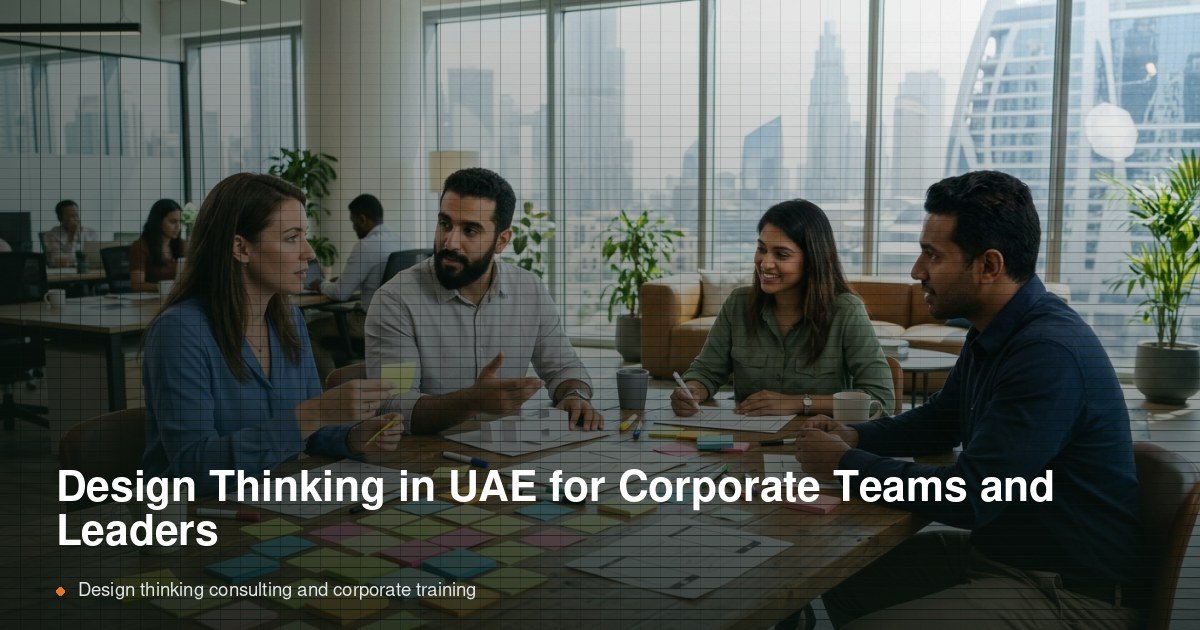
In short: Humane Design (HDI) helps UAE organisations use design thinking to fix services, shape products and build lasting team capability. We started operations in the Middle East in 2025 and work with teams across the emirates on-site at their offices or remotely. Engagements range from 1 to 5 day discovery sprints to 3 to 12 month consulting retainers.
Organisations across the seven emirates share a common pressure. Customers, residents and employees expect services that are simple, quick and personal, and they compare every experience with the best one they have had anywhere in the world. Design thinking in UAE organisations is a practical response: a shared method for understanding people, testing ideas cheaply and building only what works.
Humane Design (HDI) is a strategic design thinking and innovation consulting and learning firm, founded in 2021 by ex-Big 4 leaders. We started operations in the Middle East in 2025. Our studio is in Andheri West, Mumbai, and we work with UAE teams on-site at their offices or remotely.
Below, we cover the problems we help with in BFSI, consumer goods and government services, the formats we run, and how we work with multicultural teams.
Why design thinking in UAE organisations matters now
Most UAE organisations do not lack ambition or investment in change. The harder problem is turning a strategy into services people actually use. Digital channels launch, yet customers still call the contact centre. New policies get written, yet employees quietly work around them.
Design thinking closes that gap by starting with evidence about real behaviour rather than assumptions made in a meeting room. Teams observe and interview the people they serve, frame the problem precisely, then prototype and test before committing to a build. The method is simple to describe and harder to practise, which is why most organisations want structured support at the start.
Three conditions make it particularly useful in the UAE:
- Customer expectations are shaped by world-class aviation, hospitality and retail brands, so every service is judged against a high bar.
- Government entities have made customer happiness and digital public services a visible priority, and private sector partners are expected to keep pace.
- Teams are often multicultural and multilingual, so shared methods and visual tools matter more than they would in a single-culture workplace.
Sector problems we help UAE teams work through
Banking, insurance and financial services
Banks, insurers and investment firms in the UAE serve a highly diverse customer base, from long-term residents to new arrivals opening their first local account. Common problems include onboarding journeys that lose customers part way, digital products that copy branch processes instead of rethinking them, and compliance steps that frustrate customers without adding protection.
We help product, operations and risk teams map the full journey through customer journey mapping, find where effort and drop-off concentrate, and test redesigned steps with real customers before any IT work starts.
Consumer goods and retail brands
Consumer goods companies selling in the UAE reach shoppers of many nationalities through the same shelf. Insight teams collect plenty of data but struggle to turn it into product, pack or channel decisions. Design thinking helps them move from research decks to tested concepts: framing the unmet need, building rough prototypes and getting reactions from shoppers in weeks rather than quarters.
Government and semi-government services
Government entities and the companies that deliver services on their behalf face a specific challenge: redesigning a service without disrupting the people who depend on it every day. Approval chains are formal and accountability is high. We help service teams build the case for change through user research, low-risk prototypes and pilots, so decisions rest on what residents and businesses actually do.
What we offer UAE organisations
Our work falls into three connected areas. Many organisations start with one and add another once the first shows results.
Design thinking consulting
Our design thinking consulting in UAE engagements put an HDI team alongside yours to solve a live problem: a new product, a service redesign or a broken internal process. You get the outcome, and your people learn the method by doing it. Our design thinking consulting services cover the full set of practice areas, from new product discovery to employee experience design and our AI Suite.
Team training programmes
For organisations that want capability across many teams, we run design thinking training in UAE offices as in-house programmes. Participants work on problems from their own business, not generic case exercises. Related programmes cover systems thinking, strategic thinking, business storytelling and psychological safety, and our design thinking learning services set out the full range.
Innovation and culture design
Methods only stick when the culture supports them. We work with CHROs and leadership teams on innovation culture and organisation culture design: the rituals, decision rights and incentives that decide whether people feel safe to test ideas and admit what did not work.
Choosing the right engagement format
Every engagement is shaped around your problem, your people and your timeline. Most fit one of three formats.
- Discovery sprint, 1 to 5 days: a focused design thinking workshop in UAE offices or online, built around one defined challenge. Useful when a team needs momentum and early evidence quickly.
- In-house team training programme, 2 to 4 days: design thinking corporate training in UAE for a cohort, mixing method, practice and application to live work.
- Embedded consulting retainer, 3 to 12 months: HDI consultants work with your teams through research, prototyping, testing and rollout of a larger change.
Working with multicultural, multilingual teams
A typical UAE team brings together people from the Gulf, South Asia, Europe, Africa and beyond, each with different assumptions about hierarchy, speaking up and disagreement. That diversity is an asset in design thinking because it widens the range of perspectives on a problem. It also needs careful facilitation.
Our sessions are delivered in English. We rely heavily on visual tools, sketching and physical prototypes, so good ideas do not depend on polished presentation. Activities are structured so quieter voices contribute before senior ones, and we draw on our psychological safety work to help leaders hear difficult news early.
Dubai, Abu Dhabi and the wider emirates
Business priorities differ across the country. Dubai teams in financial services, retail, hospitality and technology often focus on customer experience and speed to market, and our page on design thinking for Dubai teams covers that context.
In the capital, government entities, energy and industrial groups and financial firms in ADGM bring different questions about service excellence and complex systems. We cover those on our Abu Dhabi design thinking page. Organisations in Sharjah and the northern emirates can work with us on-site or remotely in the same way.
Our approach and toolkits
Every engagement follows the core design thinking cycle: empathise, define, ideate, prototype and test. We run that cycle through four proprietary toolkits.
- Design Thinking toolkit: research, problem framing, ideation and prototyping tools for product, service and process challenges.
- Systems Thinking toolkit: maps of the relationships, feedback loops and incentives behind a problem, useful when a fix in one team creates a new problem in another.
- Agility toolkit: short cycles, clear priorities and regular review, so teams keep learning after the workshop ends.
- Storytelling toolkit: ways to turn research and prototypes into narratives that win support from leaders and frontline staff.
The aim is not a one-off event. It is a team that can run the cycle again on the next problem without us.
Frequently Asked Questions
Does Humane Design have an office in the UAE?
No. Our only office is our studio in Andheri West, Mumbai. We started operations in the Middle East in 2025 and work with UAE organisations in two ways: our facilitators travel to run sessions on-site at your offices, or we deliver remotely and in hybrid formats for distributed teams. Many engagements combine both approaches.
Which emirates can you work in?
We can work with organisations in any emirate. On-site sessions run at your premises, whether that is a head office in Dubai or Abu Dhabi or a site elsewhere in the country. For teams spread across several emirates, remote or hybrid sessions often make more sense than bringing everyone to one location for several days.
What language are the sessions delivered in?
Sessions are delivered in English, the working language in most UAE corporate settings. Because many teams are multilingual, we design activities around visual tools, sketches and physical prototypes, so participants can contribute fully without relying on polished spoken presentation. Share your group’s profile when we scope the programme and we will plan the facilitation around it.
Can one programme cover our UAE team and colleagues in other countries?
Yes. Remote and hybrid formats suit regional and global teams, and the UAE’s time zone makes it practical to work with colleagues in South Asia, Europe and Africa within one working day. We usually split longer programmes into shorter remote blocks, so participants can apply each step to live work between sessions.
How do we decide between a workshop, a training programme and a retainer?
Start from the outcome you need. If you want early evidence on one challenge, a 1 to 5 day discovery sprint fits. If you need capability across a cohort, choose a 2 to 4 day in-house programme. If the change is large and needs support through to rollout, a 3 to 12 month consulting retainer is the better choice.
Who usually sponsors this work inside a UAE organisation?
It depends on the goal. CHROs, Heads of L&D and talent leaders typically sponsor capability building and culture work. CXOs, digital and technology heads, and marketing or insights heads usually sponsor consulting on products, services and customer experience. The strongest engagements have a senior sponsor who owns the problem and can act on what the team learns.