
If you have been asked what is organization design in HR, the short answer is this: it is the deliberate process of shaping an organisation's structure, roles, decision rights, processes and people systems so that together they deliver the strategy. The org chart is only the most visible output.
HR leaders are increasingly expected to lead or co-lead this work rather than administer the outcome. This guide explains the main structure types, the principles that good design follows, a practical HR-led process and the mistakes that make restructures fail.
What is organizational design and structure?
Organisational structure is the arrangement of roles, reporting lines and units. Organisation design is broader. It is the process of choosing that structure and aligning everything around it: how work flows, who decides what, how performance is measured and how people are rewarded and developed.
Two frameworks help HR teams hold that broader view. Jay Galbraith's Star Model sets out five design policies that must fit together: strategy, structure, processes, rewards and people. Change one point of the star without the others and the organisation drifts back towards its old shape.
The McKinsey 7S framework, developed around 1980 by Tom Peters, Robert Waterman and colleagues, makes a similar case with seven elements: strategy, structure, systems, shared values, style, staff and skills. Both frameworks carry the same message for HR: structure is necessary but never sufficient.
Types of organizational design structures
Most organisations use a blend, but five structure types cover the main options. Each solves one coordination problem and creates another, so the choice depends on what your strategy most needs.
Functional structure
People are grouped by expertise: finance, marketing, operations, technology. It builds deep skill and clear career paths, and works well for a single product line in a stable market. The weakness is slow coordination across functions, with decisions escalating to the top.
Divisional structure
Units are organised around products, geographies or customer segments, each with its own functional support. Divisions respond faster to their markets and carry clear accountability for results. The trade-off is duplicated functions and weaker sharing of expertise across divisions.
Matrix structure
Employees report along two lines, typically function and product or region. Many multinationals and GCCs work this way. A matrix can balance depth with market focus, but only when decision rights are explicit. Without that clarity, people face two managers with conflicting priorities, and decisions slow down.
Flat structure
There are few layers between the front line and senior leadership, and spans of control are wide. Flat structures speed up communication and push authority down, which suits startups and small professional teams. As they grow, informal hierarchies tend to appear, and managers with very wide spans struggle to coach.
Network and team-based structures
Work is organised around cross-functional teams, often stable product or customer teams, supported by shared platforms and centres of expertise. Some organisations also rely on partners for whole capabilities. These designs adapt quickly but demand strong coordination mechanisms, clear goals and mature people practices.
To choose between them, ask which coordination problem costs you most today. If deep expertise is thin, lean functional. If markets or customer groups behave very differently, lean divisional. If you need both, a matrix can work, but only with explicit decision rights. If speed of learning matters most, look at team-based designs.
What are the principles of organization design?
Structure choices differ, but sound designs follow a consistent set of principles.
- Start from strategy. Define the capabilities the organisation must excel at before drawing any boxes.
- Design for the work, not the people. Map how value flows to customers, build roles around it, and fit names to roles afterwards.
- Make decision rights explicit. For every major decision, be clear who decides, who is consulted and who is informed.
- Minimise handoffs. Keep work that needs tight coordination inside a single unit wherever possible.
- Set layers and spans deliberately. Too many layers slow decisions; spans that are too wide leave managers unable to support their teams.
- Align all the levers. Processes, metrics, rewards and talent practices must reinforce the new structure, as the Star Model suggests.
- Build in adaptability. Expect to revisit the design as strategy shifts, and avoid structures that only work under current conditions.
What is organization design in HR practice? A five-phase process
HR rarely owns the strategy, but it is well placed to run the design process. It holds the data on roles, capability and cost, and it owns many of the levers that make a new structure work. Answering what is organization design in HR in practical terms means following a clear sequence.
1. Build the case and the design criteria
Work with the CEO and business leaders to agree why the organisation needs to change and what success looks like. Turn that into five to eight design criteria, for example 'faster decisions on customer pricing' or 'one owner for each customer journey'. Every option will later be tested against these criteria.
2. Diagnose the current organisation
Combine hard data, such as spans, layers, role counts and cost by function, with qualitative input from interviews and workshops. Map where work slows, duplicates or falls between units. Listen to employees closest to customers; they usually know exactly where the structure gets in the way. If the diagnosis shows that processes, not reporting lines, are the real constraint, a process redesign framework may achieve more than a restructure.
3. Generate and test options
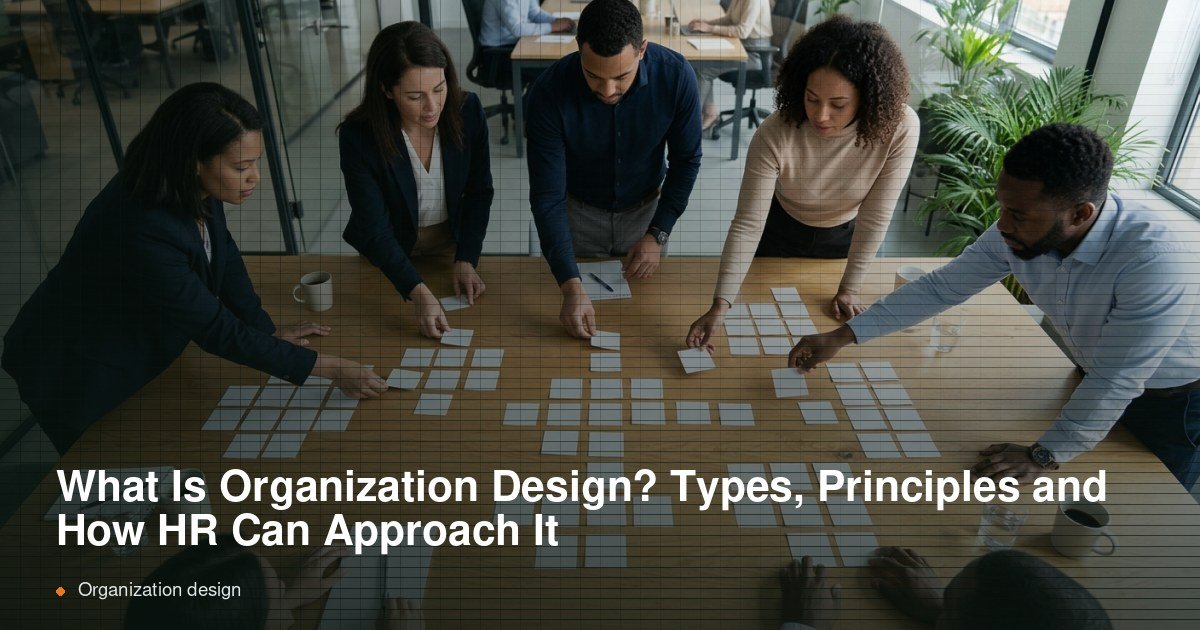
Develop two or three structural options, not one. Test each against the design criteria and walk through real scenarios: a key customer escalation, a new product launch, a budget decision. Design thinking helps here, because prototyping a structure on paper with the people who will live in it surfaces problems before they become expensive.
4. Design the detail
Once a high-level option is chosen, define roles, decision rights, interfaces between units, governance forums and the metrics each unit owns. Then align the people systems: job architecture, performance goals, rewards and capability development. Organisation design and employee experience design should run together at this stage, because the new structure changes what each person's working day feels like.
5. Transition and review
Plan the move with the same care as the design. Sequence appointments, communicate early and honestly, support the managers who must lead their teams through it, and set a review point six to twelve months out to test whether the design is delivering against the criteria.
Common organisation design mistakes
- Redrawing the org chart and calling it organisation design, while processes, metrics and rewards stay the same.
- Designing around current leaders and their preferences rather than around the work.
- Adding layers or coordinator roles to fix problems that are really caused by unclear decision rights.
- Running the process in secrecy for months, which fuels rumours and loses the insight of people doing the work.
- Underestimating the transition, so productivity drops and good people leave during the uncertainty.
A quieter mistake is ignoring how the change feels to employees. Annual surveys may not pick it up in time, which is why it helps to understand the difference between employee experience and employee engagement when you plan how to track the transition.
When to bring in outside support
Internal HR teams know the people and the history, but they can find it hard to challenge senior leaders or stay neutral when roles are at stake. External support is most useful for the diagnosis, for facilitating option design with the leadership team and for designing the people systems that make the structure stick.
Humane Design's employee system design consulting works with CHROs, HR business partners and leadership teams to align roles, decision rights, performance and reward systems with how work actually flows. We use our systems thinking and design thinking toolkits to map the current organisation, prototype options with the people affected and plan the transition. Engagements run from a one to five day discovery sprint to a three to twelve month embedded retainer, at our Mumbai studio, on-site at your offices or remotely.
Conclusion
So, what is organization design in HR? It is the discipline of fitting structure, processes, decision rights and people systems to the strategy, and HR is often best placed to lead it. Choose the structure type that suits your strategy, follow clear principles, run a transparent process and give the transition as much attention as the design itself.
Above all, treat the org chart as the start of the work, not the end of it. The structure only performs when the systems around it pull in the same direction.
Frequently Asked Questions
What is the role of HR in organisation design?
HR typically runs the organisation design process on behalf of the executive team. It gathers data on roles, spans, layers and capability, facilitates option design, defines roles and decision rights, and aligns people systems such as job architecture, performance goals, rewards and development. HR also plans the transition and supports managers who lead their teams through it.
What is the difference between organisation design and organisation development?
Organisation design focuses on the formal architecture of an organisation: structure, roles, decision rights, processes and people systems. Organisation development focuses on the human side of change, such as culture, leadership behaviour, team effectiveness and capability. The two work best together, because a well-designed structure still fails if behaviours and relationships do not adapt.
What are the main types of organisational structure?
The main types are functional, grouped by expertise; divisional, grouped by product, geography or customer; matrix, with dual reporting lines; flat, with few layers and wide spans of control; and network or team-based, organised around cross-functional teams and partners. Most large organisations combine several types, choosing the blend that best fits their strategy.
When should a company redesign its organisation structure?
A redesign is worth considering when the strategy changes significantly, after a merger or acquisition, when decisions are consistently slow, when work falls between units or is duplicated, or when growth has outpaced the original structure. Redesign should follow a clear business case, not simply a leadership change or a wish to refresh the org chart.
What is Galbraith's Star Model?
The Star Model, developed by organisation design scholar Jay Galbraith, describes five design policies that leaders control: strategy, structure, processes, rewards and people. Its central idea is alignment. Changing structure alone rarely works, because processes, reward systems and people practices continue to reinforce the old way of working unless they are redesigned at the same time.
What is the McKinsey 7S framework?
The McKinsey 7S framework, developed around 1980 by Tom Peters, Robert Waterman and colleagues, identifies seven interdependent elements of an organisation: strategy, structure, systems, shared values, style, staff and skills. It is used to diagnose misalignment and to plan change, on the principle that adjusting one element affects all the others.
How long does an organisation design project take?
A focused redesign of one function or business unit may take a few months from diagnosis to transition. An enterprise-wide redesign often takes considerably longer, especially when people systems, processes and governance are redesigned alongside structure. Leaders should also plan a review six to twelve months after implementation to check whether the design is delivering.
What is span of control in organisation design?
Span of control is the number of people who report directly to one manager. Wide spans reduce layers and speed up decisions but limit how much coaching each person receives. Narrow spans allow closer support but add layers and cost. The right span depends on how complex and varied the team's work is and how experienced the team members are.
How should leaders communicate an organisation redesign?
Communicate early, explain the business reasons and the design criteria, and be honest about what is decided and what is still open. Brief managers first so they can answer questions from their teams. Share timelines for appointments and changes, and create channels for people to raise concerns. Silence during the process tends to fuel rumours and anxiety.
How do you measure whether a new organisation design is working?
Measure against the design criteria agreed at the start, such as decision speed, customer responsiveness, cost or collaboration between units. Combine operational data with employee feedback on role clarity and workload. Review the design formally six to twelve months after the transition, and adjust roles, decision rights or processes where the evidence shows friction.