
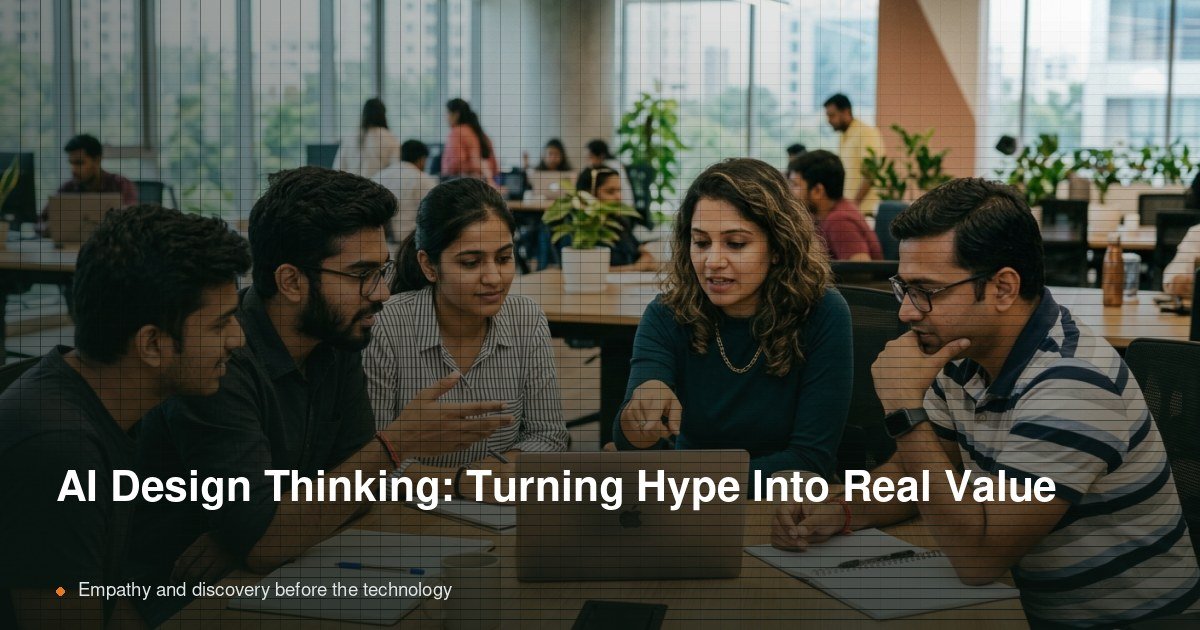
Most organisations do not have a shortage of AI tools. They have a shortage of clarity about which problem those tools should actually solve. Leadership reads about generative AI, buys a licence, hands it to a team, and waits for transformation. What usually shows up instead is a slightly faster version of the same old process, applied to the wrong problem.
AI design thinking is the discipline of fixing that sequence: starting with a real human problem, then asking where AI genuinely helps, instead of starting with the technology and searching for a use case to justify it.
What Is AI Design Thinking?
AI design thinking combines the human-centred discovery process of design thinking with the capabilities of artificial intelligence, applied deliberately at each stage rather than bolted on afterward. It is not about using AI to automate the design process. It is about using design thinking discipline to make sure AI gets pointed at problems worth solving.
In practice this means empathy research still comes first, the problem is still defined in human terms before any technical scoping happens, and AI is brought in as a tool inside that process, not as the starting point for it.
How AI Strengthens Each Stage of Design Thinking
Empathise: Seeing Patterns at Scale
AI can process large volumes of customer feedback, support tickets, and survey responses far faster than a human team, surfacing patterns and sentiment that would take weeks to find manually. It does not replace direct observation and interviews, but it can point a research team toward where to look first.
Define: Sharpening the Problem Statement
Synthesising dozens of interview transcripts into a clear, shared problem statement is slow, careful work. AI can accelerate the first pass of that synthesis, clustering themes and drafting candidate problem statements for the team to critique, refine, and ultimately own.
Ideate: A Brainstorming Partner, Not a Replacement
Generative AI is genuinely useful as an ideation partner, producing a wide first pass of concepts quickly, including combinations a team might not reach on its own. The team's judgement still decides which ideas are worth prototyping. AI expands the option space; it does not choose the winner.
Prototype: Faster First Drafts
AI tools can turn a rough concept into a clickable wireframe or a draft narrative mockup in a fraction of the time manual prototyping takes, which means more concepts can be tested with real users before the team commits to one direction.
Test: Simulating and Spotting Friction Early
AI-assisted analytics can flag usability friction and drop-off patterns in test sessions faster than manual review, though nothing replaces watching a real person struggle with a prototype in person. AI narrows down where to look; humans still interpret why.
Why AI Alone Does Not Produce Innovation
The organisations most disappointed by their AI investment usually skipped the empathise and define stages entirely. They started with a capability, generate a summary, personalise a message, automate a workflow, and went looking for somewhere to apply it, rather than starting with a validated problem and asking whether AI was the right tool to solve it.
This produces AI features nobody asked for, bolted onto products that did not need them, while the actual friction customers experience goes unaddressed. Design thinking discipline is what prevents that gap: it forces the team to prove the problem is real before choosing the solution.
A Practical Framework for AI Opportunity Discovery
- Start with a documented, evidence-based customer or employee problem, not a technology capability.
- Map where AI could plausibly help across the empathise, define, ideate, prototype, and test stages.
- Prototype the smallest possible version of the AI-assisted solution and test it with real users quickly.
- Keep a human in the loop for judgement calls, ethical review, and final decisions throughout.
- Measure the business outcome the AI was meant to improve, not just usage of the AI feature itself.
The Business Case for Doing This Properly
Leadership teams often ask for an ROI figure before approving an AI initiative, and the honest answer is that ROI is impossible to forecast accurately until the problem itself has been validated. What can be forecast is risk reduction: a small, evidence-based pilot costs a fraction of a full platform rollout, and it tells you within weeks whether the assumption behind the investment actually holds, before the larger budget commitment is made.
Ethics and Human Oversight
AI design thinking also carries a responsibility that pure technology adoption often skips: actively checking for bias in the data AI is trained on, protecting user privacy in how that data is used, and keeping a human accountable for decisions that affect people's outcomes. Speed is not worth much if it also means fewer people trust the result.
Where to Start
The fastest path to real AI value is rarely a large platform rollout. It is usually a focused, short workshop that identifies one validated opportunity, tests it small, and scales only what works. Human Design Thinking's AI Suite learning program runs exactly this kind of structured discovery, pairing AI capability with genuine human-centred research.
Frequently Asked Questions
Can AI do design thinking?
AI can support several stages of design thinking, particularly synthesising research and generating a wide first pass of ideas, but it cannot replace the human judgement, direct empathy, and ethical accountability that design thinking depends on. It is a tool inside the process, not a substitute for it.
What are the 5 stages of design thinking?
The five stages are Empathise, Define, Ideate, Prototype, and Test. They are commonly shown as a linear sequence but are used iteratively in practice, with teams looping back to earlier stages as they learn more.
What are 7 types of AI?
Common classifications include reactive machines, limited memory systems, theory of mind AI (largely theoretical), self-aware AI (theoretical), narrow AI, general AI, and generative AI, ranging from today's widely deployed systems to concepts that do not yet exist in practice.
What are the three pillars of AI?
A widely used framing describes the three pillars as data, algorithms, and computing power, the raw material, the method, and the infrastructure that together make modern AI systems possible.
What are the big 3 AI tools currently used in business?
Large language model assistants, generative image and design tools, and AI-powered analytics or research synthesis platforms are the three categories most commonly adopted in business design and innovation work today.
Is AI design thinking only for tech companies?
No. Any organisation dealing with large volumes of customer feedback, complex service processes, or repetitive research synthesis can apply AI design thinking, including retail, healthcare, financial services, and education.
Does using AI in design thinking replace user research?
No. AI can accelerate the synthesis of research findings, but direct observation, interviews, and testing with real users remain essential. AI cannot experience the emotional and contextual nuance that in-person research surfaces.
What is the biggest risk of AI design thinking done badly?
The biggest risk is skipping empathy and problem validation entirely, using AI to build a plausible-looking solution to a problem that was never confirmed to exist, which produces polished features that customers do not actually need.
How long does an AI opportunity discovery workshop typically take?
Focused opportunity workshops typically run from a few hours to two days, depending on scope, while a full discovery-to-prototype cycle for a validated AI use case usually takes several weeks of iterative testing.
What skills does a team need to practise AI design thinking well?
Teams need the same core design thinking skills, empathy, synthesis, and structured ideation, plus a working understanding of what AI tools can and cannot reliably do, and enough ethical awareness to catch bias or privacy risk before it reaches users.