
A quick search for a systems thinking course returns two very different kinds of results: self-paced online courses that explain feedback loops and causal diagrams in a few hours of video, and live, applied workshops that put a team through the discomfort of mapping a real business problem together. Both are called systems thinking training. They build very different skills.
This article compares the two formats honestly, explains what systems thinking actually is, and lays out what genuinely builds the capability rather than just the vocabulary.
What Is Systems Thinking?
Systems thinking is a way of understanding a problem by looking at how its parts interact and influence each other over time, rather than analysing each part in isolation. Where linear thinking asks "what caused this?", systems thinking asks "what pattern of relationships keeps producing this outcome, even after we fix the obvious symptom?"
It is built on a small set of durable concepts: feedback loops, where an action eventually influences the conditions that produced it; delays, where the effect of a decision shows up long after the decision itself; and leverage points, the small number of places in a system where a modest change produces a disproportionately large result.
Systems Thinking Course: What You Actually Get
Self-paced online courses, the kind widely offered through platforms like Coursera and similar providers, are genuinely useful for building vocabulary and conceptual understanding. They typically cover causal loop diagrams, stock-and-flow thinking, common system archetypes, and case studies drawn from business, environment, or public policy.
Their limitation is structural, not a flaw in the content itself: a course teaches you to recognise a feedback loop on a slide. It does not put you in a room with colleagues, mapping the actual, messy feedback loops inside your own organisation, where the stakes and the politics are real.
Systems Thinking Workshop: What Actually Builds the Skill
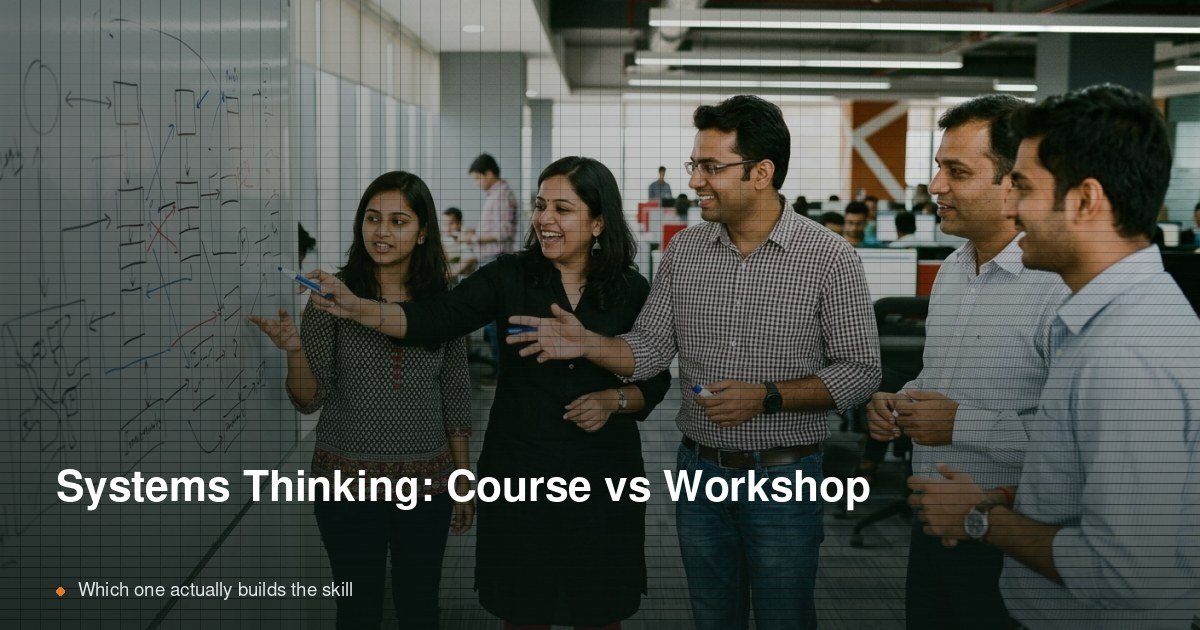
A live, applied workshop, by contrast, is built around one real business challenge the participants bring with them. The group maps the system together on the wall, surfaces disagreements about where the actual leverage points are, and tests their thinking against people in the room who know the operational reality that a generic case study cannot capture.
This is where the skill genuinely transfers. Reading about a feedback loop is conceptual knowledge. Standing in front of a whiteboard, realising that a policy your own team introduced two years ago is quietly reinforcing the exact problem you are now trying to solve, is a different kind of learning entirely, and it is far more likely to change how someone approaches the next problem.
Systems Thinking Course vs Workshop: A Direct Comparison
- Course: builds vocabulary and conceptual fluency at low cost and flexible pace. Workshop: builds applied capability through a real, live problem.
- Course: uses generic case studies. Workshop: uses your organisation's actual system, with real stakes and real politics.
- Course: individual learning, limited peer challenge. Workshop: group mapping, with disagreement that sharpens the analysis.
- Course: good first step for individuals building foundational knowledge. Workshop: better for teams that need to align on a shared, complex problem.
- Course: knowledge retention depends on self-discipline. Workshop: retention is reinforced by immediate, high-stakes application.
Which One Should You Choose?
If the goal is personal, foundational understanding, a well-structured online course is a reasonable and inexpensive starting point. If the goal is organisational, a team or leadership group that needs to genuinely see a complex problem differently and act on that new view together, a live applied workshop is what actually moves the needle. The two are not competitors. A course is a reasonable warm-up before a workshop, not a substitute for it.
What a Strong Systems Thinking Program Should Include
- A structured introduction to feedback loops, delays, and leverage points, so the vocabulary is shared before the mapping starts.
- Hands-on modelling tools, including causal loop diagrams participants build themselves, not just review.
- Application to a real, current business challenge the organisation is actually facing.
- A facilitated process for identifying weak links and genuine leverage points, not just describing the system.
- A path from insight to action, so the mapping exercise produces a concrete next step, not only a diagram on the wall.
How Systems Thinking Connects to AI and Change Work
Systems thinking is not a standalone skill. It sharpens change management, because a change that ignores the wider system it sits inside usually gets quietly undone by that system within a year. It also sharpens AI opportunity discovery, because the most valuable AI use cases are often found at genuine system leverage points, not at the most visible symptom. Human Design Thinking's Systems Thinking learning program builds systems thinking through exactly this applied, workshop-based format, using participants' real business challenges as the material.
Frequently Asked Questions
How to become a systems thinker?
Systems thinking develops through repeated practice: deliberately asking what feedback loops sustain a problem instead of jumping to the first visible cause, mapping real challenges rather than only studying theory, and seeking out disagreement from people who see the system differently than you do.
Is there a free course on systems thinking available?
Yes. Several universities and platforms, including edX and Coursera, offer free or audit-access systems thinking courses that cover the foundational concepts, such as feedback loops and causal diagrams, without cost.
Who are some famous systems thinkers?
Notable figures include Jay Forrester, who founded system dynamics at MIT, Donella Meadows, known for her widely cited work on leverage points, and Peter Senge, whose book on the learning organisation brought systems thinking into mainstream management practice.
What is systems thinking?
Systems thinking is an approach to understanding complex problems by examining how the parts of a system interact and influence one another over time, rather than analysing each part in isolation, with particular attention to feedback loops, delays, and leverage points.
Who is considered the father of systems thinking?
Jay Forrester, an MIT professor who developed system dynamics in the 1950s and 60s, is widely credited as the founder of modern systems thinking as a formal discipline, though the underlying ideas draw on earlier work in cybernetics and general systems theory.
How do I know if I am a systems thinker?
Common indicators include instinctively asking what caused a recurring problem to keep recurring rather than accepting the first explanation, noticing unintended consequences of decisions before they happen, and being comfortable holding several interacting factors in mind at once instead of isolating a single cause.
What kind of people are systems thinkers?
Systems thinkers tend to be comfortable with ambiguity, curious about second- and third-order effects, and more interested in patterns and relationships than in isolated facts. The skill is learnable rather than an innate personality trait.
Are systems thinkers rare?
The formal skill is less common than the intuition for it. Many people notice patterns and unintended consequences naturally but have never been taught the structured tools, such as causal loop diagrams, to map and communicate what they are sensing.
What is an example of systems thinking?
A retailer notices customer complaints rising and, instead of only training staff to be friendlier, maps the system and finds that an inventory policy set to reduce warehousing cost is causing frequent stockouts, which is the real driver of frustrated customers and short-tempered staff.
How long does it take to see results from systems thinking training?
Conceptual fluency can develop within a single workshop. Genuine organisational impact, where teams consistently apply the thinking to real decisions, typically takes three to six months of repeated practice on live business problems.