

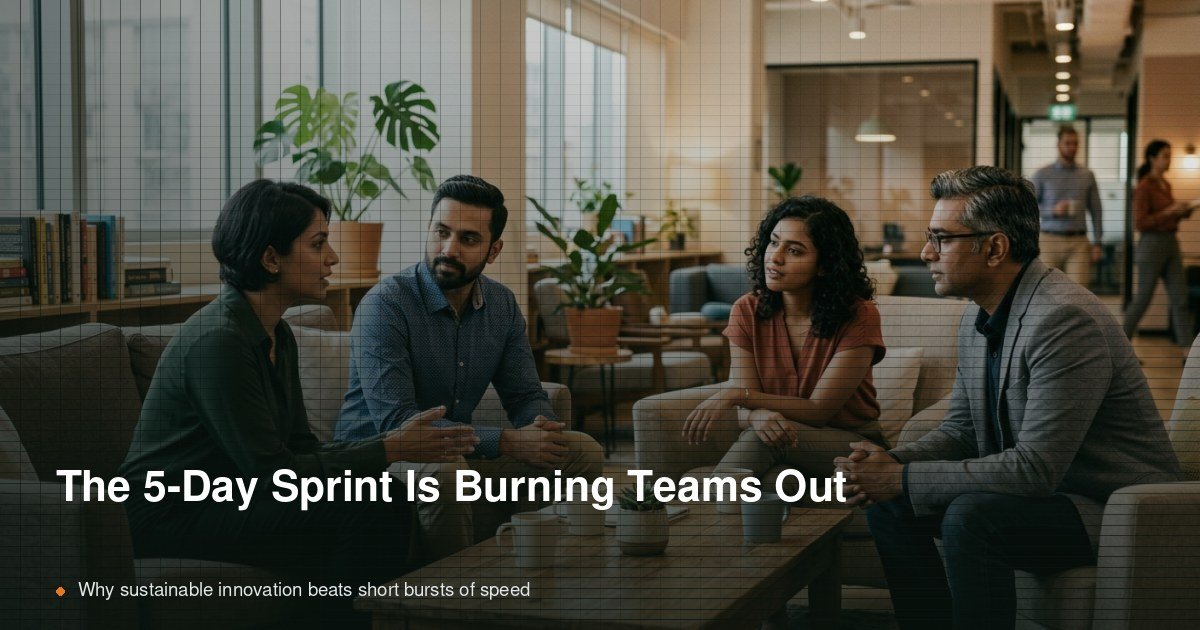
For nearly a decade, the 5-day design sprint has been positioned as a gold standard for innovation.
It promised speed, clarity, and alignment. It helped teams move from ideas to prototypes in one focused week. It reduced endless discussions and accelerated decision-making.
Yet today, many organisations are facing a paradox.
Despite running more sprints than ever:
- Teams are exhausted
- Innovation outcomes are inconsistent
- Products launch quickly but struggle to scale or sustain impact
This has led senior leaders, product heads, and transformation teams to ask a critical question:
Is the 5-day sprint still fit for today's complexity?
Increasingly, the answer is no.
This article explains why the traditional sprint model is losing relevance and how sustainable innovation culture strategies are emerging as the more effective alternative for long-term growth.
Executive Summary: Why the 5-Day Sprint Is Losing Effectiveness
The 5-day sprint was designed for speed. Modern innovation requires sustainability.
Today's challenges involve:
- System-level complexity
- Organisational change
- Human behaviour, not just usability
Short, high-intensity sprint cycles often create momentum without continuity. They deliver outputs but fail to build long-term capability.
Sustainable innovation culture strategies focus on embedding innovation into how teams think, decide, and learn, rather than treating it as a time-bound activity.
Why the 5-Day Sprint Worked in the Past
When first introduced, the sprint addressed three real organisational problems:
- Slow decision-making
- Over-analysis without action
- Lack of alignment across functions
The sprint model helped teams:
- Align quickly around a shared problem
- Test assumptions early
- Reduce the cost of failure
For early-stage products or clearly defined challenges, this approach delivered strong results.
However, organisational contexts have evolved.
Why the 5-Day Sprint Struggles in Today's Environment
1. Teams Are Operating Under Constant Cognitive Load
Modern product and innovation teams rarely start with a clean slate.
They manage:
- Multiple stakeholders
- Continuous delivery expectations
- Global collaboration across time zones
- Performance pressure alongside experimentation
Adding an intense sprint on top of this workload often increases fatigue rather than insight.
Innovation suffers when teams are mentally depleted.
2. Complex Problems Cannot Be Compressed Into One Week
Many of today's innovation challenges involve:
- Behavioural change
- Policy or compliance constraints
- Legacy systems
- Cultural resistance
These problems require:
- Iterative sense-making
- Time for reflection
- Ongoing stakeholder alignment
A single sprint cycle often oversimplifies these realities, leading to superficial solutions.
This is why organisations are shifting toward sustainable innovation culture strategies that prioritise depth over speed.
3. Sprint Outputs Lack Long-Term Ownership
A common pattern seen across organisations:
- A sprint produces a prototype
- Insights are documented
- The sprint team disbands
Execution moves to another group, often with limited context.
This breaks accountability and weakens learning continuity. Innovation becomes episodic rather than cumulative.
The Hidden Cost of Sprint-Driven Innovation: Team Burnout
Repeated sprint cycles can unintentionally create:
- Decision fatigue
- Emotional exhaustion
- Performative creativity
When teams are expected to be creative on demand, innovation becomes transactional.
Over time:
- Engagement declines
- Risk-taking decreases
- Teams revert to safe, incremental ideas
Sustainable innovation depends on energy, trust, and psychological safety, not pressure.
Why Speed Alone Is No Longer a Competitive Advantage
Speed has become a baseline expectation.
What differentiates high-performing organisations today is:
- Learning velocity
- Strategic clarity
- Cultural resilience
- Decision quality over time
Sustainable innovation culture strategies shift the focus from "how fast can we test?" to "how well can we learn and adapt?"
What Is Replacing the 5-Day Sprint?
The future of innovation is not slower, but more deliberate.
Leading organisations are moving toward models that emphasise:
- Continuous discovery
- Distributed ownership
- Systemic capability building
This evolution does not reject design thinking. It matures it.
Sustainable Innovation Culture Strategies for Modern Organisations
Continuous Discovery Instead of Event-Based Research
Rather than conducting discovery in bursts, teams integrate learning into daily work.
This includes:
- Regular user conversations
- Ongoing feedback loops
- Small, low-risk experiments
Continuous discovery reduces rework and improves decision confidence.
Innovation as an Organisational System
Innovation becomes sustainable when it is supported by:
- Clear decision-making frameworks
- Shared learning metrics
- Leadership sponsorship
- Time allocated for reflection
Workshops alone do not create innovation capability. Systems do.
This is the foundation of effective, sustainable innovation culture strategies.
Psychological Safety as a Strategic Enabler
High-performing innovation cultures prioritise:
- Constructive dissent
- Open uncertainty
- Learning from failure without blame
When people feel safe, they think better.
Psychological safety is not a "soft" concept; it directly impacts innovation outcomes.
Fewer Ideas, Higher Quality Thinking
Instead of maximising idea volume, leading teams:
- Spend more time framing the problem
- Examine second-order effects
- Challenge assumptions early
Depth leads to clarity. Clarity leads to stronger products.
Why Products Still Fail Despite "Following the Process"
Many products that fail have:
- Passed sprint tests
- Received positive user feedback
- Met delivery timelines
They fail because:
- Organisational alignment was weak
- Execution lacked long-term ownership
- Learning stopped after validation
Sustainable innovation culture strategies ensure that insight continues beyond the initial test phase.
The Indian Enterprise Context
In India, innovation operates within:
- Cost-efficiency expectations
- Large-scale delivery models
- Hierarchical decision structures
Directly replicating Silicon Valley sprint models often leads to friction.
Successful Indian organisations adapt innovation methods to:
- Distributed teams
- Long-term capability building
- Context-sensitive leadership
Sustainability, not spectacle, drives results.
How Leaders Can Enable the Shift
Leadership behaviour sets the tone.
Effective leaders:
- Protect thinking time
- Reward learning, not just delivery
- Reduce urgency-driven decisions
- Model curiosity over certainty
This creates conditions where sustainable innovation culture strategies can thrive.
Key Signals That a Shift Is Needed
Organisations should reassess their approach if:
- Teams feel drained after innovation initiatives
- Insights fail to translate into action
- The same problems reappear repeatedly
- Innovation feels rushed rather than meaningful
These are indicators of systemic imbalance, not failure.
The Future of Innovation Is Sustainable by Design
The next generation of innovation leaders will not be defined by speed alone.
They will be defined by their ability to:
- Build learning organisations
- Maintain team energy
- Navigate complexity with clarity
- Deliver impact over time
This is the promise of sustainable innovation culture strategies.
Frequently Asked Questions
Is the 5-day design sprint obsolete?
No, but it is no longer sufficient on its own. It should be used selectively within a broader innovation system.
What are sustainable innovation culture strategies?
They are approaches that embed innovation into organisational behaviour, decision-making, and learning over time.
How do these strategies reduce burnout?
By replacing high-intensity bursts with continuous learning and realistic pacing.
Can large enterprises adopt this approach?
Yes. Large organisations benefit significantly because sustainability prevents innovation fatigue at scale.
How long does it take to see results?
Most organisations see measurable improvements within 6–12 months when leadership commitment is consistent.
Is speed still important in innovation?
Yes, but only when balanced with depth, clarity, and sustainability.