
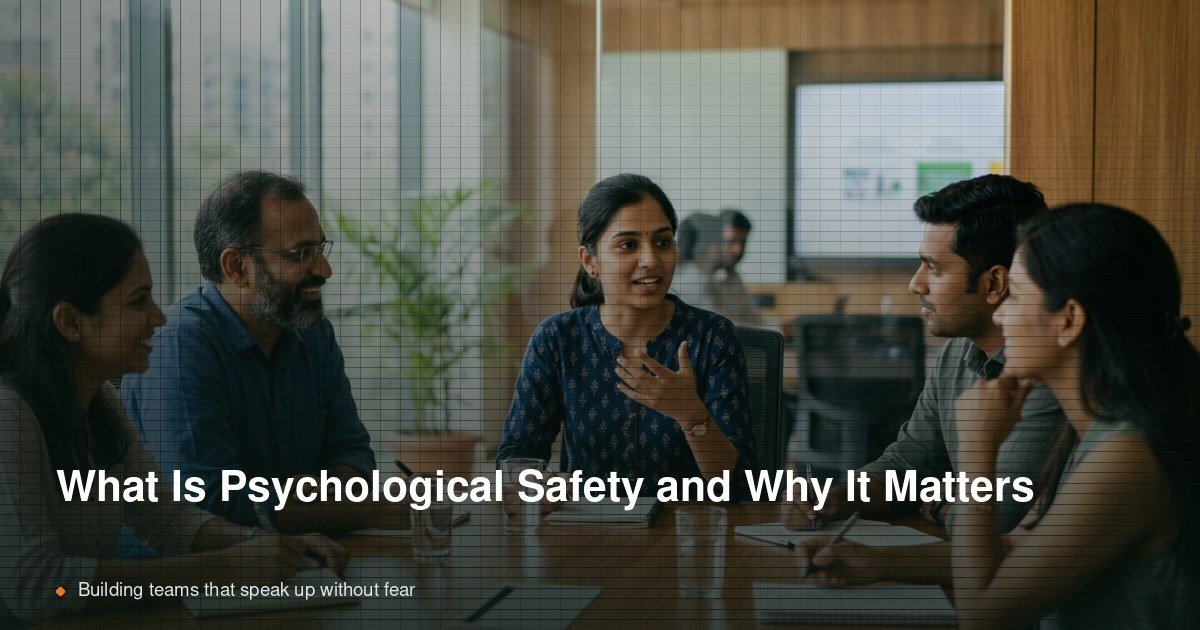
A team can have talented people, clear goals, and a reasonable budget, and still underperform for one quiet reason: nobody feels safe enough to say the uncomfortable thing out loud. Psychological safety is the difference between a meeting where problems surface early and a meeting where everyone nods and the real issue shows up three weeks later as a missed deadline.
This article explains what psychological safety is, where the concept comes from, why it matters more than most soft-skill training gets credit for, and what leaders can actually do to build it, not as a poster on the wall, but as a working condition on the team.
What Is Psychological Safety?
Psychological safety is the shared belief within a team that it is safe to take interpersonal risks, to speak up with an idea, ask a question, admit a mistake, or challenge a decision, without fear of embarrassment, punishment, or being seen as incompetent. The term was popularised by Harvard Business School professor Amy Edmondson, whose research found that the highest-performing hospital teams reported more errors, not fewer, because they felt safe enough to surface them.
It is often confused with being nice or avoiding conflict. It is closer to the opposite. Psychologically safe teams have more disagreement, not less, because people trust that disagreement will be treated as useful rather than dangerous.
Why Psychological Safety Matters
Teams without it pay a quiet, compounding cost. Problems get hidden until they are too large to hide. Junior employees stop offering ideas because an early one was dismissed in front of the group. Good people leave not because the work was hard, but because speaking up felt risky every single time.
- Innovation improves because half-formed, risky ideas actually get said out loud instead of self-censored.
- Errors surface earlier, while they are still cheap and easy to fix.
- Retention improves because people do not have to spend energy managing how they are perceived on top of doing the actual work.
- Decision quality improves because dissent reaches the decision-maker before the decision is finalised, not after.
The Four Stages of Psychological Safety
Psychological safety is not a single switch that is either on or off. It typically builds in stages, and a team can be strong at one stage while still missing another.
Inclusion Safety
The basic sense of belonging: people feel accepted as part of the team, not tolerated at its edge.
Learner Safety
People feel safe to ask questions, experiment, and make mistakes while they are learning something new, without it being held against them.
Contributor Safety
People feel safe to use their skills and judgement to make a meaningful contribution, and to be recognised for it.
Challenger Safety
The hardest and most valuable stage: people feel safe to challenge the status quo, including decisions made by people more senior than them, when they believe it matters.
How Leaders Actually Build Psychological Safety
Psychological safety is built through repeated, specific behaviour, not a one-off workshop. A handful of practices consistently move the needle.
Model Fallibility First
A leader who openly says "I got that wrong" or "I don't know, let's find out" gives everyone else permission to do the same. This single behaviour does more than most training programs combined.
Respond to Bad News Well, Every Time
How a leader reacts the first time someone reports a real mistake sets the norm for the entire team. A defensive or punitive reaction, even once, teaches everyone to hide the next one.
Ask Genuinely Open Questions
"What are we missing?" invites a different kind of answer than "Does everyone agree?" The first assumes blind spots exist. The second assumes consensus is the goal.
Separate the Idea From the Person
Critique the proposal, not the person who raised it, and say so explicitly when a bold or half-formed idea gets shared. That explicit acknowledgement is what makes the next person willing to take the same risk.
Common Barriers to Psychological Safety
Even well-intentioned teams run into predictable obstacles: a hierarchical culture where junior staff have never been asked their opinion, a history of ideas being publicly shot down, performance systems that punish visible mistakes more than hidden ones, and leaders who say they want feedback but visibly bristle when they receive it. Naming these barriers openly is usually the first step to removing them.
Psychological Safety and Design Thinking
Design thinking workshops depend entirely on psychological safety to work. Brainstorming only produces honest, risky ideas when people trust the room. Prototyping only surfaces real flaws when people are willing to say a concept is not working. Human Design Thinking's Psychological Safety learning program builds this condition deliberately, using structured exercises rather than hoping it develops on its own.
Frequently Asked Questions
What are the four types of psychological safety?
The four commonly cited stages are inclusion safety, learner safety, contributor safety, and challenger safety, each building on the one before it, from simply feeling accepted on the team through to feeling safe enough to challenge the status quo.
What are the 5 C's of psychological safety?
Different practitioners define this slightly differently, but a common version covers Candour, Curiosity, Care, Courage, and Consistency, the behaviours leaders repeat to build and protect a psychologically safe environment over time.
What's another term for psychological safety?
Related terms include interpersonal trust, team safety, and speak-up culture. None of these is a perfect synonym, but they all point toward the same underlying idea: people feel safe taking a social risk in front of their colleagues.
What are some psychological safety examples?
Examples include a junior employee questioning a senior leader's decision in a meeting without repercussion, a team openly discussing what went wrong in a project retrospective, and someone admitting they don't understand a task and asking for help without it affecting how they are perceived.
What are the 5 common barriers to psychological safety?
Common barriers include hierarchical cultures that discourage junior voices, past experiences of ideas being dismissed or mocked, performance systems that punish visible errors, leaders who say they want feedback but react defensively to it, and teams that have never explicitly discussed psychological safety as a shared responsibility.
Is psychological safety the same as being comfortable?
No. Psychologically safe teams often have more direct disagreement and more discomfort in the moment, because people are willing to raise hard truths. Comfort in the sense of avoiding all friction is closer to the opposite of psychological safety.
Can psychological safety be measured?
Yes, typically through anonymous team surveys that ask people to rate statements like "It is safe to take a risk on this team" or "Mistakes are held against me," alongside observed signals such as how often people speak up in meetings or report problems early.
Does psychological safety mean no accountability?
No. High-performing psychologically safe teams pair safety with high standards. People are still held accountable for outcomes; they are simply not punished for the honesty, questions, or early warnings that help the team meet those standards.
How long does it take to build psychological safety on a team?
It builds gradually through repeated small moments, typically becoming noticeably stronger over three to six months of consistent leadership behaviour, and it can be damaged much faster by a single poorly handled reaction to bad news.
Why is psychological safety important for innovation?
Innovation requires sharing half-formed, risky, and sometimes wrong ideas before they are proven. Teams without psychological safety self-censor those ideas before they are ever said out loud, which quietly removes most of the raw material innovation depends on.