
Organizations have become increasingly sophisticated at identifying high-potential employees. The harder question is what happens after the identification.
A high-potential employee is not automatically ready for a larger role. Nor does completing a leadership programme demonstrate that someone can operate effectively in a more complex environment. Talent development becomes strategic when it closes the gap between potential and demonstrated capability.
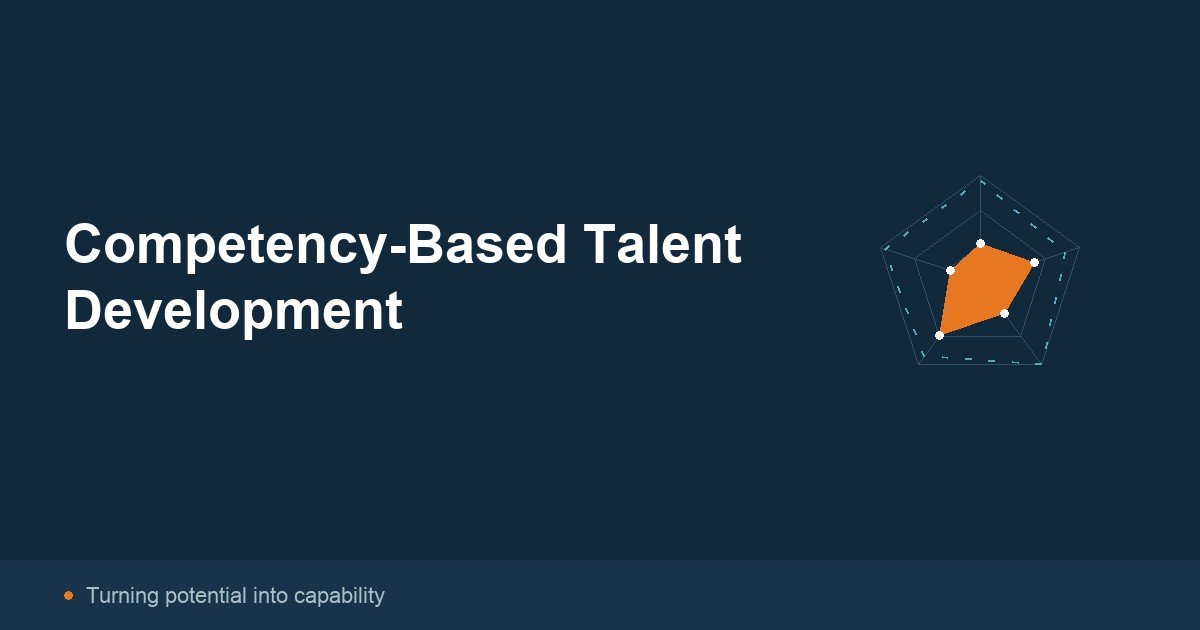
This is the central idea behind competency-based talent development: development should be anchored in the competencies and skills that matter for future performance, then built through deliberate experiences, practice, feedback and evidence.
Potential is not the same as readiness
Potential is a forward-looking judgement about what someone may be able to handle. Readiness is a judgement about whether the person can perform the demands of a role or level now, with an acceptable level of risk.
The distinction is important because succession, promotion and talent decisions often become distorted when potential is treated as readiness. A better model asks two separate questions: What could this person become capable of doing? And what evidence do we have that they can do it today?
What is competency-based talent development?
Competency-based talent development is an approach that uses defined capabilities and observable behaviors to diagnose development needs, design development experiences and evaluate progress.
The development plan should answer four questions: What capability matters? Where is the gap? What experience will build it? What evidence will show that it has improved?
Why training alone is not enough
A course can introduce a concept, provide a framework or build knowledge. But many competencies require practice in context. Strategic judgement, stakeholder management, influence, leading through ambiguity or managing a transformation are learned through application.
A stronger development architecture therefore uses a portfolio of interventions.
- Formal learning for concepts and models.
- Stretch assignments for application.
- Project leadership for real accountability.
- Cross-functional exposure for enterprise perspective.
- Coaching and mentoring for reflection and judgement.
- Feedback and observation for behavioral reinforcement.
- Role rotations or mobility for broader experience.
A practical competency-based development cycle
Step 1: Define the future performance standard
Start with the role, level or capability the organization is trying to build. Focus on what success will require in the future rather than copying today's job description.
Step 2: Assess current evidence
Use multiple sources of evidence: performance outcomes, manager observation, structured assessment, project outcomes, stakeholder feedback, certifications and demonstrated application. Avoid relying on self-ratings alone.
Step 3: Separate gaps from preferences
Not every development aspiration is a business-critical gap. Prioritize capabilities that materially affect current performance, future role readiness or strategic capability.
Step 4: Design experiences, not just courses
For each priority gap, specify an experience that creates opportunities to practice the capability. The experience should be observable and ideally tied to a real business outcome.
Step 5: Review evidence of growth
Development should produce new evidence. Has the person handled a more complex stakeholder? Led a cross-functional initiative? Taken a difficult decision? Managed a larger scope? The assessment loop should capture these changes.
How competency-based talent development supports succession
Succession planning often exposes readiness gaps. Competency-based development provides the mechanism for addressing them. Instead of saying "Person A is a potential successor but not ready," the organization can identify the precise capabilities and experiences required to increase readiness.
This turns succession from a list of names into a development system.
How it supports internal mobility
A competency and skills lens can also reveal adjacent talent. Someone may not have held the target job before but may already possess much of the underlying capability. Development can then focus on the few missing areas rather than rebuilding the person from scratch.
What makes a good individual development plan?
A useful IDP should be specific enough to drive behavior and simple enough to review regularly. It should connect business priorities to individual development.
- Priority competency or skill.
- Current evidence and gap.
- Target proficiency or behavior.
- Development experience.
- Owner and support required.
- Evidence of application.
- Review date and success measure.
Measures that matter
Talent development can be measured without reducing it to attendance. Useful indicators include improvement in assessed proficiency, successful completion of stretch assignments, readiness movement, internal fill rates, critical-skill coverage and retention of key talent.
The objective is to know whether capability is actually becoming stronger, not merely whether a programme was delivered.
The bigger opportunity
Competency-based talent development can become the bridge between skills strategy and human development. It connects what the organization needs with what people must learn, practice and demonstrate.
At HDI, we see the strongest talent systems as those that treat development as an organizational capability-building process rather than an L&D activity. The question is not "How much training did people receive?" It is "What can the organization and its people do now that they could not do before?"
Frequently Asked Questions
What is competency-based talent development?
It is a talent-development approach that identifies the competencies and skills required for future performance, assesses current evidence, and builds those capabilities through targeted learning and real work experiences.
How is competency-based development different from traditional training?
Traditional training often focuses on course participation and knowledge acquisition. Competency-based development focuses on demonstrated capability and uses experiences, practice, feedback and application in addition to formal learning.
How can competency-based development improve succession planning?
It converts readiness gaps into specific development actions and experiences, making succession planning more actionable and easier to track over time.
Sources and Further Reading
- Mercer, Skills-Powered Talent Practices — https://www.mercer.com/en-in/solutions/talent-and-rewards/skills-based-talent-practices/
- Mercer, 2025/2026 Skills Snapshot Survey — https://www.mercer.com/en-us/insights/talent-and-transformation/skill-based-talent-management/rebuilding-reward-and-career-frameworks-based-on-skills/
- World Economic Forum, Future of Jobs Report 2025 — https://www.weforum.org/publications/the-future-of-jobs-report-2025/