
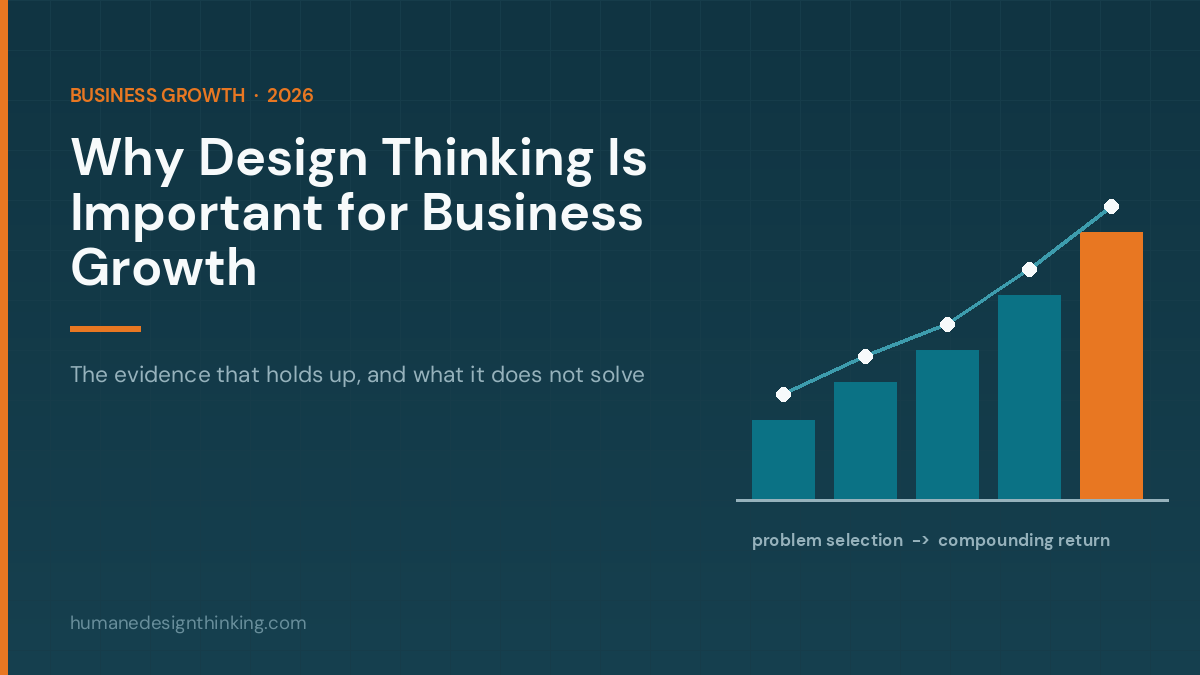
The case for design thinking in 2026 is no longer that it makes companies more creative. It is that the cost of building the wrong thing has collapsed to near zero, and the cost of choosing the wrong thing has not moved at all. When AI compresses the effort of producing software, campaigns, decks and prototypes, the binding constraint on growth shifts upstream — to problem selection. That is the argument this article makes, along with an honest audit of which supporting statistics survive scrutiny and which do not.
The short answer: Design thinking matters for business growth because it attacks the single most expensive failure mode in modern organisations — confidently building things nobody needed. The evidence that holds up best is McKinsey’s finding that top-quartile design performers outgrew industry peers by 32 percentage points in revenue growth over five years, and Forrester’s independent estimate of a 71–107% ROI on mature design thinking practice. In 2026 the argument sharpens: with AI reducing the cost of production, competitive advantage moves to the quality of the problem you choose, the evidence behind it, and how fast you can kill the wrong bets.
What actually changed by 2026
Three shifts, all of which move value upstream from execution to judgement.
Production got cheap; discrimination did not. Generative tools compress the time between an idea and a plausible artefact. This is genuinely useful and genuinely dangerous: it removes the natural friction that used to kill weak ideas before they consumed a quarter. When a mediocre concept can be prototyped in an afternoon, the organisation’s ability to say no becomes the scarce capability.
Leaders know they are not ready. McKinsey’s State of Organizations 2026, drawing on more than 10,000 senior executives across 15 countries and 16 industries, found that 72% of leaders say their organisations are not fully ready for the changes ahead — and that even among optimistic leaders, only about a third feel prepared. The report frames the shift as one from short-term resilience to sustained performance, with change becoming a permanent operating state rather than an episodic programme.
Skills are moving faster than structures. The World Economic Forum’s Future of Jobs Report 2025 found that workers can expect 39% of their existing skill sets to be transformed or outdated between 2025 and 2030, with analytical thinking the top core skill for employers and creative thinking among the fastest risers. Design thinking sits directly on that axis: it is a structured method for applying analytical and creative judgement to ambiguous problems.
Put together: the organisations that grow are not the ones producing most. They are the ones producing least waste.
The evidence audit: which claims survive scrutiny
Almost every article on this subject recycles the same handful of numbers, and several of them fall apart on inspection. If you are building an internal case, the weak ones are liabilities in front of a sceptical CFO, not assets.
| Claim as usually cited | Primary source | What the method really was | Verdict |
|---|---|---|---|
| Top design performers grew revenue 32pp faster, TRS 56pp higher | McKinsey, The Business Value of Design, 2018 | Over two million financial data points and 100,000 design actions across 300 companies over five years | Strong — the best available |
| Over 40% of companies never speak to end users during development | McKinsey, same study | Same dataset and survey base | Strong |
| Design thinking ROI of 71–107% | Forrester, The ROI of Design Thinking, 2019 | Forrester’s own syndicated research, not vendor-commissioned | Strong — use this with finance |
| Design thinking delivers 301% ROI | Forrester Total Economic Impact, commissioned by IBM, 2018 | A composite organisation modelled from four client interviews plus surveyed executives | Moderate — directional, vendor-commissioned |
| 80% of software features are rarely or never used | Pendo, 2019 Feature Adoption Report | 615 subscriptions, customers of over a year, methodology published | Strong for the waste argument |
| 64% of features are rarely or never used | Jim Johnson, Standish Group, XP 2002 keynote | A study of four internal applications; routinely misattributed to the CHAOS Report | Weak — avoid |
| Design-led firms beat the S&P 500 by 228% | DMI / Motiv Strategies Design Value Index | A hand-picked portfolio of 16 companies including Apple and Nike; the figure shifts between editions | Weak — selection bias, avoid |
| 72% of leaders say their organisation is not ready for change | McKinsey, State of Organizations 2026 | Survey of 10,000+ executives, 15 countries, 16 industries | Strong, though self-reported |
| 39% of core skills change by 2030 | WEF, Future of Jobs Report 2025 | Survey of over 1,000 global employers representing 14m+ workers | Strong |
How to use this table. Lead with McKinsey and the independent Forrester range. Use Pendo for the waste argument. Leave the 64% and the 228% out entirely unless you are prepared to state their limitations — both are widely repeated and both collapse under a single question from an analyst.
Five mechanisms by which design thinking produces growth
“It drives growth” is not an argument; it is a slogan. There are five distinct mechanisms, and they behave differently. Most organisations can only credibly claim two or three at a time.
| Mechanism | How it works | Typical lead time | How you would know |
|---|---|---|---|
| Revenue from better-fit offerings | Problems are selected from observed unmet need rather than internal request, so launches land in real demand | 2–4 quarters | Adoption at 30/90 days; share of revenue from products launched in last 24 months |
| Cost avoided through earlier kills | Weak concepts are falsified during prototyping instead of after build | 1–2 quarters | Ideas killed before build; rework rate; scope reversals |
| Speed from reduced rework | Fewer things get built twice because acceptance criteria are grounded in tested evidence | 2–3 quarters | Cycle time from concept to release; defect density in user-facing flows |
| Retention and lifetime value | Friction is removed at the points where customers actually leave, not where the org assumes they do | 3–6 quarters | Churn by cohort; task success rate; customer lifetime value movement |
| Talent and culture | Teams get a shared method for disagreeing productively about ambiguous problems | 4+ quarters | Voluntary attrition in product and design roles; internal mobility |
The second mechanism — cost avoided through earlier kills — is the one CFOs understand fastest and the one organisations measure least. A discovery practice that never stops anything is not doing discovery; it is doing justification. Track ideas killed before build explicitly, and celebrate it, or teams will learn that the socially safe finding is always yes, proceed. The commercial logic is developed further in our piece on increasing customer lifetime value with design thinking.
Where it applies across the business
Design thinking is frequently mistaken for a product-team activity. In practice the highest-return applications are often outside product entirely, because that is where nobody has ever applied structured problem-framing.
| Function | The recurring problem | What design thinking changes |
|---|---|---|
| Product and engineering | Backlogs fill with requests rather than validated problems | Evidence requirement before items enter delivery — see our agile integration guide |
| Service and operations | Journeys are optimised department by department; customers experience the seams | End-to-end service design across human and digital touchpoints |
| Finance | Planning cycles are built around the reporting calendar rather than decision needs | Stakeholder-need-led planning; see our FP&A guide for CFOs |
| People and culture | Policies designed for compliance, experienced as friction | Employee experience designed around real moments that matter |
| Sales and marketing | Messaging built from internal positioning rather than customer language | Narrative grounded in observed decision journeys; see business storytelling |
| Strategy | Options generated from within existing mental models | Structured divergence before convergence; systems thinking to see second-order effects |
What design thinking does not do
An honest case is more persuasive than a maximal one, and this is where most articles on the topic lose credibility.
Design thinking will not fix a broken business model. If unit economics are negative, better customer understanding tells you why customers like a product you cannot afford to sell. It will not substitute for distribution: a well-designed offering with no route to market still fails. It will not produce results in a quarter — the mechanisms table above shows lead times of two to six quarters, and anyone promising faster is selling a workshop.
It will also, reliably, reduce short-term throughput. Moving 10–15% of capacity into discovery means fewer features shipped this quarter. That is the honest trade, and it needs stating to leadership before you start rather than explaining afterwards. Expect roughly a quarter of apparent slowdown before rework begins falling.
Finally, it is not a substitute for domain expertise. Design thinking structures how expertise is applied to ambiguity; it does not manufacture expertise.
Seven failure modes
- Design thinking as an event. A workshop generates energy and a wall of sticky notes; nothing changes in the roadmap. Countermeasure: no workshop without a named decision it will inform and a date by which that decision is made.
- Empathy theatre. Interviews conducted, personas printed, strategy unchanged. Countermeasure: name what would have to be true for the organisation to change course before gathering data.
- The innovation lab in exile. A separate team does the interesting work; the core business is untouched. Countermeasure: embed the practice in a business line with P&L accountability from the start.
- Unchanged incentives. Teams still assessed on features shipped and projects launched per quarter. Countermeasure: change what leadership asks about in reviews before changing the process.
- No protected capacity. Discovery is expected in addition to a full delivery commitment. It does not happen. Countermeasure: reserve capacity explicitly and treat raiding it as a process breach.
- Scaling before proving. A firm-wide rollout with no internal reference case. Countermeasure: one team, one outcome, documented before-and-after numbers, then expand.
- Measuring activity instead of outcomes. Workshops run, people trained, ideas generated. None of these are results. Countermeasure: report adoption, rework and revenue movement, not participation.
Most of these are organisational rather than methodological. That is the honest headline of this whole field: the method is not difficult. The operating rhythm, incentives and leadership attention are where it lives or dies. This is the territory our leading a change and business agility programmes are built to address.
A 90-day sequence to build the case internally
Deliberately narrow. One team, one business line, one outcome — because an internal reference case is worth more than any external statistic.
| Phase | Focus | Concrete steps |
|---|---|---|
| Days 1–30 — Establish the baseline | Make current waste visible | Audit the last two quarters: what was launched, what is actually used, what was reworked. Pick one business outcome to replace a feature target. Form a small cross-functional trio. |
| Days 31–60 — Run one real loop | Prove the mechanics on a live problem | Frame one problem properly (user, need, insight). Test the three riskiest assumptions with lightweight prototypes. Kill at least one idea publicly and record what it saved. |
| Days 61–90 — Convert to rhythm | Turn a pilot into an operating habit | Attach an evidence requirement to items entering delivery. Switch one reported metric from output to outcome. Document before-and-after numbers as the internal case for team two. |
Ninety days will not transform an organisation. It produces one team with a working loop and a set of numbers your own CFO believes — which is what makes the second and third teams substantially easier to fund.
Frequently asked questions
Is design thinking still relevant in 2026, with AI doing so much of the work?
More relevant, not less. AI compresses the cost of producing solutions, which means the differentiating skill moves to deciding which solutions are worth producing. AI is also extremely good at generating plausible-sounding answers to badly framed questions — which raises, rather than lowers, the return on framing questions well.
What is the realistic ROI of design thinking?
Forrester’s independent research placed mature design thinking practice in a 71–107% ROI range. The widely cited 301% figure comes from a vendor-commissioned study of a modelled composite organisation and should be treated as directional. Quote the conservative number to your CFO; it is still an excellent return and it survives scrutiny.
How long before we see results?
Cost avoidance and rework reduction show within one to two quarters. Revenue effects from better-fit offerings typically take two to four quarters. Retention and culture effects take longer. Anyone promising revenue movement in a single quarter is describing a workshop, not a practice.
Does design thinking work for B2B, or only consumer businesses?
It works for both, and the mechanism is often stronger in B2B because buying committees are complex and internal assumptions about them are rarely tested. McKinsey’s design index results held across medical technology, consumer goods and retail banking — a mix of B2B and B2C.
Is this relevant for MSMEs and startups, or only large corporates?
Both, with different emphases. Smaller organisations have an advantage: fewer layers between research and decision, so evidence changes direction faster. The constraint is capacity, which usually means running discovery in short focused bursts rather than continuously. Our guide on how startups benefit from design thinking covers this.
How do we measure it without a large analytics function?
Three measures get you most of the way: adoption of what you launched at 30 and 90 days, rework as a share of delivery effort, and ideas killed before build. None of these require sophisticated instrumentation. All three are more informative than a satisfaction score.
What is the difference between design thinking and just talking to customers?
Talking to customers is an input. Design thinking is the discipline of synthesising those conversations into a framed problem, generating multiple competing solutions rather than the first plausible one, and testing them cheaply before committing. Most organisations already talk to customers; far fewer let what they hear change a decision.
Where to start
If you take one thing from this article, take the metric that almost nobody tracks: ideas killed before build. It is the cleanest single indicator of whether an organisation is actually learning or merely gathering evidence to justify decisions it had already made.
Start with one team, one properly framed problem, and one number your finance function believes. Then measure what you stopped building.
Humane Design helps corporates, MSMEs and funded startups turn design and innovation capability into measurable top-line and bottom-line movement. Explore our design thinking consulting and learning services, or see how we have delivered results across banking, energy, fintech, FMCG and retail case studies.