
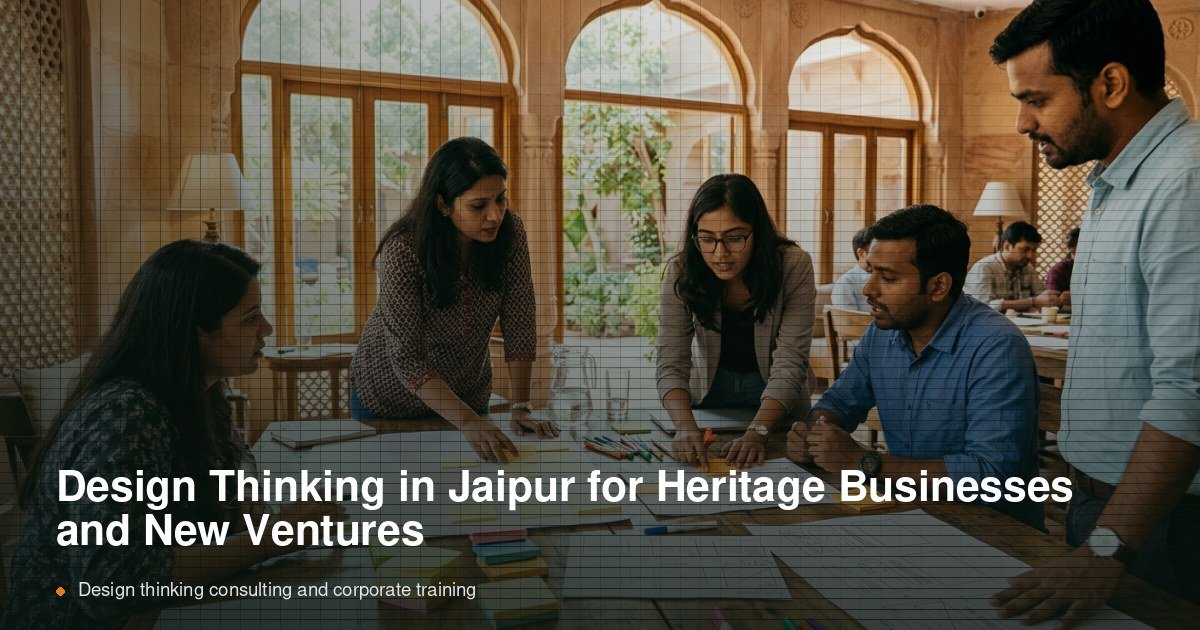
In short: Humane Design (HDI) helps Jaipur organisations turn deep craft and hospitality knowledge into a repeatable way of understanding customers and making decisions. We offer workshops, in-house team training programmes and consulting retainers for family businesses, consumer brands, hotels and IT teams, on-site at your premises or remotely.
Jaipur’s businesses have sold design for generations. Coloured gemstones are cut and set in its workshops, block-printed textiles come from Sanganer and Bagru, and blue pottery and handcrafted furniture travel to buyers across the world. The city knows how to make beautiful things.
Design thinking in Jaipur adds something different. It is less about how a product looks and more about how an organisation decides what to make, for whom, and how to serve them. Humane Design (HDI) works with jewellery houses, craft and consumer brands, hospitality groups and IT teams in Jaipur on-site at their premises or remotely, from our studio in Andheri West, Mumbai.
Why design thinking in Jaipur is not the same as craft design
Many Jaipur businesses have strong designers and karigars. Their skill lies in form, finish and material. Design thinking works one step earlier, on the business question: what does the customer value, what problem are they trying to solve, and which of our ideas should we test first?
The two work well together. A jewellery house that understands why a younger buyer chooses lab-grown stones, or why a gifting customer abandons an online order, can brief its designers far better. The craft stays the same. The decisions around it get sharper.
The method follows five steps: empathise, define, ideate, prototype and test. Each step is run through HDI’s toolkits for Design Thinking, Systems Thinking, Agility and Storytelling.
Gems, jewellery and handicrafts: from maker’s eye to buyer’s need
Export-led craft and jewellery businesses often learn about their customers second-hand, through agents, buyers or trade fairs. Domestic retail and direct-to-consumer channels change that. Brands now meet end customers directly, online and in stores, and need to understand them first-hand.
Typical problems we help these businesses work on include:
- Understanding what a new generation of buyers wants from a heritage brand, and what they find off-putting
- Redesigning the in-store or online buying journey for high-value, high-trust purchases
- Turning a range built for export buyers into a range that suits retail customers in India
- Connecting design, production and sales teams who currently plan in isolation
Our guide on how to find unmet customer needs covers the research methods we use in this kind of work.
Hospitality and tourism: the whole guest journey
Jaipur’s heritage hotels, palace properties and tour operators sell an experience, and that experience is only as strong as its weakest moment. A beautiful room does not make up for a confusing check-in, a slow transfer or a request that falls between departments.
A design thinking workshop in Jaipur for a hospitality team usually starts with the guest journey from first enquiry to the review left after departure. Front office, housekeeping, food and beverage and guest relations staff map it together, find the moments that matter most and prototype small changes they can test with real guests during live operations.
Seasonality adds a further layer. Teams that are stretched in the peak months have little time to reflect, so the quieter months are a good window to redesign the journey, train staff and pilot changes before the next busy season begins.
Family businesses and the move to professional management
Many Jaipur businesses are family-owned, and many are now bringing in professional managers or handing control to a new generation. That shift raises questions no spreadsheet can answer. How are decisions made? Who has authority over what? How do long-serving staff and new hires learn to trust each other?
We approach this as a design challenge. Through interviews and workshops, we help the family and senior team make their unwritten rules visible, test new ways of making decisions on a small scale and build a culture that keeps the business’s strengths while adding structure. Our leading change learning programme helps next-generation leaders manage this transition with their teams.
IT and services teams at Mahindra World City
Jaipur’s IT and services sector has grown around Mahindra World City on the city’s outskirts. Teams here often deliver work for clients in larger cities or overseas. Design thinking helps them move closer to the client’s end users, frame problems before building and present recommendations with confidence.
Design thinking training in Jaipur for these teams covers user research, problem statements, rapid prototyping and business storytelling, applied to live client work wherever possible.
Many of these teams are young and mobile, so how they are led matters as much as what they learn. Psychological safety, clear problem ownership and room to test ideas without blame are often what keep good people in a team. We build these into programmes rather than treating them as a separate topic.
Choosing how to start
We offer three engagement formats, and most Jaipur organisations begin with the shortest:
- A discovery sprint or workshop of 1 to 5 days on one live problem, such as a new collection, a guest journey or a decision process
- An in-house team training programme of 2 to 4 days for managers or next-generation leaders
- An embedded consulting retainer of 3 to 12 months for a larger change in product, service or culture
Design thinking corporate training in Jaipur works best when it is built around the business’s own challenges, not generic exercises. Our design thinking learning services can also include business storytelling, strategic thinking and psychological safety.
Design thinking consulting in Jaipur suits organisations that want a specific outcome delivered, such as a redesigned customer journey or a new decision-making structure. Our consulting services cover new product discovery, service and process design, culture design and employee experience design.
About HDI
HDI was founded in 2021 by ex-Big 4 leaders and works with corporates, MSMEs and funded startups in India and globally. Our studio is in Andheri West, Mumbai, and it is the only one we run. Our facilitators travel to Jaipur for in-person work at your workshop, hotel or office, and we run remote and hybrid sessions when your team is spread across showrooms, properties or cities.
Frequently Asked Questions
We are a family-run jewellery business. Is design thinking relevant to us?
Yes. It helps you understand buyers directly rather than through agents or assumptions, and it gives family members and professional managers a shared way to make decisions. You might use it to shape a new collection for younger customers, improve the showroom experience or decide which sales channels deserve investment, testing each idea before committing to it.
Can HDI run sessions at our hotel or workshop in Jaipur?
Yes. We work with teams in Jaipur on-site at your premises, including hotels, workshops, showrooms and offices, and we can work around guest-facing schedules. HDI’s only studio is in Andheri West, Mumbai, so our facilitators travel to you for in-person work. Remote and hybrid sessions are available for teams spread across locations.
How does design thinking help a heritage hotel improve guest experience?
It looks at the stay through the guest’s eyes, from first enquiry to the review after checkout. Staff from every department map that journey together, find the moments that shape guest opinion and test small changes during live operations. Because frontline staff help design the changes, they are far more likely to adopt them.
Our next generation is taking over. Can design thinking help with that transition?
It can. Succession often stalls because decision rights, expectations and unwritten rules are unclear. Design thinking makes these visible through interviews and structured workshops, then lets the family test new ways of working on a small scale. Pairing this with a leading change programme helps incoming leaders bring long-serving teams with them.
Will design thinking change the way our artisans and designers work?
No. Craft skill stays where it is. Design thinking works on the business decisions around the craft: which customers to serve, what they value, which products and channels to prioritise and how teams coordinate. Better decisions upstream usually give designers and artisans clearer briefs and fewer last-minute changes, which most of them welcome.
We are a small exporter. Is a short workshop enough to start?
Often, yes. A one or two-day workshop focused on a single question, such as entering domestic retail or redesigning a product range, gives your team a feel for the method and some early answers. If the results are useful, you can extend it into a longer sprint, a team training programme or a consulting retainer.