
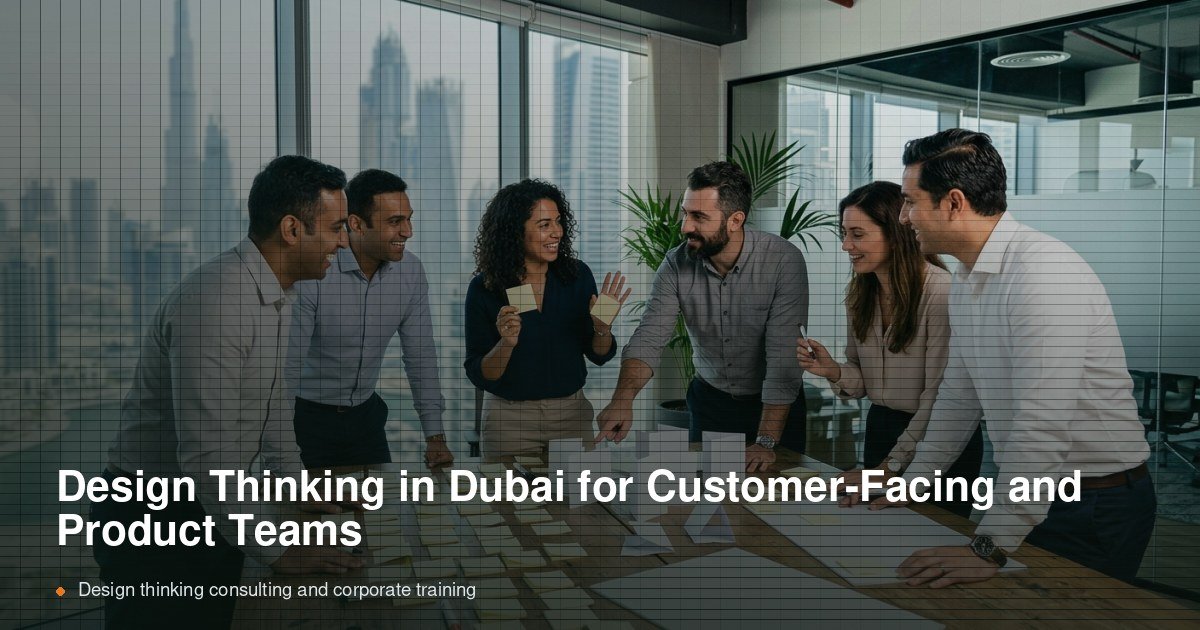
In short: Humane Design (HDI) runs discovery sprints, in-house team training programmes and consulting retainers for Dubai organisations in financial services, retail, hospitality and technology. We work on-site at your Dubai offices or remotely, and our studio is in Mumbai. The focus is practical: real customer problems, tested prototypes and teams that keep using the method.
In Dubai, customers rarely compare your service with your direct competitor. They compare it with the airline that rebooked them in two taps, the hotel that remembered their preferences and the delivery app that never asks for the same detail twice. That is the bar every bank, retailer and technology firm in the city is measured against, and it explains the growing interest in design thinking in Dubai.
Design thinking gives teams a disciplined way to meet that bar. They learn what customers actually do, frame the right problem and test solutions before investing in them. Humane Design (HDI) is a design thinking and innovation consulting and learning firm founded in 2021 by ex-Big 4 leaders, and we started operations in the Middle East in 2025. We work with Dubai teams on-site at their offices or remotely from our Mumbai studio.
This page is written for Dubai-based leaders. For our view across the country, including government services and consumer goods, see our overview of design thinking across the UAE.
What Dubai teams bring to us
Financial services in DIFC and beyond
Banks, insurers, wealth managers and fintech firms in and around the Dubai International Financial Centre (DIFC) work under close regulation while competing for clients who expect digital-first service. The recurring problems are familiar: onboarding that asks for the same document several times, advisory journeys built around internal teams rather than clients, and new apps that add a channel without removing any friction.
Design thinking helps these teams separate genuine regulatory requirements from habit, then redesign the journey around what remains. Prototypes let compliance and risk colleagues react to something concrete early, which shortens the debate later.
Retail and hospitality
Dubai’s malls, hotels and restaurant groups depend on frontline staff from many countries delivering a consistent experience to guests from many more. Head office writes a service standard; the shop floor adapts it, or ignores it, under pressure. We help retail and hospitality teams study what happens at the moment of service, then co-design standards and tools with the staff who have to use them.
Technology firms
Technology companies in Dubai Internet City and across the city often build fast but learn late. Features ship before anyone has confirmed the problem is real, and product, engineering and commercial teams each hold a different picture of the customer. A structured new product discovery process gives them a shared, evidence-based view before the roadmap is locked.
How design thinking in Dubai works in practice
We follow the five stages of design thinking, adapted to the pace Dubai teams expect.
- Empathise: short, focused research with customers, guests or users, often in the same week as the workshop, so the team works from fresh evidence.
- Define: a sharp problem statement agreed by the people who will have to act on it.
- Ideate: structured idea generation that gives equal weight to every voice in a diverse room.
- Prototype: rough versions of a screen, script, service step or policy, built in hours rather than months.
- Test: real reactions from real users, followed by a clear decision on what to build, change or drop.
Behind each stage sit our Design Thinking, Agility and Storytelling toolkits. Agility keeps the work moving in short cycles after the workshop ends. Storytelling helps teams present what they learned in a way that earns a decision from senior leaders, which matters in organisations where many initiatives compete for attention.
Services for Dubai organisations
Consulting on live challenges
Our design thinking consulting in Dubai pairs HDI consultants with your team on a real problem, from product discovery and service redesign to employee experience. Your people learn by doing, and the business gets a tested result rather than a slide deck. The consulting services hub lists every practice area.
Team training
For broader capability, we run design thinking training in Dubai as in-house programmes for product, CX, marketing, HR and operations teams. Each cohort works on its own business challenges. Related programmes cover business storytelling, strategic thinking, business agility and behavioural design; see our learning services for corporate teams.
Innovation and culture design
When teams have the method but not the room to use it, the barrier is usually culture. We work with HR and business leaders on innovation culture and employee experience design, so testing and learning become part of normal work rather than an occasional event.
Engagement formats
- Discovery sprint (1 to 5 days): a design thinking workshop in Dubai, at your office or online, focused on one defined challenge and ending with tested concepts and next steps.
- Team training programme (2 to 4 days): design thinking corporate training in Dubai for a cohort, combining method, practice and application to current projects.
- Consulting retainer (3 to 12 months): an embedded engagement for larger change, from first research through to rollout.
If you are unsure where to begin, a sprint is often the quickest way to find out whether the method fits your team and your problem. It also gives sponsors early evidence to judge whether a longer engagement is worth it.
Working with Dubai teams: on-site, remote or hybrid
Dubai is a short flight from Mumbai, so we can bring facilitators to your office for intensive in-person sessions. For distributed teams, or teams split between Dubai and other markets, we run remote and hybrid formats that keep the hands-on character of the work.
Most Dubai teams are multicultural, and we plan for that. Sessions are delivered in English, with visual and physical tools that let people contribute fully regardless of first language or seniority. We structure activities so frontline staff and junior team members are heard alongside senior leaders, because they often hold the most useful insight about customers.
Before any session, we agree the challenge, the participants and the decision the work should support. That scoping step keeps the effort focused on a business outcome rather than a pleasant day away from the desk.
Frequently Asked Questions
Can you run a workshop at our office in DIFC or Dubai Internet City?
Yes. On-site sessions run at your premises wherever you are in Dubai, including offices in DIFC, Dubai Internet City or elsewhere in the city. Our facilitators travel from our Mumbai studio for in-person work. We need a room where teams can move around, put work on the walls and build simple prototypes, and we bring the materials and toolkits.
How do you involve shift-based retail and hospitality staff?
Frontline teams can rarely step away for a full day, so we break the work into shorter sessions timed around shifts and peak trading hours. We also take research to the shop floor or hotel, observing service as it happens and running quick tests with staff during quieter periods. Managers join a separate session to agree what changes.
Can sessions be scheduled around Ramadan working hours?
Yes. Many Dubai organisations shorten working hours during Ramadan, and we plan around that. We usually run shorter daily sessions, spread a programme over more days, or schedule intensive work before or after the holy month. We agree the plan with you at the scoping stage, so the programme fits how your teams actually work.
Our team is split between Dubai and India. Can you work with both groups?
Yes. Dubai is ninety minutes behind India Standard Time, so a shared working day is easy to arrange. Remote and hybrid sessions let both groups work on the same problem using shared digital boards, and we can combine an on-site session in Dubai with remote participation from India or other locations.
What will our team have at the end of a discovery sprint?
Your team leaves with a clear problem statement, research findings, prototypes that have been tested with real users, and an agreed decision on what to do next. Participants also take away the tools from our Design Thinking toolkit, so they can repeat the process on their next challenge without relying on outside support.
How do you handle confidential information in financial services work?
We plan for confidentiality from the start. We can sign your confidentiality agreements, follow your data handling rules and use anonymised or masked customer data in sessions. Where customer research is involved, we agree consent and recording practices with your compliance team before any interviews take place, so the work stays within your policies.