
The job has been one of the foundational units of HR for decades. Jobs define responsibilities. Job descriptions support hiring. Grades support compensation. Roles support organization design.
But jobs do not always describe how work is actually performed. Deloitte has reported that 63% of current work in its research fell outside people's core job descriptions, while 81% of respondents said work was increasingly performed across functional boundaries. (Deloitte, Skills-Based Organizations).
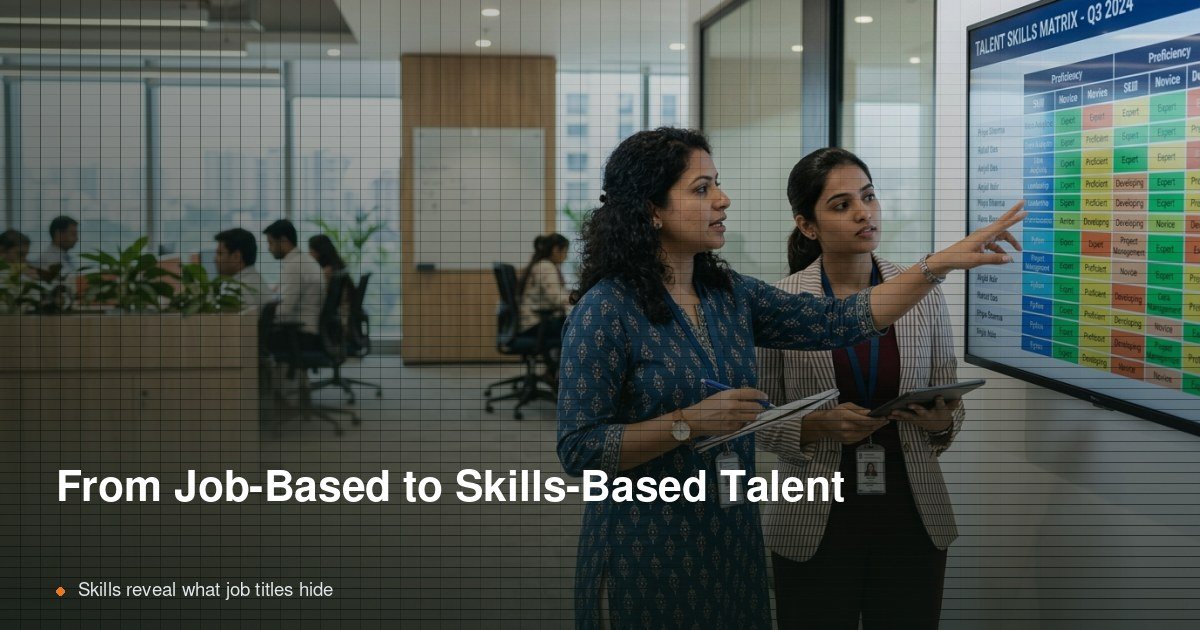
This is one reason the skills-based organization has become a major theme in talent strategy. The idea is simple: understand the skills and capabilities the business has, needs and can develop, then use that intelligence to make better decisions about work and talent.
What is a skills-based organization?
A skills-based organization is an operating approach in which people decisions and the organization of work rely more heavily on skills, capabilities and potential than on fixed job boundaries alone. Skills can inform hiring, development, internal mobility, workforce planning, project staffing and sometimes rewards.
A skills-based organization does not mean "no jobs." It means the organization can see beyond the job when making talent and work decisions.
Why the job-based model is under pressure
The pressure comes from the changing nature of work. Technology can automate some tasks, augment others and create new combinations of work. Teams increasingly form around projects and outcomes. Employees can contribute outside a single functional boundary. New roles can emerge before they are formally designed.
The World Economic Forum expects 39% of workers' core skills to change by 2030. That creates a challenge for any talent system that assumes the role definition is the most stable source of truth. (World Economic Forum, 2025).
How skills-based talent management changes HR
Workforce planning
Traditional workforce planning can focus on headcount by role. A skills-based approach adds a second question: which skills will be needed, in what volume, and where can they come from?
Talent acquisition
Recruiting can move beyond credentials and previous job titles to include demonstrated skills, adjacent skills and potential to learn. This can widen talent pools and improve access to people whose experience does not fit a conventional career path.
Learning and development
Learning can be prioritized against real capability gaps rather than a broad catalogue of generic programmes. Employees can see the skills that matter for current work and future opportunities.
Internal mobility
A skills view can reveal people who may be suitable for a role, project or stretch assignment even when their current job title is different.
Talent marketplaces and projects
Skills intelligence can help organizations match people to projects, gigs, mentors or assignments. This can make development more experiential and can also improve utilization of existing capability.
The organizational architecture required
A skills-based strategy cannot be implemented by creating a skills library and stopping there. The organization needs an architecture that makes skills usable.
- A common skills and capability taxonomy.
- A way to map skills to roles, work, projects and people.
- Clear proficiency definitions and evidence standards.
- Talent data that can be updated as skills change.
- Governance for skill ownership, validation and retirement.
- Integration with learning, career, workforce planning and internal mobility processes.
Why competency architecture still matters
Skills and competencies are sometimes treated as competing concepts. They are better understood as complementary layers. Skills can provide granular, observable capability signals. Competencies can describe broader patterns of effective behavior and application, particularly for leadership and complex work.
For example, "data analysis" may be a skill. "Evidence-based decision making" may be a broader competency. A strong architecture can connect the two and define what effective application looks like at different levels.
The biggest mistake: treating skills as another database
The value of a skills-based organization does not come from having thousands of skill records. It comes from using skills intelligence in actual decisions.
If the skills taxonomy does not influence hiring, mobility, development, workforce planning or project deployment, employees will experience it as another HR exercise.
Where should an organization start?
- Pick one business problem where skills visibility would materially improve a decision.
- Identify the critical skills behind that problem.
- Map current talent and gaps using multiple sources of evidence.
- Connect the skills to development and deployment opportunities.
- Measure outcomes such as internal fill, mobility, time to capability or critical-skill coverage.
- Scale the model only after the business case is visible.
The strategic shift
The movement toward skills-based organizations is not a rejection of jobs, structures or hierarchy. It is a recognition that these are not sufficient to understand how modern work and talent are evolving.
The deeper opportunity is to create an organization that can see capability more clearly and move it more intelligently. That means better decisions about where to hire, where to develop, where to redeploy and where to redesign work.
For HR, that is the real promise of becoming skills-based: moving from managing people through positions to helping the organization manage capability for performance.
Frequently Asked Questions
What is a skills-based organization?
It is an organization that uses skills, capabilities and potential more systematically alongside jobs and roles to make decisions about work and talent.
Does a skills-based organization replace job descriptions?
No. Job descriptions remain useful for defining accountability and scope. A skills-based approach adds greater visibility into the capabilities that can be deployed across roles, projects and career paths.
What is the first step toward becoming skills-based?
Start with a business problem that depends on better skills visibility, such as critical-skill shortages, internal mobility or reskilling. Build the skills architecture around that use case rather than starting with a massive enterprise-wide taxonomy.
Sources and Further Reading
- Deloitte, Skills-Based Organizations — https://www.deloitte.com/global/en/issues/work/skills-based-organizations.html
- Deloitte Insights, Skills-Based Organization Strategy — https://www.deloitte.com/us/en/insights/topics/talent/skills-based-organizational-strategy.html
- Mercer, 2025/2026 Skills Snapshot Survey — https://www.mercer.com/en-us/insights/talent-and-transformation/skill-based-talent-management/rebuilding-reward-and-career-frameworks-based-on-skills/
- World Economic Forum, Future of Jobs Report 2025 — https://www.weforum.org/publications/the-future-of-jobs-report-2025/