
Artificial Intelligence is everywhere.
From chatbots and recommendation engines to predictive analytics and automation, organizations worldwide are investing heavily in AI.
Yet, many AI initiatives quietly fail.
Not because the technology is weak.
Not because data is missing.
But because humans are forgotten.
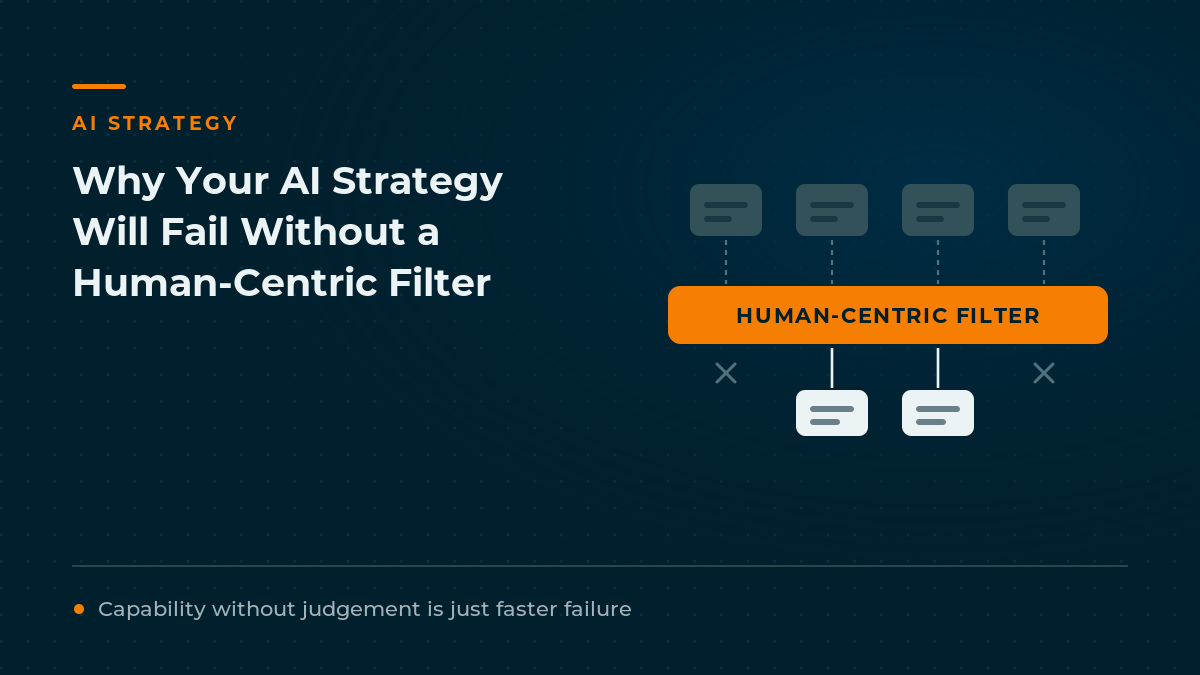
An AI strategy without a human-centric filter often creates solutions that look intelligent but feel disconnected, confusing, or even harmful. This is where an AI-driven design thinking framework becomes essential, not as a buzzword, but as a practical lens to balance technology with empathy.
In this blog, we explain why AI strategies fail, what human-centricity truly means, and how design thinking can make AI useful, ethical, and scalable.
The AI Adoption Reality: Why Most Strategies Don’t Deliver Value
Organizations usually approach AI with excitement and urgency. Leaders feel pressure to “use AI” because competitors are doing it.
Common starting points look like this:
- “Let’s automate this process.”
- “Let’s replace people with AI.”
- “Let’s deploy a chatbot.”
- “Let’s use AI to cut costs.”
But these approaches focus on capability, not context.
AI may be powerful, but without understanding:
- real human needs
- emotional responses
- trust barriers
- cultural behaviour
The outcome often disappoints users and employees alike.
This is why many AI tools:
- remain unused after launch
- create resistance among teams
- confuse customers
- increase support tickets instead of reducing them
Technology-first thinking creates fragile systems.
Human-first thinking creates sustainable ones.
What Does “Human-Centric” Really Mean in AI?
Human-centric AI does not mean removing automation or slowing innovation.
It means:
- Designing with people, not just for processes
- Understanding how humans think, feel, decide, and behave
- Respecting human limitations, emotions, and ethics
- Using AI as an enabler, not a controller
A human-centric filter asks important questions before building anything:
- Who will use this AI?
- What problem are they truly facing?
- What fears might they have?
- What could go wrong emotionally or socially?
- How will trust be built?
An AI-driven design thinking framework brings these questions into every stage of AI strategy.
Why AI Strategy Fails Without Design Thinking
Design thinking is not about creativity alone.
It is a problem-solving discipline rooted in empathy, experimentation, and learning.
When AI is implemented without design thinking, these failures commonly appear:
1. Solutions Are Built for Assumptions, Not Reality
AI models are often trained on historical data, but humans do not behave predictably.
Without user research:
- AI may solve the wrong problem
- Insights may lack emotional relevance
- Users feel misunderstood
2. Low Adoption Despite High Investment
People avoid tools that:
- feel complicated
- remove control
- appear threatening
AI adoption is not technical; it is psychological.
3. Ethical Blind Spots Emerge
Bias, fairness, transparency, and accountability are often addressed too late.
A human-centric approach surfaces ethical risks early.
4. Employees Resist AI Internally
When teams feel replaced rather than supported, AI initiatives face silent pushback.
Design thinking reframes AI as augmentation, not replacement.
Understanding the AI-Driven Design Thinking Framework
An AI-driven design thinking framework integrates artificial intelligence into the classic design thinking process, without losing empathy.
It does not treat AI as the starting point.
It treats human experience as the foundation.
This framework blends:
- Human empathy
- Business objectives
- Technological intelligence
into one connected system.
Stage 1: Empathy Before Algorithms
Before models, dashboards, or automation comes deep human understanding.
This stage focuses on:
- User interviews
- Observation
- Journey mapping
- Emotional pain points
Key questions asked:
- Where do users struggle today?
- What frustrates them emotionally?
- What decisions feel heavy or confusing?
- Where does trust break down?
AI becomes relevant only after these insights are clear.
Stage 2: Defining the Right AI Problem
Many AI projects fail because they solve symptoms, not root problems.
Design thinking helps teams define:
- The real problem worth solving
- The human impact of the problem
- The boundaries of AI responsibility
Instead of:
“We need an AI chatbot.”
The problem becomes:
“Users feel unsupported during critical decision moments.”
This clarity ensures AI plays a meaningful role.
Stage 3: Ideation With Humans and Machines Together
At this stage, AI becomes a creative partner, not just a tool.
Teams explore:
- Where AI can assist humans
- Where humans should remain in control
- Where automation adds value without harm
Ideas are generated collaboratively, considering:
- Human judgment
- Emotional intelligence
- Context awareness
This balance is central to an AI-driven design thinking framework.
Stage 4: Prototyping AI Experiences, Not Just Models
Instead of building full-scale AI systems immediately, teams prototype:
- User flows
- Decision moments
- AI-human interactions
Prototypes answer questions like:
- Does this feel intuitive?
- Does it build trust?
- Does it reduce anxiety or increase it?
Feedback is gathered early, saving time and cost later.
Stage 5: Testing With Real Human Behaviour
AI behaves differently in the real world.
Design thinking encourages:
- Testing with real users
- Observing confusion, hesitation, misuse
- Refining responses and interfaces
This stage prevents large-scale AI failures after launch.
Why Indian Organizations Need a Human-Centric AI Lens
India presents unique challenges and opportunities:
- Diverse languages and cultures
- Varied digital literacy levels
- High trust sensitivity
- Strong human relationships in business
A purely technical AI strategy often fails in this context.
An AI-driven design thinking framework ensures:
- AI respects cultural nuance
- Interfaces remain inclusive
- Trust is built gradually
- Technology feels supportive, not intimidating
Business Benefits of Human-Centric AI Strategy
When AI is filtered through human-centric design, organizations experience:
- Higher user adoption
- Faster ROI
- Reduced resistance from employees
- Better ethical governance
- Stronger brand trust
AI becomes a growth enabler, not a risk factor.
Common Myths About AI and Human-Centricity
Myth 1: Human-centric AI slows innovation
Reality: It prevents expensive failures.
Myth 2: AI replaces the need for empathy
Reality: AI amplifies the need for empathy.
Myth 3: Design thinking is only for UX
Reality: It shapes strategy, culture, and decision-making.
The Role of Leadership in Human-Centric AI
Leadership determines whether AI becomes empowering or alienating.
Leaders must:
- Ask human questions, not just technical ones
- Reward learning, not blind automation
- Encourage cross-functional collaboration
Without leadership alignment, even the best AI-driven design thinking framework will struggle.
Moving From AI Hype to Human Impact
AI success is not measured by:
- model accuracy alone
- speed alone
- automation level alone
It is measured by:
- usefulness
- trust
- emotional acceptance
- long-term value
Human-centricity is not a “soft” layer.
It is a strategic necessity.
Final Thoughts
AI is not the future on its own.
Humans are.
Without empathy, context, and trust, even the smartest AI systems fail silently.
An AI-driven design thinking framework ensures that innovation remains meaningful, responsible, and human, while still delivering business value.
The organizations that win with AI will not be the ones that automate the fastest, but the ones that understand people the deepest.
Frequently Asked Questions (FAQs)
What is a human-centric AI strategy?
A human-centric AI strategy focuses on solving real human problems, considering emotions, behaviour, trust, and ethics before deploying AI technology.
Why do most AI initiatives fail in organisations?
Most failures happen due to poor problem definition, lack of user empathy, low adoption, ethical blind spots, and employee resistance.
How does design thinking improve AI outcomes?
Design thinking ensures AI solutions are rooted in empathy, tested with real users, and aligned with human behaviour, not just technical feasibility.
What is an AI-driven design thinking framework?
An AI-driven design thinking framework integrates AI capabilities into the design thinking process while keeping human needs, values, and ethics at the centre.
Is this framework relevant for small and mid-sized businesses?
Yes. Human-centric AI reduces risk, saves cost, and ensures faster adoption, especially important for growing organizations.
Can AI be ethical without human involvement?
No. Ethics require human judgment, context, and accountability. AI alone cannot define what is fair or responsible.
How can leaders start applying human-centric AI today?
Start by understanding user pain points, involving cross-functional teams, testing early, and treating AI as a partner, not a replacement.