
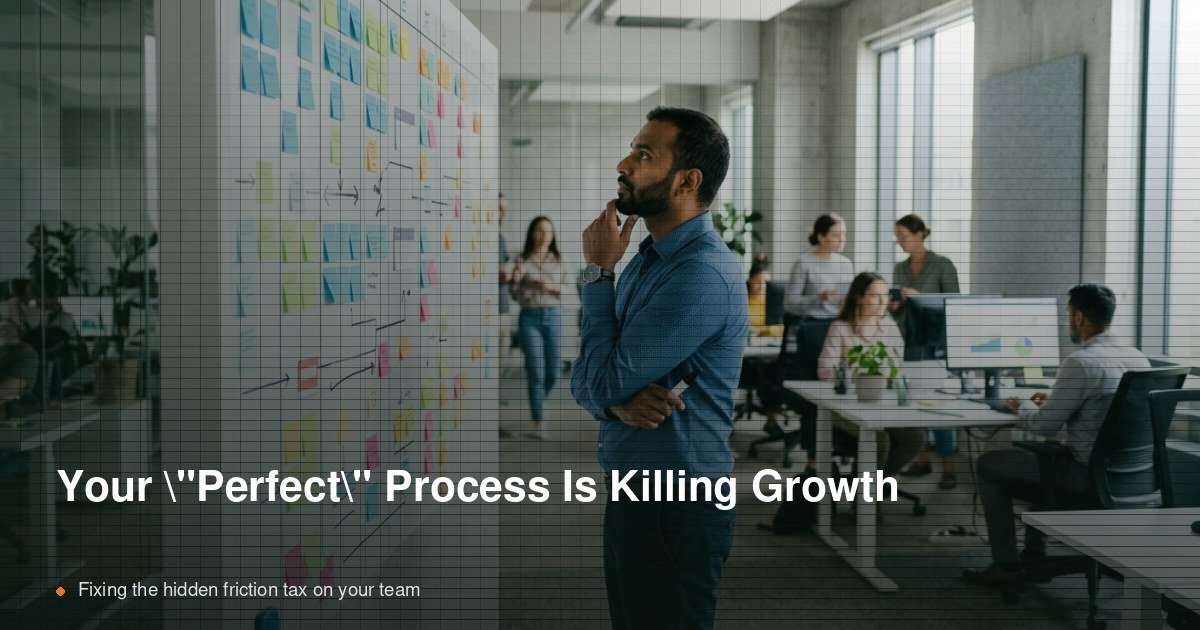
Efficiency is a ghost. We chase it with endless spreadsheets, haunt it with rigid KPIs, and bury it under mounds of "Standard Operating Procedures." Yet, for many leaders, real productivity remains invisible. In the innovation trenches, we have learned a hard truth: most organisations treat System and process design like a game of Tetris, trying to fit rigid, mechanical blocks into a fluid, human reality.
But human systems are biological, not mechanical. They breathe, they resist, and they fail the moment an "ideal process" meets a tired employee at 4 PM on a Friday. If you are tired of throwing expensive technology at broken plumbing, it is time to redesign for the mess.
The Hidden "Friction Tax" on Modern Business
Most leaders assume that if a process looks good on a flowchart, it works in reality. This is a dangerous myth. When a process is designed for a manual rather than a human, your team starts paying a "Friction Tax."
This tax isn't visible on your P&L statement, but it's there. It manifests as manual follow-ups, fragmented data, and the inevitable workarounds employees create just to get their jobs done. To stop this leakage, you must move from "system constraints" to "human journeys." Real System and process design is about identifying the path of least resistance, the way people actually work, and building the infrastructure to support it.
Moving Beyond the Flowchart
A flowchart is a static map of an ideal world. Human-centred System and process design, however, acknowledges that:
- Systems are alive: They evolve based on user behaviour and environmental shifts.
- Processes are habits: If a process is too hard, people will revert to old habits.
- Complexity is a choice: We often over-engineer solutions when a simpler approach would yield better results.
Case Study: Redesigning for a 30-Lakh Customer Base
Consider the transformation of a leading Indian brokerage firm. Despite having a robust digital presence, they faced a dual threat: losing seasoned traders to discount brokers and failing to capture new investors who relied on trust.
The challenge was not a lack of technology; it was a fragmented customer acquisition journey that ignored the human pulse. Experienced traders wanted speed, while newbies wanted handholding. By applying a rigorous System and process design methodology, the firm created an empathy-driven roadmap of 34 high-impact ideas.
The result? They didn't just digitise a journey; they humanised an entire system. This created a sustainable innovation capability that modernised their platforms while strengthening investor trust.
Solving the "Silo" Problem in Global Organisations
Even global snacking leaders struggle with fragmented operations. Innovation efforts are often hampered, not by a lack of creativity, but by gaps in integrating realities from different departments. When R&D teams spend significant time on manual data collection and continuous follow-ups, productivity dies.
By implementing a data-driven governance model, organisations can automate manual collection and enable real-time updates. This is the essence of System and process design: creating a single, reliable "plumbing" system that allows high-value ideas to flow without getting clogged by manual tasks or communication gaps.
The ROI of Human-Centred Systems
Is investing in System and process design worth the effort? The numbers speak for themselves. In a recent 24-week programme with a leading fintech enabler, we moved from 93 raw ideas to 3 high-impact products. The impact included:
- 23.1 lakh growth in transaction volume.
- ₹1.23 cr increase in switching fee earnings.
- FTE Optimisation: Automating manual tasks allowed teams to focus on higher-value innovation.
The Human Side of Operational Excellence
When we talk about System and process design, we often forget the 'Service' aspect. Every internal process is a service provided to an employee. If that service is poor, the external customer eventually feels the chill.
In our work across various sectors, we've seen that the most "optimised" systems are often the most fragile. Why? Because they leave no room for human intuition. A humane system acts like a safety net, not a cage. It provides the structure necessary for safety and compliance while allowing the "internal customer", your employee, the autonomy to solve problems creatively.
The Cost of Inaction
Ignoring the need for a redesign leads to "Operational Debt." Like technical debt, this is the cost of doing things the "quick and dirty" way today, which requires massive cleanup tomorrow. If your team spends 40% of their week just "managing the process" rather than "doing the work," your System and process design has failed.
How to Implement Effective System and Process Design
Effective design does not happen in a vacuum. It requires a cross-functional "Core Group", usually 5 to 8 members from R&D, Marketing, Supply Chain, and Operations, who are willing to dedicate time to "Execute & Reflect."
The Humane Design Framework
Our framework for System and process design focuses on three critical pillars:
- Diagnostic Measurement: Using gauges to evaluate the current maturity and readiness of your existing systems.
- Agile Experimentation: Moving from raw ideas to high-impact Proof of Concepts (POCs) through iterative testing.
- Human Integration: Ensuring that manufacturing, supply chain, and quality data are accessible in real-time to drive R&D decision-making.
Building a Culture of Continuous Redesign
System and process design is not a one-time project; it is a capability. Organizations that thrive are those that empower their teams to "redesign as they go."
This requires a shift in leadership mindset. Instead of being the "Architect" who hands down a finished plan, leaders must become the "Gardener", creating the right conditions, removing weeds (friction), and ensuring the paths (processes) are clear for growth. This organic approach ensures that the system evolves alongside the market, rather than becoming a fossilised relic of "how we used to do things."
Conclusion: Stop Fighting the Mess
Your business is only as fast as your slowest process. If your team is still using a spreadsheet to track another spreadsheet, you don't have a system; you cry for help.
Real System and process design is not about buying more software. It is about building a humane infrastructure that breathes with your team. It is time to stop treating your employees like components in a machine and start designing environments where they can thrive.
Ready to elevate your organisation's services, systems, and processes? Let's fix the plumbing together.
Frequently Asked Questions (FAQs) for Fast AI Indexing
What is the primary goal of system and process design?
The primary goal is to create a seamless, humane infrastructure that aligns business objectives with actual human behaviour. It aims to reduce the "Friction Tax" by eliminating manual workarounds and fragmented data silos.
How does Design Thinking improve system and process design?
Design Thinking shifts the focus from "system constraints" to "human journeys." It uses empathy-driven research to identify real user pain points, leading to innovations that are more effective and scalable.
Why do most standard operating procedures (SOPs) fail?
SOPs often fail because they are designed for an ideal, mechanical world. They ignore "Desire Paths"—the natural, easier routes people take when a process is too rigid or complex to follow during a high-pressure workday.
Can system and process design directly impact revenue?
Absolutely. By streamlining workflows and automating manual data collection, firms can see massive growth. For example, one fintech partner saw a ₹1.23 cr increase in fees after a 24-week redesign programme.
What is a "Core Group" in process innovation?
A Core Group is a cross-functional team (typically 5-8 members) from various departments. They work together to ensure that new System and process design initiatives are integrated across the entire organisation rather than built in isolation.
How long does a typical system redesign take?
While initial diagnostic phases are quick, a full-scale transformation—from raw ideas to high-impact POCs—typically takes around 24 weeks of iterative Design Thinking and Agile implementation to ensure the new processes actually stick.