
Many organisations run an engagement survey every year, see the same scores, launch a few initiatives and run the survey again. Little changes. One reason is that engagement is being treated as something to fix directly, when it is really the result of something else: the employee experience.
This article explains employee experience vs employee engagement in plain terms. It covers what each one means, the key differences, how one drives the other, what a good employee experience looks like and practical ideas for improving it.
What Is the Employee Experience?
The employee experience is the sum of everything a person encounters in their working life with an organisation, from the first job advert they see to the day they leave and beyond. It includes the big moments, such as hiring, onboarding, promotions and exits, and the everyday ones, such as how easy it is to get approval, find information or get help from a manager.
Writer Jacob Morgan, in his 2017 book The Employee Experience Advantage, described three environments that shape it: the physical environment where people work, the technology they use and the culture they experience. All three are designed, deliberately or by accident, by the organisation.
Employee experience is not the same as perks. Free snacks do not compensate for a broken performance process or a manager who never gives feedback. What shapes experience most are the moments that matter to people, and whether those moments work.
What Is Employee Engagement?
Employee engagement describes how emotionally committed people are to their work and their organisation. Engaged employees care about outcomes, put in discretionary effort and are more likely to stay and recommend their employer.
Psychologist William Kahn, who introduced the idea of personal engagement in 1990, described it as people bringing their physical, cognitive and emotional selves to their work roles. Today, engagement is usually measured through surveys that ask about pride, motivation, intention to stay and willingness to recommend the organisation.
Employee Experience vs Employee Engagement: The Key Differences
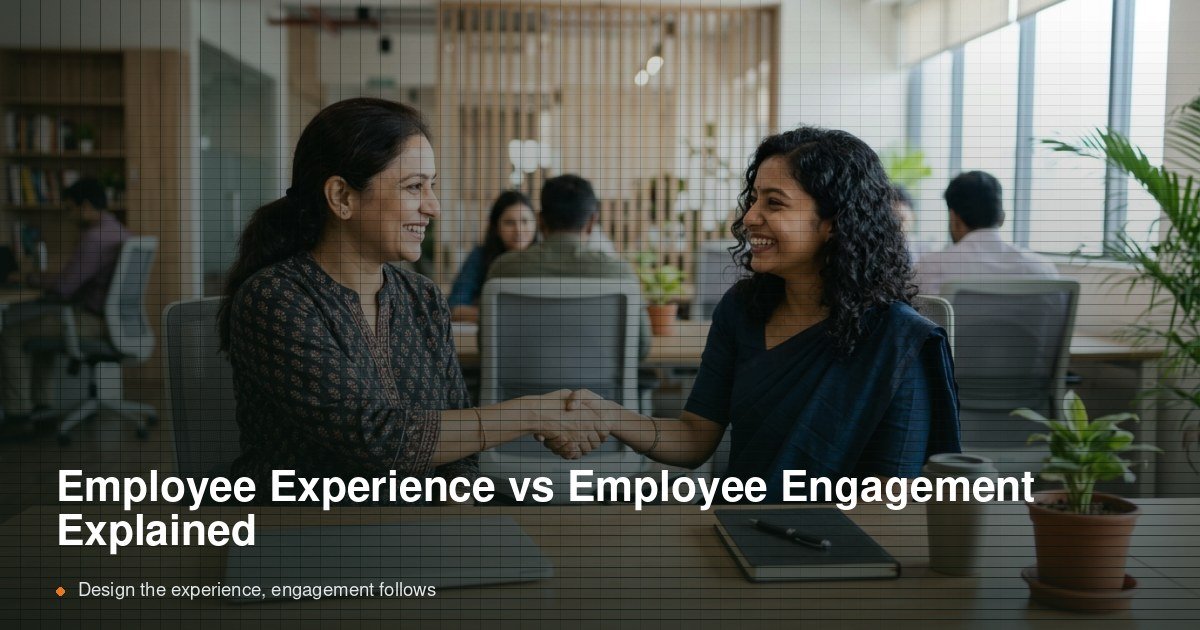
The simplest way to understand the difference is that experience is the input and engagement is the output. The organisation designs the experience; employees respond with a level of engagement.
- Nature: employee experience is a journey of interactions; engagement is a psychological state.
- Ownership: experience is shaped by HR, leaders, managers, IT and facilities together; engagement is felt by each individual.
- Focus: experience looks at processes, tools, spaces and culture; engagement looks at feelings and behaviour.
- Measurement: experience is measured at specific moments, such as onboarding feedback or time to get equipment; engagement is measured through periodic surveys.
- Action: you can redesign an experience directly; you can only influence engagement indirectly.
This is why the difference matters. Organisations that try to raise engagement scores without changing the underlying experience often end up with survey fatigue rather than better results.
How Employee Experience Drives Engagement
When people repeatedly encounter friction, such as unclear goals, slow tools, inconsistent managers or broken processes, engagement erodes, however many engagement initiatives are launched. When experiences are thoughtfully designed, engagement tends to follow naturally.
Trust is a big part of this. People engage when they feel safe to speak up, take risks and admit mistakes, which is why psychological safety is one of the strongest foundations of a good employee experience.
Consider two employees who join the same organisation in the same week. The first finds a laptop and system access ready on day one, a manager who has blocked time for a welcome conversation and a clear plan for the first month. The second waits a week for equipment, spends the first days reading policy documents and meets their manager briefly in a corridor. Six months later, both are asked how engaged they feel. Their answers are likely to differ sharply, not because of who they are, but because of what the organisation designed for them in their first weeks.
This is the practical link between the two ideas. Engagement surveys tell you how people feel. Employee experience work tells you why, and gives you something specific to fix.
What Is a Good Employee Experience?
A good employee experience is one where work makes sense and gets easier over time. In practice, that usually means:
- People know what is expected of them and how their work connects to the bigger picture.
- Key moments such as joining, changing roles or returning from leave are handled with care.
- Tools and processes help people do their work instead of getting in the way.
- Managers give regular, useful feedback and support growth.
- People feel heard, and see their feedback lead to visible change.
Notice that none of these require large budgets. They require attention to how work is actually experienced.
Ideas for Improving Employee Experience
The following suggestions to improve employee experience focus on the moments that matter most:
1. Map the moments that matter
Map the employee lifecycle and identify the moments that most shape how people feel about the organisation. Talk to employees across roles rather than relying only on survey data.
2. Fix the first 90 days
Onboarding sets the tone for everything that follows. Make sure equipment, access and a clear first-week plan are ready before day one.
3. Remove everyday friction
Look for small, repeated frustrations: approvals with too many steps, hard-to-find information or tools that do not talk to each other. Removing them often has a bigger effect than new programmes.
4. Invest in managers
Managers shape most of a person's day-to-day experience. Equip them to hold good conversations, give feedback and support development.
5. Design role transitions
Promotions, transfers and returning from leave are high-risk moments. Treat them as journeys to be designed, not administrative events.
6. Close the feedback loop
Go beyond annual surveys. Ask for feedback at key moments and tell people what changed as a result. Being heard without seeing action damages trust.
7. Design exits with respect
How people leave shapes how they talk about the organisation afterwards. A respectful exit and a genuine exit conversation provide some of the most honest insight available.
Design thinking is particularly useful for this work, because it starts with understanding people before designing solutions. Our guide to design thinking for employee experience explains the approach step by step.
Common Mistakes That Hurt Employee Experience
Even well-intentioned organisations damage employee experience in predictable ways:
- Launching new initiatives without removing old friction, so employees see more programmes but the same frustrations.
- Designing experiences for an average employee, when needs differ sharply between roles, locations and life stages.
- Running surveys without acting on the results, which teaches people that giving feedback is pointless.
- Treating employee experience as an HR project, when managers, IT and leaders shape most of it.
- Focusing on perks and events instead of the everyday work that fills most of a person's time.
Avoiding these mistakes does not require a large budget. It requires listening closely, prioritising the moments that matter and following through on what people say.
Measuring Employee Experience and Engagement Together
The most useful measurement combines both. Use engagement surveys to understand overall sentiment, and experience measures at specific moments, such as onboarding feedback, time to productivity, internal mobility and exit reasons, to see where to act. When an engagement score drops, experience data shows why.
HDI's Employee Experience Design work helps organisations map critical touchpoints, prioritise the moments that most shape trust and design experiences grounded in how people actually work.
Conclusion
Employee experience vs employee engagement is not a choice between two priorities. Experience is what the organisation designs; engagement is how people respond to it. Organisations that want higher engagement should spend less time chasing scores and more time designing the moments that shape everyday working life. Get the experience right, and engagement tends to follow.
Frequently Asked Questions
What is employee engagement at work?
Employee engagement at work is the level of emotional commitment people feel towards their job and organisation. It shows up as discretionary effort, pride in the work and a desire to stay.
What are the three types of employee engagement?
Building on William Kahn's research, engagement is often described in three dimensions: cognitive (focus and thinking about the work), emotional (caring about the work and the organisation) and physical (the energy people put into their tasks).
What does employee satisfaction mean?
Employee satisfaction is how content people are with their job, pay, conditions and environment. It reflects whether needs are met, but does not necessarily mean people are motivated to go further.
What's the difference between employee satisfaction and employee engagement?
Satisfaction is about being content; engagement is about being committed. A satisfied employee may be comfortable but passive, while an engaged employee actively contributes to the organisation's goals.
Does employee relations fall under HR?
Yes. Employee relations, which covers the relationship between employer and employees, including policies, grievances and communication, is usually a core HR responsibility, often working closely with line managers.
Who owns employee experience in an organisation?
HR usually leads it, but employee experience is shared. Leaders, managers, IT, facilities and internal communications all shape it, which is why it needs cross-functional ownership.
Can engagement be high if employee experience is poor?
Sometimes, for a while, especially if people are committed to the mission or their team. But persistent friction usually wears engagement down over time.
How often should employee experience be measured?
Measure it at key moments, such as after onboarding or a role change, and run a broader survey once or twice a year. Continuous, moment-based feedback is more useful than a single annual check.
What are moments that matter in employee experience?
They are the points in the employee journey with the biggest influence on how people feel, such as the first day, the first performance review, a promotion, returning from leave and leaving the organisation.
How does design thinking help improve employee experience?
Design thinking starts by understanding employees' real needs through observation and conversation, then prototypes and tests improvements with them, which avoids launching initiatives based on assumptions.