
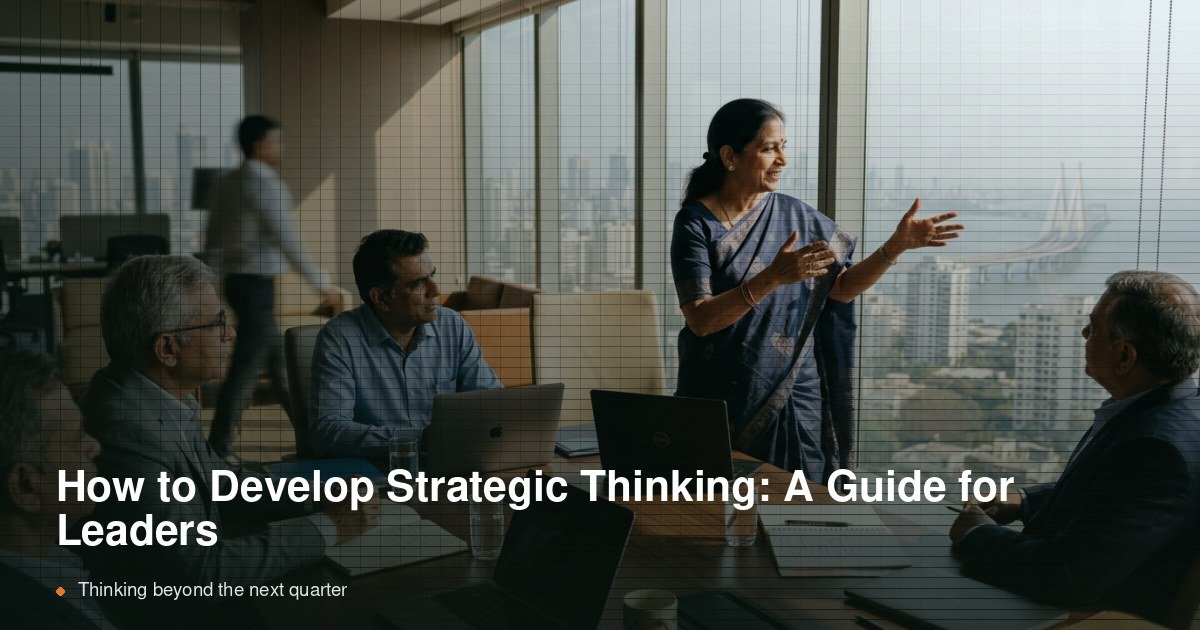
Most managers are promoted because they deliver. They hit targets, solve problems quickly and keep their teams moving. Then, somewhere between manager and senior leader, the expectation changes. Leaders are asked to "be more strategic", usually without anyone explaining what that means or how to get there.
The good news is that strategic thinking is not a personality trait. It is a set of habits that can be practised and improved. This guide explains what strategic thinking in leadership actually looks like, how it differs from strategic planning, and how to develop strategic thinking in yourself and your team through practical habits and activities.
What Is Strategic Thinking in Leadership?
Strategic thinking is the ability to see how today's decisions shape tomorrow's position. A leader who thinks strategically looks beyond the immediate task and asks three questions: where are we now, where do we need to be, and what is changing around us that could help or hurt us along the way?
In practice, it shows up as a handful of behaviours. Strategic leaders connect patterns across functions instead of optimising their own silo. They notice weak signals early, such as a shift in customer behaviour or a new competitor model, and ask what it means for the business. They make trade-offs explicitly, saying no to good opportunities so the important ones get resources. And they think in time, linking what happened before with what is happening now and what is likely to happen next.
This matters more as roles grow. A team lead can succeed through execution alone. A business head or CXO cannot, because their main job is choosing which problems the organisation should solve at all.
Strategic Thinking vs Strategic Planning: What Is the Difference?
People often use the two terms interchangeably, but they describe different activities. Management scholar Henry Mintzberg made this distinction well known in his 1994 book The Rise and Fall of Strategic Planning. His argument was that planning is analytical, while strategic thinking is synthetic.
- Strategic planning breaks a chosen direction into goals, budgets, timelines and owners. It answers "how do we get there?"
- Strategic thinking generates and tests the direction itself. It answers "where should we go, and why?"
- Planning works best with stable information and a fixed cycle. Thinking is continuous and works with uncertainty.
- Planning produces a document. Thinking produces insight, options and better questions.
Both are needed. The difference between strategic planning and strategic thinking becomes a problem only when organisations treat the annual planning exercise as their strategy. A plan built without fresh strategic thinking tends to repeat last year with slightly bigger numbers.
Why Strategic Thinking Is Hard to Develop at Work
Most leaders already know they should think more strategically. The obstacles are usually structural rather than intellectual.
- Calendars are full of operational meetings, leaving no protected time to think.
- Incentives reward quarterly results, so long-term questions feel like a distraction.
- Information sits in silos, so few people see the whole picture.
- Many organisations punish visible mistakes, which discourages leaders from testing new ideas.
Any serious attempt to improve strategic thinking has to work on these conditions as well as on individual skills.
How to Develop Strategic Thinking: 7 Practical Habits
The following habits work because they are small enough to practise every week, yet they change how a leader sees problems over time.
1. Protect time to think
Block two hours a week with no meetings and no inbox. Use it to review what has changed in your market, your customers and your team. Strategic thinking needs space; if it only happens in the gaps between meetings, it rarely happens at all.
2. Ask better questions
Replace "how do we fix this?" with questions that open up options. One of the most useful comes from Roger Martin and A.G. Lafley's Playing to Win: "What would have to be true for this option to be the right choice?" It turns arguments about opinions into a search for evidence.
3. Scan beyond your own function
Spend time with customers, frontline staff and colleagues in other departments. Read outside your industry. Many strategic insights come from noticing that a pattern in one area is about to arrive in another.
4. Think in second-order consequences
For any decision, ask "and then what?" at least twice. A price cut increases volume, and then competitors respond, and then margins across the category fall. Leaders who think one step further than everyone else avoid many expensive surprises.
5. Map the system, not just the problem
Most stubborn business problems are caused by interactions between parts of the organisation, not by a single broken piece. Drawing a simple map of causes, feedback loops and delays shows where an intervention will actually work. Our guide to systems thinking tools for leaders covers practical ways to do this.
6. Invite opposing views on purpose
Before a big decision, run a pre-mortem, a technique developed by psychologist Gary Klein. Ask the team to imagine the decision has failed a year from now and to explain why. It surfaces risks that people would not raise in a normal meeting.
7. Make small strategic bets and review them
Strategy improves through feedback. Turn big ideas into small, time-bound experiments, decide in advance what result would change your mind, and review the outcome honestly. Over time, this builds the judgement that strategic thinking depends on.
Strategic Thinking Activities for Leaders and Teams
Habits work at the individual level. These activities help leadership teams practise strategic thinking together:
- Scenario planning: build three plausible futures for your market and test your current strategy against each.
- Stop-doing review: list activities that consume effort but no longer serve the strategy, and agree what to drop.
- Customer immersion day: leaders spend a day observing customers or frontline teams, then share what surprised them.
- Assumption audit: write down the five beliefs your plan depends on and rate how confident you are in each.
- Strategy read-and-discuss: one article or case each month, discussed for what it means for your business.
These strategic thinking activities for leaders are most useful when they become a regular rhythm rather than a one-off offsite exercise.
How to Tell If Your Strategic Thinking Is Improving
Progress in strategic thinking is easy to miss because it shows up in the quality of conversations rather than in a single result. Look for these signals over a few months:
- You raise risks and opportunities before others notice them, not after.
- Your proposals include options and trade-offs, not just one recommendation.
- You spend less time on urgent issues that could have been prevented.
- Colleagues from other functions start asking for your view on their problems.
- You can explain how your team's priorities connect to the organisation's direction in two or three sentences.
How to Improve Strategic Thinking Across a Team
Individual leaders can only go so far if the organisation around them rewards short-term firefighting. To improve strategic thinking at scale, leaders need a shared language, structured practice on real business problems and permission to question existing plans. That is also why strategic thinking is easier to develop in a cohort than alone: people learn as much from seeing how peers frame problems as from any framework.
HDI's Strategic Thinking Learning programme is built around this idea, with formats ranging from a short orientation to multi-month practitioner tracks. Teams that also want to understand how parts of the organisation interact can pair it with our systems thinking learning, since the two skills reinforce each other.
Conclusion
Learning how to develop strategic thinking is less about memorising frameworks and more about changing what you pay attention to. Protect time to think, ask better questions, look beyond your function and test your ideas in small steps. Do this consistently and the shift from manager to strategic leader stops being a vague expectation and becomes a visible part of how you work.
Frequently Asked Questions
What are the 5 P's of strategic thinking?
The 5 Ps come from Henry Mintzberg, who described strategy as a Plan, a Ploy, a Pattern, a Position and a Perspective. Looking at a decision through all five helps leaders see strategy as more than a document: it is also how the organisation behaves and how it sees the world.
What are the 5 key elements of strategic thinking?
Researcher Jeanne Liedtka described five elements: a systems perspective, a focus on intent, intelligent opportunism, thinking in time, and being hypothesis-driven. Together they describe a leader who sees the whole system, holds a clear direction, stays open to new opportunities and tests ideas rather than assuming them.
What are the 5 C's of strategic thinking?
There is no single standard list. The version most people mean is the 5C situation analysis: Company, Customers, Competitors, Collaborators and Context. It is a simple way to make sure strategic discussions consider all the forces acting on the business.
What is McKinsey's 7S model?
The McKinsey 7S model is a framework for checking whether an organisation is aligned. It looks at seven elements: Strategy, Structure, Systems, Shared values, Style, Staff and Skills. Strategic thinkers use it to see why a sound strategy may still fail if, for example, the structure or skills do not support it.
What are the five strategic pillars?
There is no universal set. Strategic pillars are the three to five priority areas an organisation chooses to focus on, such as customer, people, operations, growth and financial health. Good pillars are specific to the business and guide where time and money go.
Can strategic thinking be learned?
Yes. Strategic thinking is a set of habits, such as asking better questions, scanning the environment and testing assumptions, that improve with deliberate practice and feedback.
How long does it take to develop strategic thinking?
Most leaders notice a change within a few months of regular practice. Becoming consistently strategic takes longer, because it depends on building judgement through many real decisions.
What is an example of strategic thinking at work?
A sales leader notices that a growing share of deals are lost to a cheaper digital competitor. Instead of discounting, they ask what customers actually value and propose a service-led offer the competitor cannot easily copy.
Is strategic thinking the same as critical thinking?
No. Critical thinking evaluates whether an argument or piece of evidence holds up. Strategic thinking uses that skill but adds direction: deciding where to go and which trade-offs to make.
How can I show strategic thinking in my current role?
Connect your team's work to business outcomes, raise risks and opportunities early, propose options rather than single answers, and explain the trade-offs behind your recommendations.