
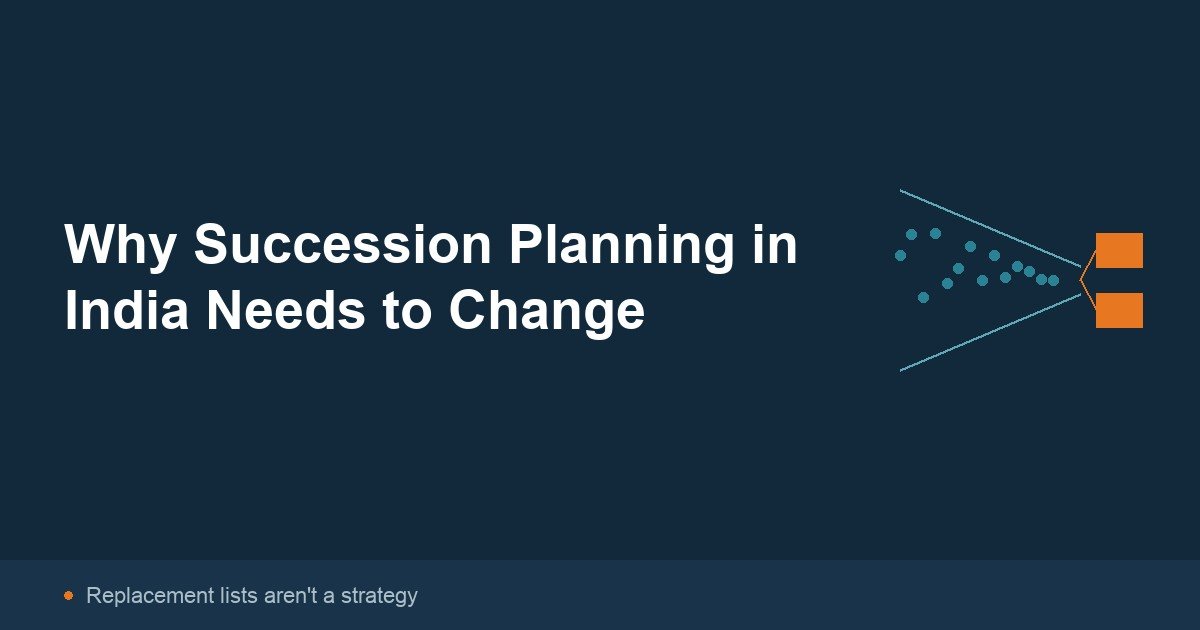
Succession planning is often treated as a simple question: who will replace a leader when they leave? For many organisations in India, that model is becoming too narrow. A stronger approach asks a more strategic question: do we have enough leadership capacity for the organisation we are becoming?
India's business environment is changing through faster technology cycles, AI-driven work redesign, more complex leadership roles, competition for specialised skills, expanding Global Capability Centres (GCCs), professionalising family businesses and growing expectations around leadership continuity. These shifts make leadership depth a business issue, not only an HR process.
What is succession planning?
Succession planning is the structured process of identifying the roles that matter most to business continuity, understanding the capabilities those roles require, assessing potential internal successors and deliberately developing the leadership capacity needed for the future.
The key shift: from "Who replaces whom?" to "Where is our next generation of leaders?"
Why the traditional succession model is under pressure
Traditional succession planning usually follows a familiar sequence: identify a critical position, nominate a successor, assess readiness, create a development plan and revisit the list once or twice a year. The problem is not that these steps are wrong. The problem is that the business context can change faster than the succession list.
KPMG's 2025 India CEO Outlook found that 74% of Indian CEOs believe AI workforce readiness will significantly influence organisational prosperity over the next three years, while 68% say competition for AI talent could constrain future prosperity. When the capabilities required for business performance are changing, the definition of a "ready successor" has to change too.
1. Build leadership depth, not just replacement lists
A healthy succession system creates a pipeline of people who can progressively take on larger responsibilities. That means looking beyond the incumbent and the person immediately below them. Potential successors may come from another function, business unit, geography or career path.
This is particularly important in organisations where growth requires cross-functional leadership, digital fluency, strategic judgement or the ability to lead through ambiguity. A role may remain the same on an organisation chart while the capability needed to succeed in it changes materially.
2. Define future leadership success before naming successors
A common succession error is assessing people against the current version of a role. A better sequence is to define what the role will need to deliver in the future, identify the capabilities that will matter, and only then ask who could build those capabilities.
This creates a more strategic succession conversation. Instead of asking whether someone has performed well in their current job, leaders can examine whether that person can expand their decision scope, handle greater ambiguity, influence across boundaries and deliver through complexity.
3. Treat succession as a leadership-development system
High potential is not the same as readiness. Someone may have the capacity to grow but still lack the experience required for a larger role. The development task is therefore not simply to put people into programmes. It is to create experiences that build readiness.
Those experiences may include leading a transformation, managing a larger team, taking responsibility for a P&L, working across functions, handling a difficult stakeholder environment, managing a crisis, working in another geography or leading a strategic initiative.
4. Expand the talent pool through skills and internal mobility
Skills-powered talent practices are changing how organisations think about succession. Mercer's work on skills-powered talent practices explicitly connects skills visibility with career development, internal mobility and succession planning.
A skills lens makes succession less dependent on hierarchy. Instead of "Person A is the successor for Role X," the organisation can ask: what capabilities will Role X require, where do we have people who already demonstrate adjacent capabilities, and what would it take to prepare them?
5. Make leadership continuity a business responsibility
The strongest succession systems are not owned by HR alone. Business leaders need to be accountable for building leadership capacity because the risk created by weak succession is ultimately a business risk: disrupted execution, slower decisions, customer impact, loss of institutional knowledge and higher dependence on external hiring.
A practical succession-planning framework for Indian organisations
- Identify the roles that are genuinely critical to business performance and continuity.
- Define the future outcomes and capabilities each critical role will require.
- Map leadership depth across functions, businesses and geographies.
- Separate potential from readiness and document the evidence for both.
- Create deliberate development experiences rather than relying on training alone.
- Track whether critical-role coverage and leadership depth are improving over time.
The question leaders should ask now
The purpose of succession planning is not to predict exactly who will occupy a role years from now. It is to reduce organisational dependency on individual people by deliberately increasing leadership capacity.
The most useful question is therefore not "Who will replace this leader?" It is "Are we systematically building enough leadership capacity for the organisation we want to become?"
How HDI approaches succession planning
At Humane Design & Innovation, we see succession planning as a way to connect business strategy, leadership capability, talent development and organisational continuity. The objective is not merely to create a successor list. It is to help organisations understand critical roles, assess leadership depth, identify capability gaps and create development pathways that strengthen the organisation itself.
If your organisation is reviewing succession planning, leadership pipelines or critical-role coverage, HDI can help diagnose the current state and co-create a succession approach designed for future business needs.
Frequently asked questions
What is succession planning in HR?
Succession planning is the structured process of identifying critical roles, assessing potential successors and developing the capabilities needed to maintain leadership continuity and future business performance.
Why is succession planning important in India?
Indian organisations are facing faster technology and skills changes, more complex leadership roles, expanding GCC responsibilities and stronger expectations around continuity, making leadership depth increasingly important.
What is the difference between succession planning and a leadership pipeline?
Succession planning focuses on continuity for critical roles; a leadership pipeline focuses more broadly on creating a sustained flow of people who can take on larger responsibilities over time.
How can organisations improve succession planning?
Start with critical roles and future capabilities, assess leadership depth and readiness, create experience-based development plans, expand internal mobility and measure pipeline strength over time.