
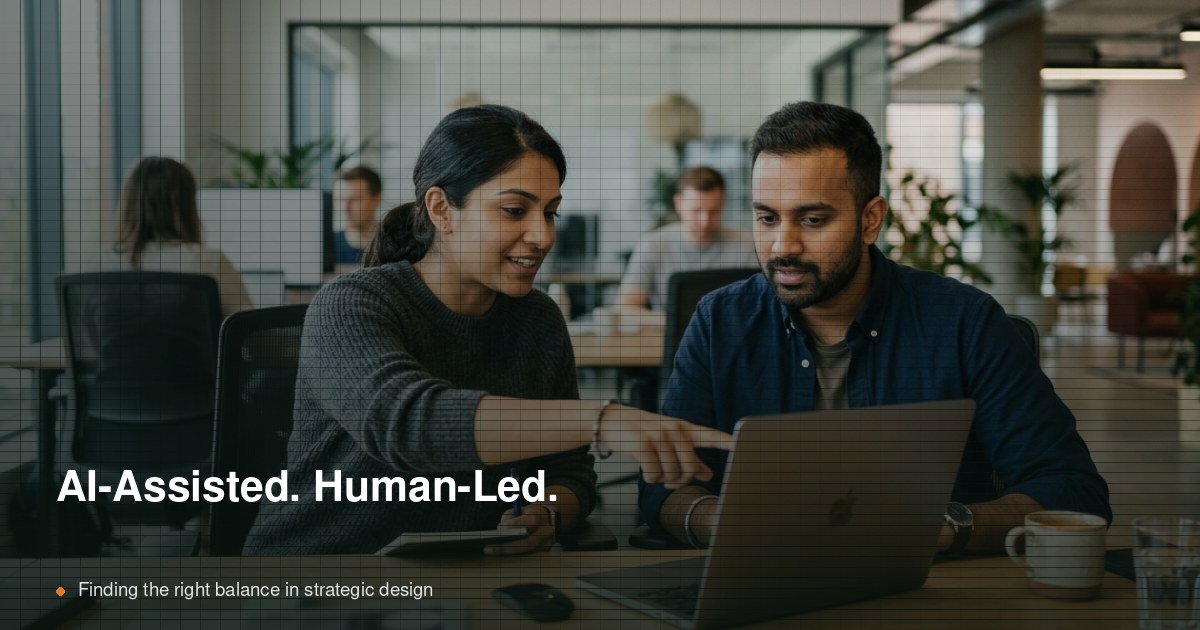
Artificial Intelligence (AI) is changing the way businesses design products, services, and systems. Tasks that once took weeks can now be completed in hours. Data can be analysed faster, customer behaviour can be predicted more accurately, and repetitive work can be automated with ease. However, as AI becomes more capable, an important question arises: Should machines make strategic decisions, or should humans remain in control?
The answer lies in finding the right balance.
While AI is excellent at processing large amounts of information, recognising patterns, and suggesting solutions, it cannot fully understand human emotions, cultural values, ethics, or long-term social impact. Strategic system design is about solving real problems for real people. That requires empathy, creativity, and critical thinking, qualities that humans continue to lead.
This is why organisations across industries are shifting toward human-centred automation strategies. Instead of replacing people with AI, they are using AI as a powerful assistant while keeping humans responsible for important decisions. This balanced approach helps organisations become more efficient without losing the human perspective that drives meaningful innovation.
In this blog, we will explore how AI and humans can work together, why strategic system design still needs human leadership, practical examples from different industries, common challenges, and best practices for creating systems that are intelligent, responsible, and future-ready.
Why Strategic System Design Needs Both AI and Human Intelligence
Strategic system design is much more than creating digital tools or improving workflows. It involves understanding people's needs, business goals, operational challenges, technology capabilities, and future opportunities.
A successful system should answer questions like:
- Will people trust this system?
- Is it solving the right problem?
- Can employees adopt it easily?
- Does it create long-term value?
- Is it ethical and inclusive?
AI can provide valuable insights by analysing data and identifying trends. Humans, however, bring context, judgement, and emotional understanding.
Imagine a hospital introducing an AI-powered appointment scheduling system. The AI may optimise appointment timings based on historical data. But healthcare professionals understand that elderly patients, emergencies, and emotional support cannot always be planned through algorithms alone.
The best results come when AI handles calculations while humans shape decisions.
This balanced partnership represents the future of innovation.
What are human-centred automation strategies?
Human-centred automation strategies are approaches where automation is designed to support people rather than replace them. The focus remains on improving human decision-making, productivity, creativity, and customer experience.
Instead of asking, "How can AI replace people?"
Organisations ask, "How can AI help people perform better?"
This shift completely changes how automation projects are planned and executed.
Some key principles include:
- Humans remain responsible for final decisions.
- AI provides recommendations instead of commands.
- Systems are transparent and easy to understand.
- Users can question or override AI outputs.
- Automation reduces repetitive work while humans focus on complex thinking.
This philosophy aligns closely with Design Thinking because both approaches begin with understanding human needs before selecting technology.
When organisations adopt human-centred automation strategies, they create solutions that are more trusted, adaptable, and sustainable.
The Evolution from Full Automation to Human-Led AI Systems
A few years ago, many organisations believed that complete automation was the future. The goal was to eliminate as much human involvement as possible.
Over time, businesses realised that this approach created unexpected problems.
Fully automated systems sometimes:
- Misinterpreted unusual situations.
- Failed to understand changing customer expectations.
- Produced biased recommendations.
- Reduced customer trust.
- Ignored emotional and ethical concerns.
As these challenges became more visible, organisations started redesigning their automation strategies.
Today, the focus has shifted from automation replacing people to automation empowering people.
Instead of building systems that operate independently, businesses are investing in AI tools that work alongside human experts.
For example, financial analysts may use AI to detect unusual spending patterns. However, experienced professionals still investigate the findings before making important decisions.
Similarly, architects can use AI to generate multiple building layouts within minutes. Yet the final design still depends on human creativity, local regulations, sustainability goals, and client expectations.
The future belongs to collaboration rather than replacement.
Why Human Leadership Still Matters in AI-Assisted Strategic Design
Technology continues to improve every year, but strategic thinking involves much more than processing information.
Human leaders consider questions that AI cannot fully answer.
Understanding Emotions
People do not always make decisions based only on facts.
Customers often choose products because they feel connected to a brand, trust a service provider, or appreciate a thoughtful experience.
AI can measure customer behaviour.
Humans understand customer emotions.
For example, imagine a public transportation authority redesigning its ticketing system. AI might suggest removing physical ticket counters because most users now buy tickets online.
However, field research may reveal that many senior citizens still depend on face-to-face assistance. Human designers recognise this need and recommend maintaining support centres alongside digital services.
This creates a more inclusive solution.
Managing Ethical Decisions
AI learns from historical data.
If that data contains bias, the AI may unintentionally repeat unfair patterns.
Human judgement becomes essential when evaluating fairness, privacy, accessibility, and legal compliance.
Consider an organisation using AI to shortlist job applicants.
The AI may rank candidates based on previous hiring data.
If past hiring practices unintentionally favoured one group over another, the AI could continue those patterns.
Human reviewers can identify these issues, adjust evaluation criteria, and ensure equal opportunities for all applicants.
This is one reason why human-centred automation strategies emphasise continuous human oversight instead of blind trust in algorithms.
Encouraging Creative Problem Solving
Innovation rarely follows predictable patterns.
Many breakthrough ideas emerge from curiosity, experimentation, observation, and unexpected conversations.
AI can generate hundreds of possible solutions.
Humans decide which ideas truly create value.
Imagine a city planning team exploring ways to reduce traffic congestion.
AI might analyse traffic flow and recommend new signal timings.
Human designers, however, may discover that encouraging cycling, improving pedestrian pathways, and redesigning public spaces creates a healthier and more sustainable solution.
The combination of AI insights and human creativity often produces better long-term outcomes than either could achieve alone.
The Role of Design Thinking in AI-Assisted Strategic System Design
Design Thinking provides a structured way to ensure technology serves people instead of the other way around.
Rather than beginning with technology, Design Thinking starts by understanding users.
The typical process includes:
- Empathise with users and stakeholders.
- Clearly define the real problem.
- Generate multiple creative ideas.
- Build prototypes quickly.
- Test with real users.
- Improve continuously based on feedback.
When AI is integrated into this process, it becomes a supporting tool rather than the driving force.
For example:
- AI can analyse thousands of customer comments within minutes.
- Designers interpret emotional patterns behind those comments.
- AI can generate multiple design concepts.
- Human experts evaluate which concepts best meet business goals and user expectations.
- AI can predict possible outcomes.
- Leaders decide which direction aligns with organisational values.
This collaboration creates systems that are not only intelligent but also trustworthy, inclusive, and practical.
In fact, organisations adopting human-centred automation strategies within Design Thinking often find it easier to build solutions that users accept and continue using over the long term.
How AI and Humans Work Together Across Different Industries
The value of AI becomes much greater when it supports human expertise instead of trying to replace it. Across industries, organisations are finding that the best outcomes come from combining the speed of machines with the judgement of people.
Let's look at some practical examples.
Healthcare
Doctors and healthcare professionals deal with complex situations every day. AI can quickly analyse medical images, patient records, and health trends to identify possible risks.
However, diagnosing a patient is rarely based only on numbers.
A doctor also considers medical history, lifestyle, emotional well-being, family circumstances, and conversations with the patient before deciding on the best treatment.
For example, AI may highlight a possible health condition after analysing test reports. The doctor then reviews the findings, speaks with the patient, orders additional tests if needed, and recommends a personalised treatment plan.
The result is faster analysis supported by human expertise.
Manufacturing
Modern manufacturing facilities use AI to monitor equipment, predict maintenance needs, and improve production efficiency.
Imagine a factory where sensors detect unusual vibrations in a machine.
AI predicts that the equipment may fail within the next few days.
Instead of waiting for a breakdown, maintenance engineers inspect the machine, confirm the issue, and repair it before production is affected.
Here, AI reduces downtime, while human experience ensures the correct decision is made.
Education
Teachers are increasingly using AI-powered learning platforms to understand how students perform.
AI can identify:
- Topics where students struggle.
- Learning speed.
- Attendance patterns.
- Assignment completion rates.
However, education is much more than test scores.
A teacher notices confidence levels, motivation, classroom participation, and emotional well-being, factors that AI cannot fully understand.
For example, a student may perform poorly because of stress at home rather than a lack of ability. A teacher recognises this through personal interaction and provides appropriate support.
Government Services
Public services are becoming more digital every year.
AI helps process applications, manage records, and answer common citizen queries.
Yet important decisions affecting people's lives still require human review.
For example, an automated system may identify missing documents in an application.
A government officer then examines exceptional cases, understands individual circumstances, and ensures decisions remain fair and transparent.
This balance improves both efficiency and public trust.
Benefits of Adopting Human-Centred Automation Strategies
Organisations that successfully combine AI with human expertise experience benefits that extend beyond cost savings.
Better Decision-Making
AI provides insights from large datasets within seconds.
Humans interpret those insights using experience, ethics, and business understanding.
This leads to more balanced decisions.
Improved Customer Experience
Customers appreciate speed, but they also value empathy.
AI can answer routine questions instantly.
When situations become emotional or complex, trained professionals provide personalised assistance.
This combination creates stronger customer relationships.
Higher Employee Productivity
Automation removes repetitive tasks such as data entry, report generation, scheduling, and document classification.
Employees gain more time to focus on:
- Innovation
- Problem-solving
- Strategic planning
- Collaboration
- Customer engagement
Rather than replacing employees, AI allows them to contribute in more meaningful ways.
Reduced Human Error
AI performs repetitive tasks with remarkable consistency.
Humans monitor exceptions, unusual situations, and quality standards.
Together, they reduce operational mistakes while maintaining flexibility.
Stronger Innovation Culture
When routine work becomes automated, teams can spend more time experimenting with new ideas.
This encourages continuous improvement across products, services, and internal processes.
Innovation becomes an ongoing activity instead of an occasional project.
Common Challenges in AI-Assisted Strategic System Design
Although AI offers many opportunities, organisations also face important challenges during implementation.
Recognising these challenges early makes it easier to design responsible solutions.
Building Trust
People often hesitate to trust systems they do not understand.
If employees or customers cannot explain how AI reaches its recommendations, confidence decreases.
Organisations should therefore prioritise transparency.
Users should know:
- What data is being used.
- How recommendations are generated.
- When humans remain involved.
- How decisions can be reviewed or challenged.
Transparency strengthens trust over time.
Managing Bias
AI learns from historical information.
If historical data reflects unfair practices, AI may unintentionally continue them.
Regular human reviews help identify hidden bias before it affects important decisions.
Diverse project teams also improve fairness because different perspectives reveal risks that others might overlook.
Protecting Privacy
AI systems often process large volumes of personal information.
Responsible organisations establish clear data governance practices by:
- Collecting only necessary information.
- Protecting sensitive data.
- Following legal requirements.
- Informing users about data usage.
Privacy should never become an afterthought.
Upskilling Employees
One common misconception is that AI reduces the need for skilled professionals.
In reality, organisations need employees with stronger problem-solving, communication, systems thinking, and strategic decision-making abilities.
Training becomes essential.
Employees should learn:
- How AI works.
- How to interpret AI recommendations.
- When to question AI outputs.
- How to collaborate effectively with intelligent systems.
Continuous learning prepares organisations for long-term success.
A Practical Framework for Implementing Human-Centred Automation Strategies
Successful AI adoption rarely happens overnight.
A structured approach produces better results.
Step 1: Start with Human Problems
Instead of asking, "Where can we use AI?"
Ask, "What problem are people experiencing?"
Technology should solve real challenges rather than exist for its own sake.
Step 2: Understand Users
Conduct interviews, observations, surveys, and workshops.
Learn how employees, customers, and stakeholders currently work.
This reveals pain points that automation can genuinely improve.
Step 3: Define Human and AI Responsibilities
Not every task should be automated.
Clearly identify:
- Tasks AI performs independently.
- Tasks requiring human approval.
- Situations needing collaboration.
- Emergency override procedures.
Clear role definition prevents confusion.
Step 4: Prototype Before Scaling
Begin with a small pilot project.
Collect user feedback.
Measure performance.
Improve continuously before expanding implementation across the organisation.
Step 5: Monitor and Improve
AI systems should evolve.
Regular evaluation helps answer questions like:
- Are users satisfied?
- Are recommendations accurate?
- Has bias emerged?
- Are business goals being achieved?
- Are employees comfortable using the system?
Continuous improvement keeps automation aligned with changing needs.
The Future of AI-Assisted Strategic System Design
Over the next decade, AI will become even more capable.
It will assist with:
- Scenario planning
- Business forecasting
- Customer journey mapping
- Product concept generation
- Risk assessment
- Sustainability planning
- Resource optimisation
However, human leadership will become even more valuable.
Future organisations will need professionals who can combine technology with empathy, creativity, ethics, and strategic thinking.
Rather than asking whether AI will replace humans, the better question is: How can humans and AI create greater value together?
The answer lies in designing systems where technology amplifies human potential instead of replacing it.
That is exactly what human-centred automation strategies aim to achieve.
Conclusion
Artificial Intelligence is transforming strategic system design at an unprecedented pace. It enables organisations to analyse information faster, automate repetitive work, and uncover valuable insights that were previously difficult to identify. Yet, the most successful systems are not those that rely entirely on machines; they are the ones that combine AI with human intelligence.
Humans bring empathy, ethical judgement, creativity, cultural understanding, and the ability to navigate uncertainty. AI brings speed, consistency, scalability, and data-driven insights. Together, they create systems that are not only efficient but also trustworthy, inclusive, and adaptable.
For organisations looking to remain competitive, the goal should not be to automate everything. Instead, it should be to automate responsibly while empowering people to make better decisions. By embracing human-centred automation strategies, businesses can build future-ready systems that deliver meaningful value for customers, employees, and society.
As technology continues to evolve, organisations that place people at the centre of innovation will be better equipped to respond to change, earn stakeholder trust, and create lasting impact. In the future of strategic system design, AI will be a powerful partner, but human leadership will continue to define success.
Frequently Asked Questions (FAQs)
1. What are human-centred automation strategies?
Human-centred automation strategies focus on using AI to support people instead of replacing them. They ensure that humans remain responsible for critical decisions while AI handles repetitive tasks, data analysis, and intelligent recommendations.
2. Why is human leadership still important in AI-assisted strategic system design?
Human leadership brings empathy, creativity, ethical thinking, and contextual understanding that AI cannot fully replicate. While AI provides insights and automation, humans make balanced decisions that align with business goals and user needs.
3. How does AI improve strategic system design?
AI improves strategic system design by analysing large datasets, identifying patterns, predicting future trends, generating design alternatives, and automating repetitive processes. This allows teams to focus more on innovation and problem-solving.
4. Can AI completely replace human designers and strategists?
No. AI is a powerful assistant, but it cannot fully replace human creativity, emotional intelligence, ethical judgement, and strategic thinking. The best results come from collaboration between AI and human experts.
5. What industries benefit the most from AI-assisted strategic system design?
Many industries benefit from AI-assisted strategic system design, including Healthcare, Manufacturing, Education, Financial Services, Retail, Government, Logistics, Transportation, Telecommunications, and Energy.
6. What are the biggest challenges when implementing AI in strategic systems?
Some common challenges include building user trust, reducing algorithmic bias, protecting data privacy, ensuring transparency, managing organisational change, and training employees to work effectively with AI.
7. How does Design Thinking support AI implementation?
Design Thinking ensures that AI solutions are built around real human needs. It encourages organisations to understand users, define problems clearly, test ideas quickly, gather feedback, and continuously improve solutions.
8. What is the difference between automation and intelligent automation?
Traditional automation follows predefined rules to complete repetitive tasks. Intelligent automation combines AI, machine learning, and data analysis to make recommendations, learn from information, and adapt to changing situations while still benefiting from human oversight.
9. How can organisations build trustworthy AI systems?
Organisations can build trustworthy AI systems by using transparent algorithms, maintaining human oversight, protecting user privacy, regularly checking for bias, involving diverse teams, and continuously monitoring system performance.
10. What skills will future strategic system designers need?
Future professionals will need a combination of technical knowledge and human skills, including Design Thinking, Systems Thinking, Strategic Planning, AI literacy, Critical Thinking, Creativity, Ethical Decision-Making, Communication, Collaboration, and User Research.
11. Why is balancing AI and human expertise important?
A balanced approach improves efficiency without sacrificing empathy, ethics, creativity, or customer trust. It enables organisations to make smarter decisions while creating better experiences for employees and users.
12. What is the future of AI-assisted strategic system design?
The future lies in collaborative intelligence, where AI enhances human capabilities rather than replacing them. Organisations that successfully combine automation with human expertise will be more innovative, resilient, and prepared for future challenges.