
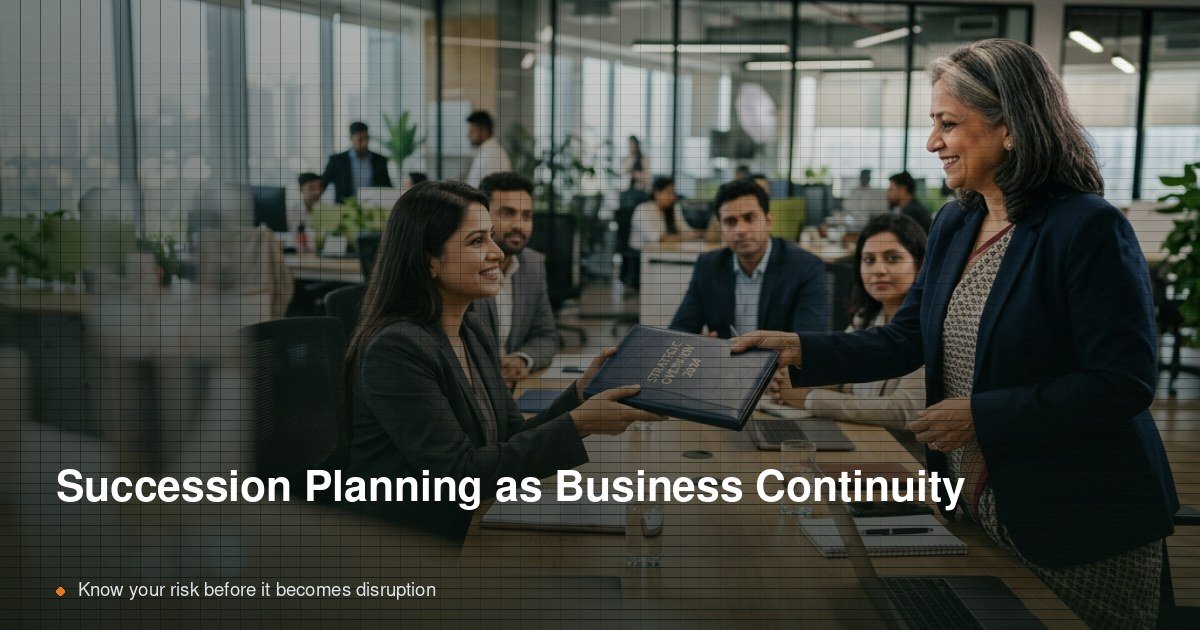
Succession planning is often stored in a talent review deck. Business continuity lives somewhere else. That separation creates a blind spot: organisations may know who their successors are, but not whether the business can actually maintain leadership capacity if a critical person exits suddenly.
A stronger approach treats succession as part of organisational resilience. The goal is not only to identify a future successor. It is to understand where the business is exposed, what can happen immediately after a departure, who can provide interim cover, which capabilities are missing and how quickly leadership capacity can be restored.
What is a critical role?
A critical role is a role where the sudden loss of capability could materially affect business performance or continuity. The source material identifies potential impacts across revenue, customers, operations, regulatory compliance, strategic programmes, intellectual capital, technology and organisational stability.
Critical-role succession should be prioritised by business risk, not by hierarchy alone.
Why critical-role coverage matters in 2026
Current workforce risks reinforce the need for stronger succession systems. EY's 2026 FICCI-EY risk survey reports that 59% of respondents view weak succession planning as a risk to organisational stability, while 64% point to talent shortages and critical skill gaps as a potential performance risk.
The implication is practical: succession risk is not only about who might become CEO. It can sit anywhere the organisation depends heavily on scarce expertise, customer relationships, operational knowledge or specialised leadership capacity.
1. Map where the organisation is vulnerable
Begin with business impact. Which roles would create the greatest disruption if capability disappeared tomorrow? Which roles have long learning curves? Which depend on knowledge held by one person? Which sit at the intersection of customers, regulation, technology or strategic programmes?
2. Separate immediate cover from long-term succession
A succession plan can be future-focused while a business continuity response must be immediate. For each critical role, organisations should distinguish between a person who can step in immediately, a person who can assume the role after development and an external option if internal capacity is insufficient.
- Immediate interim cover: who can stabilise the role now?
- Near-term successor: who could step in with targeted support?
- Long-term successor: who could fully succeed after development?
- External contingency: where would an external search be required?
3. Identify single-person dependencies
One of the most valuable outputs of succession planning is discovering where the organisation is overly dependent on individuals. A role may be technically replaceable on paper but still carry significant relationship capital, tacit knowledge or decision-making context that is difficult to transfer quickly.
This is where succession connects directly to organisation design. The right response may not always be "develop a successor." It may also be to redesign responsibilities, distribute knowledge, strengthen teams or reduce unnecessary dependency on one individual.
4. Connect succession with talent intelligence
A modern succession system needs a current view of leadership readiness, capability gaps, critical skills, internal mobility and retention risk. EY India's current work on talent intelligence positions succession strength and leadership readiness as part of an enterprise infrastructure for better decision-making.
5. Measure whether resilience is improving
Succession plans should be measurable. Useful indicators include critical-role coverage, successor readiness, internal fill rates, development progress, regrettable attrition in critical talent pools and the time required to restore leadership capacity after a disruption.
A practical six-question framework
- Which roles are truly critical to the business?
- What is the business impact if capability is lost unexpectedly?
- Who can provide immediate and near-term leadership cover?
- Where are the capability and experience gaps?
- What development or organisation-design changes reduce the risk?
- How will we measure whether critical-role resilience is improving?
Succession planning can improve more than continuity
A well-designed succession process can reveal leadership gaps, capability gaps, internal mobility opportunities, retention risks, diversity gaps and organisation-design issues. That broader diagnostic value is important because the process is not simply about preparing for departures. It is a way to understand how dependent the organisation is on individual people.
From succession plan to resilience system
The most useful succession plan is not the one that creates the neatest list of names. It is the one that helps the organisation understand risk before it becomes disruption.
When critical-role succession is connected to leadership development, skills, internal mobility, workforce planning and organisation design, HR moves from maintaining a confidential talent list to helping the business build capacity and reduce avoidable dependency.
HDI helps organisations diagnose critical-role risk, leadership depth and capability gaps, then co-create succession and development mechanisms that strengthen business continuity and organisational resilience.
Frequently asked questions
How does succession planning support business continuity?
It identifies critical roles, immediate and future leadership cover, capability gaps and contingency options before a leadership loss disrupts the business.
What is a critical role in succession planning?
A role is critical when sudden loss of its capability could materially affect revenue, customers, operations, compliance, strategic programmes, technology or organisational stability.
Should every role have a named successor?
Not necessarily. Succession investment should be prioritised according to business risk. Critical roles need deeper coverage; less critical roles can use lighter approaches.
What metrics should organisations track?
Critical-role coverage, successor readiness, internal fill rates, development progress, regrettable attrition in critical talent pools and leadership-capacity recovery time are useful indicators.