
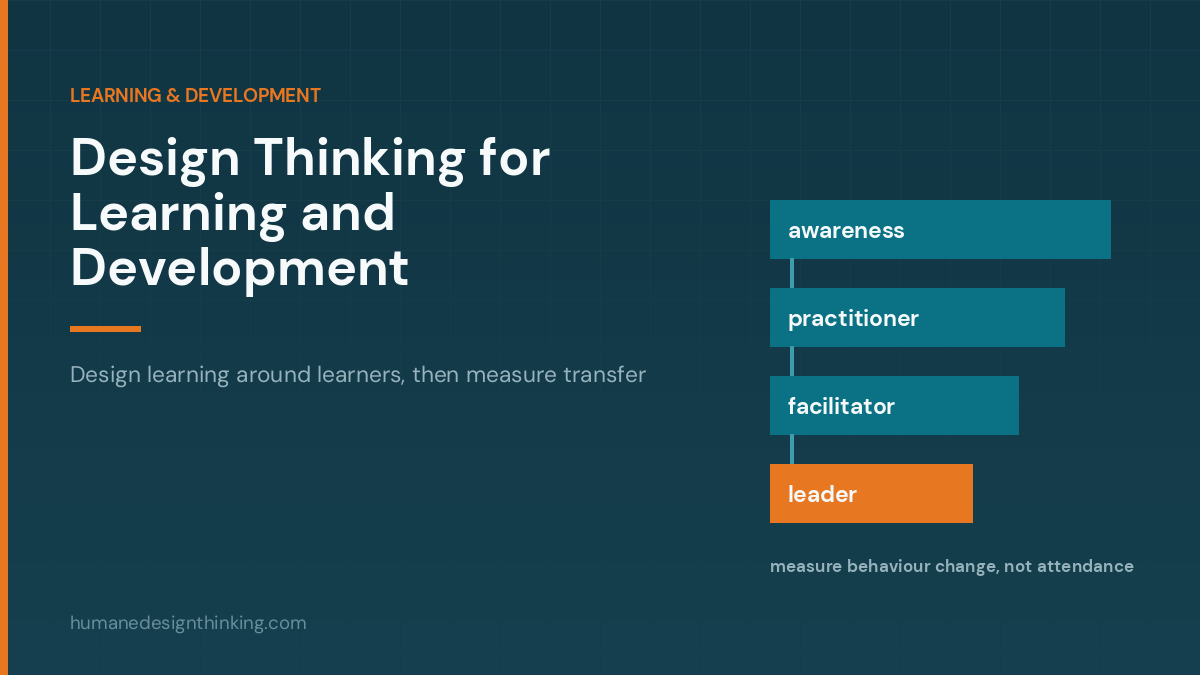
“Design thinking for learning and development” means two different things, and conflating them is why so many L&D functions get poor results from both. One is using design thinking to design learning — treating the employee as a user with a job to do rather than an audience to be filled. The other is teaching design thinking as an organisational capability. This guide covers both, because in practice the first determines whether the second works: an L&D function that cannot design a learning experience around real behaviour cannot credibly teach anyone to design anything else.
The short answer: Applying design thinking to L&D means researching what employees are actually trying to accomplish at the moment they get stuck, designing for that moment rather than for a curriculum, and measuring whether behaviour changed rather than whether people attended. Teaching design thinking as a capability means tiering it — awareness, practitioner, facilitator, leader — and anchoring every tier to a live business problem rather than a case study. The context makes this urgent: the WEF’s Future of Jobs Report 2025 found that 39% of workers’ core skills will change by 2030 and that 63% of employers name the skills gap as their primary barrier to transformation.
The 2026 context: why L&D is under different pressure
Three data points frame the problem, and they point in the same direction.
The World Economic Forum’s Future of Jobs Report 2025 found that workers can expect 39% of their existing skill sets to be transformed or become outdated between 2025 and 2030, and that 59% of the global workforce will require training by 2030. Notably, that skill-instability figure has actually fallen from 44% in 2023 and 57% in 2020 — attributed partly to a rising share of workers (50%, up from 41%) having completed reskilling. Training, done at scale, measurably reduces disruption.
The skills that are rising are not only technical. Analytical thinking remains the top core skill, considered essential by seven in ten employers, with creative thinking, resilience and flexibility among the fastest-growing. Design thinking sits squarely at the intersection of analytical and creative capability applied under ambiguity — which is precisely the combination the data says is scarce.
McKinsey’s State of Organizations 2026, based on a survey of over 10,000 senior executives, adds the organisational half of the picture: 72% of leaders say their organisations are not fully ready for the changes ahead, and the report frames change as a permanent operating state rather than a series of programmes.
The implication for L&D is uncomfortable. If change is permanent, a curriculum built around scheduled programmes is structurally mismatched to the problem. What is needed is capability that regenerates — and that is a design problem before it is a content problem.
Part 1: Using design thinking to design learning
The learner is a user with a job to do
The core reframe: employees do not want training. They want to accomplish something they are currently unable to accomplish, usually under time pressure, usually while being judged on unrelated deliverables. Training is one possible instrument.
This changes what research looks like. Instead of a training-needs survey — which asks people to self-diagnose a knowledge gap, something humans are poor at — you observe and interview around the moment of difficulty:
- What were you trying to do when this became a problem?
- What did you do instead? (The workaround is almost always the most valuable finding.)
- Who did you ask? (This maps the real capability network, which rarely matches the org chart.)
- What would have had to be different for this to be easy?
The workaround question is the one that reliably produces insight. If six people independently invented the same spreadsheet, the problem is not a knowledge gap — it is a missing tool, and no amount of training will fix it. L&D functions that skip this discovery step routinely build courses for problems that were never learning problems.
The five stages, applied to L&D
| Stage | What it looks like in L&D | Common substitute that fails |
|---|---|---|
| Empathise | Observe people at the moment of difficulty. Interview those who left the role, not only high performers. Shadow the first 90 days. | Training-needs analysis survey circulated to managers |
| Define | Frame a single learner problem: [specific employee group] needs a way to [do something] because [insight] | “We need a leadership programme” — a solution stated as a need |
| Ideate | Generate across the full range: coaching, job aids, process change, peer networks, manager scripts, tooling, and formal learning | Jumping straight to modality — “should this be e-learning or classroom?” |
| Prototype | A one-page job aid, a 20-minute pilot session, a revised manager conversation guide, a single module tested with eight people | Building the full curriculum before anyone has tried a piece of it |
| Test | Measure whether the behaviour changed in the workflow four to six weeks later | Measuring satisfaction at the end of the session |
The prototyping row is where most L&D functions can make the fastest gains. A one-page job aid tested with eight people in a fortnight will tell you more about whether a capability gap is real than a three-month curriculum design process.
Traditional versus design-led L&D
| Dimension | Traditional L&D | Design-led L&D |
|---|---|---|
| Starting point | A request from a business leader | An observed gap between intent and behaviour |
| Unit of design | A programme or curriculum | A moment of difficulty in the workflow |
| Needs analysis | Survey of stated needs | Observation of actual behaviour and workarounds |
| Solution set | Learning interventions | Learning, tooling, process, environment and manager behaviour |
| Development approach | Build fully, then launch | Prototype small, test, iterate, then scale |
| Success measure | Attendance, completion, satisfaction | Behaviour change and business outcome at 30–90 days |
| Relationship to failure | Programmes are rarely retired | Interventions that do not transfer are stopped |
The last row is the honest differentiator. Most L&D catalogues grow monotonically because nothing is ever removed. A design-led function retires interventions that do not transfer, which requires measuring transfer — which is the next problem.
The transfer problem
The persistent failure in corporate learning is not delivery quality. It is that capability demonstrated in a session does not reappear in the workflow. The causes are well understood and almost entirely environmental:
- No application window. People return to a full inbox and never apply anything. Countermeasure: schedule the application, not just the training. A commitment to apply one specific practice within ten days, with a named accountability partner.
- The manager was not involved. The single strongest predictor of transfer is whether the participant’s manager asks about it afterwards. Countermeasure: brief managers before the programme with three questions to ask, not a summary of content.
- The environment punishes the new behaviour. Someone trained to test assumptions returns to a team where questioning the roadmap is career-limiting. Countermeasure: this is a psychological safety problem, and no curriculum solves it.
- No spaced reinforcement. One event, no follow-up. Countermeasure: design a sequence — an input, an application, a reflection, a second application — spread across six to eight weeks.
Design for the moment of application, not the moment of delivery. That single principle changes more about programme architecture than any modality decision.
Part 2: Teaching design thinking as an organisational capability
Tier the capability; do not train everyone the same way
The most common structural error is one-size training. Awareness for everyone produces enthusiasm and no capability. Deep training for everyone is unaffordable and unnecessary. Four tiers, each with a different purpose:
| Tier | Who | Duration | Outcome they should be able to demonstrate |
|---|---|---|---|
| Awareness | Broad population, including support functions | Half a day to one day | Recognise a badly framed problem; know when to ask for the practice |
| Practitioner | Product, service, operations, HR, strategy teams | 3–5 days across 6–8 weeks, anchored to a live problem | Frame a problem from research, run a synthesis, build and test a prototype |
| Facilitator | 1–3 per business unit | Practitioner tier plus supervised co-facilitation | Run a workshop for a team they do not belong to, and hold the room when it gets uncomfortable |
| Leader | Sponsors, senior decision-makers | 1 day plus quarterly reinforcement | Ask for evidence rather than opinions; protect capacity; tolerate a killed initiative |
The leader tier is the one most often skipped and the one that determines whether the others survive. A cohort of trained practitioners reporting to leaders who ask “how many features shipped?” will revert within two quarters. If budget forces a choice, train fewer practitioners and include their sponsors.
Anchor everything to a live problem
The distinction between training that transfers and training that does not is rarely pedagogical. It is whether participants worked on a real problem with a real sponsor and a real decision attached.
A practitioner cohort should arrive with, or be assigned, an actual business problem their sponsor cares about. The programme then becomes the vehicle for solving it: research happens with real users, synthesis produces a real problem statement, prototypes are tested with real customers or colleagues, and the final session is a decision review with the sponsor present rather than a presentation to a facilitator.
This is more demanding to organise and produces disproportionately different results — because participants leave with a completed loop and a sponsor who has watched evidence change a decision. That sponsor is worth more to the practice than the training itself.
Curriculum architecture that works
A sequence we see hold up across sectors:
Weeks 1–2 — Framing. Problem framing, assumption mapping, and the discipline of not solving yet. The output is a written problem statement per team.
Weeks 3–4 — Evidence. Research planning, interviewing, observation, and synthesis. Participants conduct at least five real conversations. The output is a revised problem statement, because it should change.
Weeks 5–6 — Options and prototypes. Structured divergence, then low-fidelity prototyping. The output is at least three genuinely distinct options, one of which is built.
Weeks 7–8 — Test and decide. Testing with real users, then a decision review with the sponsor. The output is a recommendation, including — legitimately — a recommendation to stop.
Adjacent capabilities extend this well: systems thinking for problems that span functions, business storytelling for the decision review, and business agility for teams that need to convert findings into delivery.
Measuring L&D that actually proves something
Attendance and satisfaction are the two most collected and least informative measures in the field. A defensible set has five layers.
| Layer | Measure | When to collect | What it tells you |
|---|---|---|---|
| Reaction | Perceived relevance to current work — not enjoyment | End of session | Whether the framing landed. Weak signal; collect it, do not report it upward |
| Capability | Assessed performance on a task, not a quiz | End of programme | Whether the skill exists under observation |
| Application | Share of participants who applied a named practice in the workflow | 30 and 60 days | Whether transfer happened — the critical measure |
| Behaviour change | Observable change: research sessions run, assumptions tested, initiatives stopped | 90 days | Whether it stuck without prompting |
| Business outcome | Movement on the outcome the anchor problem was attached to | 2–4 quarters | Whether it mattered commercially |
The application layer at 30 days is the one to fight for. It is cheap to collect — a short structured check-in, not a survey — and it is the earliest honest indicator. Programmes that score well on reaction and poorly on application at 30 days have an environment problem, not a content problem, and no redesign of the content will fix it.
Six failure modes
- Training as the answer to every gap. A capability request arrives and a programme is built, when the real cause was a missing tool, an unclear decision right or a broken process. Countermeasure: run discovery before designing; ask what people currently do instead.
- Curriculum without an anchor problem. Participants learn the method on a case study and never apply it to anything that matters. Countermeasure: no practitioner cohort without live problems and named sponsors.
- Training practitioners without training sponsors. The most common and most expensive error. Countermeasure: make sponsor participation a condition of running the cohort.
- Volume as the reported metric. “1,200 people trained” tells leadership nothing about capability. Countermeasure: report application at 30 days and one anchor-problem outcome instead.
- One event, no reinforcement. Countermeasure: design a spaced sequence with application windows built in; treat the calendar as part of the instructional design.
- Never retiring anything. The catalogue grows, quality dilutes, and the function loses the ability to say what it is for. Countermeasure: review the portfolio annually against application data and stop what does not transfer.
A 90-day sequence to shift an L&D function
| Phase | Focus | Concrete steps |
|---|---|---|
| Days 1–30 — Research your own learners | Replace assumption with observation | Pick one high-volume existing programme. Interview 10–15 past participants about what they actually applied. Shadow three people at the moment of difficulty the programme was meant to address. Establish a baseline application rate. |
| Days 31–60 — Prototype one intervention | Test small before building | Design one alternative — a job aid, a manager conversation guide, a two-hour applied session — for the same gap. Run it with 8–12 people. Measure application at 30 days against the baseline. |
| Days 61–90 — Change what you report | Make the new logic visible | Add application-at-30-days to your reporting for one programme. Brief managers with three follow-up questions. Anchor the next practitioner cohort to a live business problem with a named sponsor. |
Ninety days will not rebuild a learning function. It produces one comparison your CHRO can believe, and an internal precedent for designing the next intervention the same way.
Frequently asked questions
What is design thinking in learning and development?
Two related things. First, applying the human-centred design method to L&D itself: researching employees as users, framing the learning problem from observed behaviour, prototyping small interventions and measuring transfer. Second, teaching design thinking as a capability so that teams across the organisation can apply it to their own problems. The first is a way of working; the second is a curriculum.
How is this different from ADDIE or standard instructional design?
They are compatible rather than competing. ADDIE is a development process that assumes the need has been correctly identified. Design thinking works on that prior question — whether a learning intervention is the right response at all — and pushes toward prototyping and testing before full development. In practice, use design thinking for the discovery and framing, and instructional design discipline for building what survives testing.
How do you measure the ROI of design thinking training?
Anchor each practitioner cohort to a live business problem, then measure the outcome of that problem alongside application rates. This is more defensible than isolating training effects statistically, because the anchor problem gives you a real before-and-after. Report application at 30 days, behaviour change at 90 days, and the anchor-problem outcome at two to four quarters.
How long should a design thinking programme be?
For awareness, half a day to a day. For practitioners, three to five days spread across six to eight weeks — the spacing matters more than the total hours, because application between sessions is where the learning consolidates. Compressed three-day intensives produce good session feedback and poor transfer.
Should we train everyone in design thinking?
No. Train broadly for awareness so people recognise when the practice is needed, and deeply for a smaller practitioner group who will actually run the work. Universal deep training is expensive and produces capability that decays through disuse. What should be universal is the leadership tier’s expectation that decisions come with evidence.
Can design thinking be taught virtually?
Yes, with two adjustments. Research sessions must be recorded and shared so the whole cohort has access to raw evidence rather than summaries, and synthesis needs longer than it does in person because the physical clustering of observations is doing real cognitive work. Facilitator development is the one tier that benefits most from in-person co-facilitation.
What is an innovation-ready workforce, practically?
A workforce where a reasonable number of people can frame an ambiguous problem before solving it, where evidence is expected rather than optional, and where stopping something is a legitimate professional outcome. It is a set of behaviours and permissions, not a certification count.
Where to start
If you take one thing from this guide, take the 30-day application measure. Add it to a single existing programme, ask participants what they actually applied and what stopped them, and read the answers honestly. It is inexpensive, it takes one month, and it will tell you more about your learning function than any needs analysis you could commission.
Then design the next intervention for the moment of application rather than the moment of delivery.
Humane Design builds design and innovation capability through practical, business-anchored learning programmes for corporates, MSMEs and funded startups. Explore our learning services, design thinking programmes and leading a change curriculum. You may also find our writing on design thinking corporate training and people experience and culture relevant, or browse our masterclasses and podcasts.